Urbana holds community session on alternative response; residents press for funding, equity and coordination
May 05, 2026 | Urbana, Champaign County, Illinois
This article was created by AI summarizing key points discussed. AI makes mistakes, so for full details and context, please refer to the video of the full meeting. Please report any errors so we can fix them. Report an error »
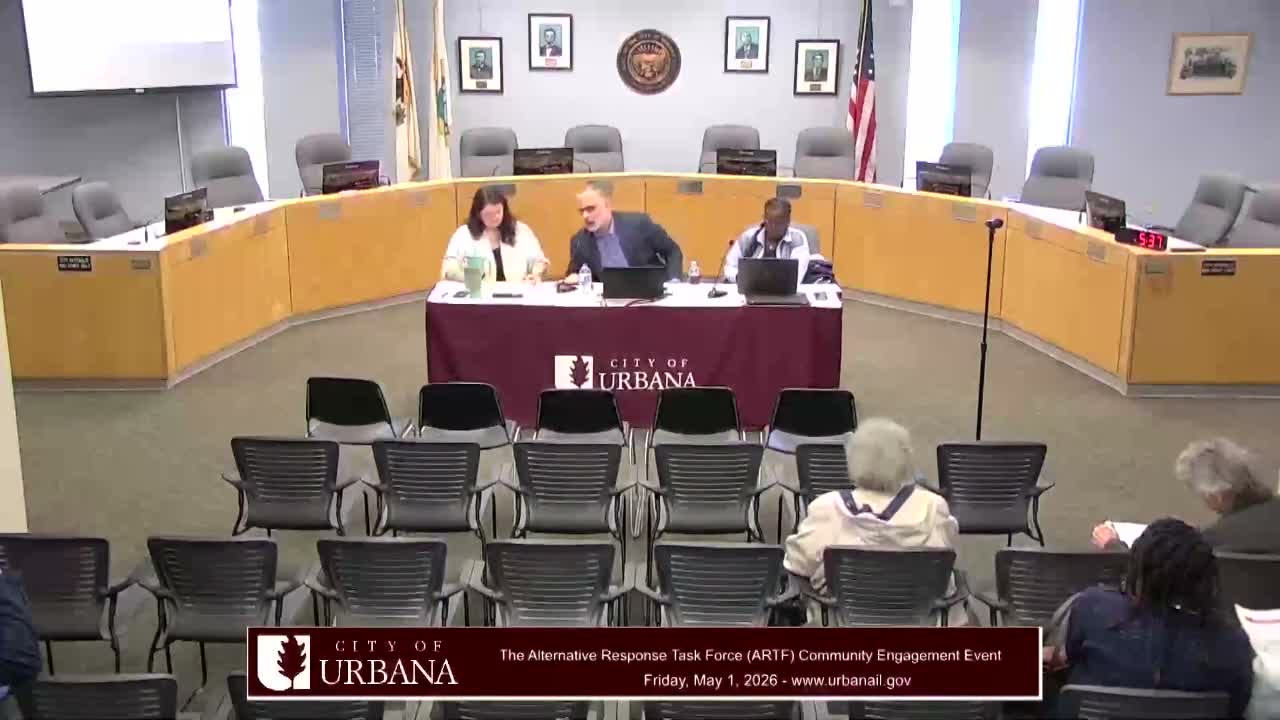
Urbana city staff and consultants from LEAP presented options for an "alternative response" community responder program and heard roughly 90 minutes of public comment on program design, costs, equity and coordination.
LEAP consultant Deontay "Dee" Martin told the community that LEAP works with cities to design community responder programs—unarmed professionals trained to handle low‑risk 9‑1‑1 calls such as welfare checks, neighbor disputes, panhandling and some mental‑health responses. "We are a nonprofit organization," Martin said, and explained the firm analyzed Urbana MetCAD call narratives to identify calls that could safely be diverted from a police response. He cited LEAP’s inventory of existing programs (about 91 programs nationwide across roughly 31 states) and described models in Dayton, Evanston and Durham as examples for Urbana.
Why it matters: LEAP said its analysis of Urbana call narratives shows the largest share of eligible calls relates to conflict resolution, which it estimated at about 58.2% of reviewed calls; mental‑health‑related calls formed about 17.9% and service‑connection calls roughly 10.7%. Those proportions, Martin said, drive decisions about responder types, hours and housing agency. "You want responders to be equipped to handle the calls that they're responding to," he said.
Public commenters and local officials generally welcomed the concept but focused on three recurring concerns: financing, coordination with 9‑1‑1 (MetCAD) and equity. Cunningham Township supervisor Danielle, who described her office’s street‑outreach pilot, urged that response teams be paired with reliable referral pathways: "Response is just 10% or 15% — so which resources are we connecting people to?" she asked, emphasizing that connecting people to shelter, detox and other services must be part of any workable design.
Council member Chris Evans warned the council and public that meaningful coverage will be costly. "Staffing, supplies, vehicles ... is going to be a substantial investment," Evans said, and he asked whether Urbana residents will accept the revenue choices required to sustain the program. Multiple speakers and task force members urged creative, regional funding partnerships and grant or philanthropic seed funding to prove the program’s value before asking voters for ongoing revenue.
Coordination with MetCAD was raised repeatedly. Jane McClintock and others asked whether Urbana’s 9‑1‑1 dispatch center is prepared to route eligible calls to a community responder team; Martin said MetCAD has been involved in the task‑force process and that LEAP is drafting dispatch protocols to align with existing 9‑1‑1 workflows.
Several commenters also pressed for explicit equity safeguards. Danielle asked how designers will prevent a two‑tiered system in which diversion programs yield disparate outcomes by race, gender or class; task force members said equity will be a design principle to be addressed in recommendations.
On operations, Martin said responders would not be volunteers: "This is not volunteer work at all"—responders are typically paid, dispatched in two‑person teams and may be housed inside a city department or patrol from vehicles depending on the chosen model. He and others noted that hours of operation and staffing levels will be tailored to Urbana’s eligible call volume.
Next steps: LEAP and city staff urged residents to complete a community survey and said all materials are posted to the Alternative Response Task Force website. The task force will continue meeting and the city clerk announced a seventh session for June 11, 03:30–05:30 at the India Center; recordings of sessions are posted to UPTV and the city website.
The meeting closed with staff reiterating outreach plans and commitments to coordinate with regional partners as the task force works toward a final report and program recommendations.
LEAP consultant Deontay "Dee" Martin told the community that LEAP works with cities to design community responder programs—unarmed professionals trained to handle low‑risk 9‑1‑1 calls such as welfare checks, neighbor disputes, panhandling and some mental‑health responses. "We are a nonprofit organization," Martin said, and explained the firm analyzed Urbana MetCAD call narratives to identify calls that could safely be diverted from a police response. He cited LEAP’s inventory of existing programs (about 91 programs nationwide across roughly 31 states) and described models in Dayton, Evanston and Durham as examples for Urbana.
Why it matters: LEAP said its analysis of Urbana call narratives shows the largest share of eligible calls relates to conflict resolution, which it estimated at about 58.2% of reviewed calls; mental‑health‑related calls formed about 17.9% and service‑connection calls roughly 10.7%. Those proportions, Martin said, drive decisions about responder types, hours and housing agency. "You want responders to be equipped to handle the calls that they're responding to," he said.
Public commenters and local officials generally welcomed the concept but focused on three recurring concerns: financing, coordination with 9‑1‑1 (MetCAD) and equity. Cunningham Township supervisor Danielle, who described her office’s street‑outreach pilot, urged that response teams be paired with reliable referral pathways: "Response is just 10% or 15% — so which resources are we connecting people to?" she asked, emphasizing that connecting people to shelter, detox and other services must be part of any workable design.
Council member Chris Evans warned the council and public that meaningful coverage will be costly. "Staffing, supplies, vehicles ... is going to be a substantial investment," Evans said, and he asked whether Urbana residents will accept the revenue choices required to sustain the program. Multiple speakers and task force members urged creative, regional funding partnerships and grant or philanthropic seed funding to prove the program’s value before asking voters for ongoing revenue.
Coordination with MetCAD was raised repeatedly. Jane McClintock and others asked whether Urbana’s 9‑1‑1 dispatch center is prepared to route eligible calls to a community responder team; Martin said MetCAD has been involved in the task‑force process and that LEAP is drafting dispatch protocols to align with existing 9‑1‑1 workflows.
Several commenters also pressed for explicit equity safeguards. Danielle asked how designers will prevent a two‑tiered system in which diversion programs yield disparate outcomes by race, gender or class; task force members said equity will be a design principle to be addressed in recommendations.
On operations, Martin said responders would not be volunteers: "This is not volunteer work at all"—responders are typically paid, dispatched in two‑person teams and may be housed inside a city department or patrol from vehicles depending on the chosen model. He and others noted that hours of operation and staffing levels will be tailored to Urbana’s eligible call volume.
Next steps: LEAP and city staff urged residents to complete a community survey and said all materials are posted to the Alternative Response Task Force website. The task force will continue meeting and the city clerk announced a seventh session for June 11, 03:30–05:30 at the India Center; recordings of sessions are posted to UPTV and the city website.
The meeting closed with staff reiterating outreach plans and commitments to coordinate with regional partners as the task force works toward a final report and program recommendations.
View the Full Meeting & All Its Details
This article offers just a summary. Unlock complete video, transcripts, and insights as a Founder Member.
✓
Watch full, unedited meeting videos
✓
Search every word spoken in unlimited transcripts
✓
AI summaries & real-time alerts (all government levels)
✓
Permanent access to expanding government content
30-day money-back guarantee
