SPD reports 1,184 citations since Oct. 28; officers cite increased service offers and navigation‑center enrollments
May 04, 2026 | Spokane, Spokane County, Washington
This article was created by AI summarizing key points discussed. AI makes mistakes, so for full details and context, please refer to the video of the full meeting. Please report any errors so we can fix them. Report an error »
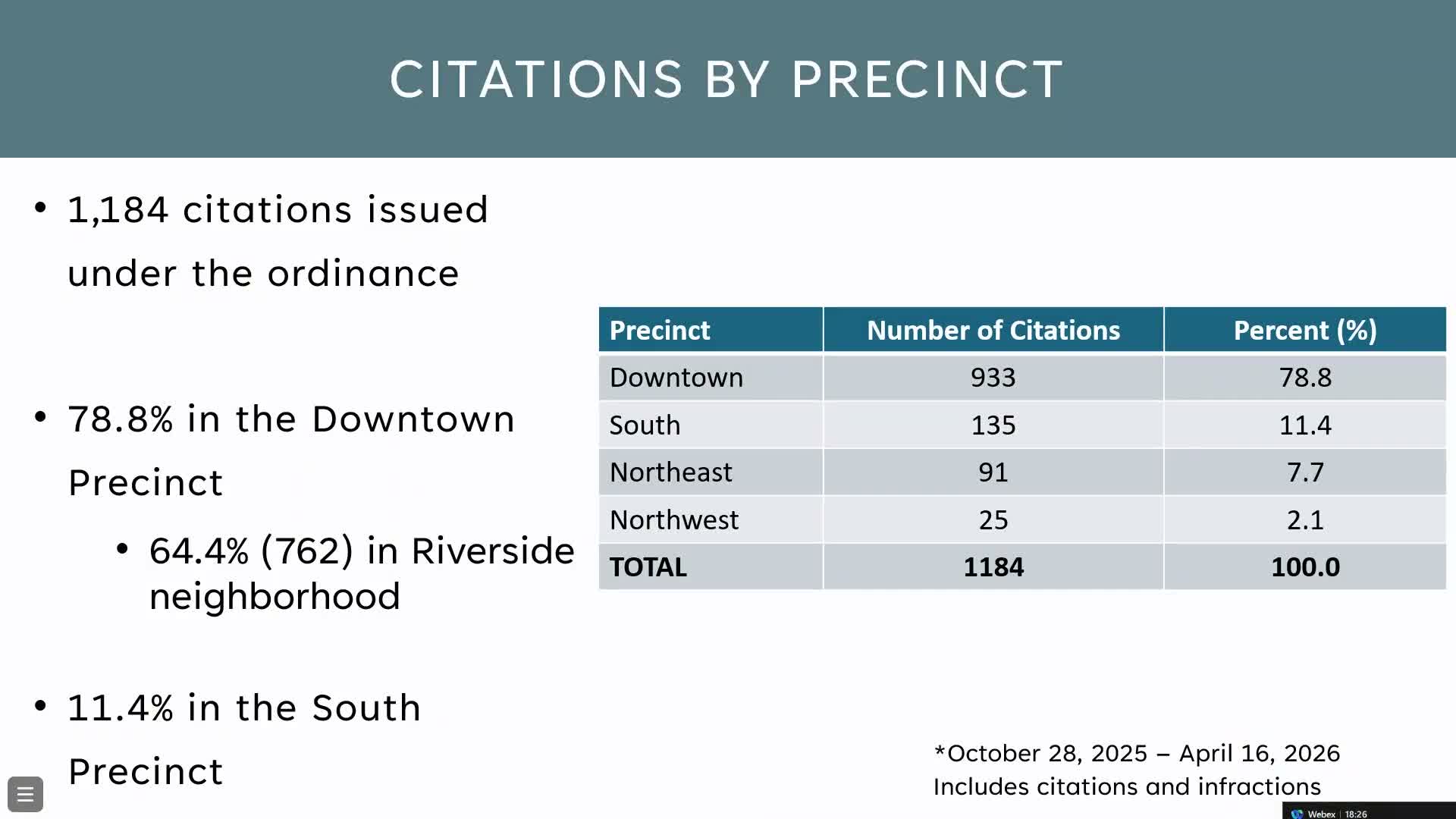
Chief Hall, chief of the Spokane Police Department, told the Public Safety & Community Health Committee on May 4 that 1,184 citations have been issued since the downtown ordinance took effect Oct. 28.
“Overall, there's been 1,184 since October 28 when the ordinance went into effect,” Chief Hall said, and added that about 79% of citations were downtown and the majority of those occurred in the Riverside neighborhood. He said citations peaked in January and have been ticking down, which he attributed in part to increased compliance in the downtown core.
Hall provided a breakdown of repeat citations: 11 individuals were cited more than once in a 24‑hour period (under 2 percent), 69 percent of cited individuals received a single citation, 87 percent received one or two, and 13 percent received three or more. He said higher counts (five or more) were often associated with substance‑use or behavioral‑health issues and that those people were being engaged by community court and outreach teams, with many citations later dismissed.
The chief also reported outreach and service offers from officers: officers have offered services in numerous contacts and the department recorded 389 acceptances of some type of service. Chief Hall described the officer contacts tracked as events where enforcement was a possibility and said fewer than half of those contacts result in a citation.
Dawn Kinder, who stepped forward to explain navigation‑center data, clarified the slide labels and exit destinations, noting that the category “place not meant for habitation” follows HUD definitions and denotes people who exited services but remained on the street. Kinder said the navigation center slide contained a recorded total clients‑enrolled figure shown on the presentation slide.
Council members pressed staff for details about how people exited services (into transitional housing, shelters or remaining unsheltered). Kinder said the navigation center and outreach teams are using transportation services and multiple follow‑up contacts to enroll people in transitional housing projects and other non‑night‑by‑night programs.
The committee heard additional outreach metrics: outreach staff closed just over 2,700 citizen complaints since October and reported that 77 percent of those complaints did not require code enforcement abatement, allowing code staff to focus on the sites that did need intervention. Code enforcement has closed 96 abatement activities during the period cited by staff.
The meeting did not include formal votes on enforcement policy, but council members asked for continued updates and clarification on exit‑destination data and repeat citation tracking.
“Overall, there's been 1,184 since October 28 when the ordinance went into effect,” Chief Hall said, and added that about 79% of citations were downtown and the majority of those occurred in the Riverside neighborhood. He said citations peaked in January and have been ticking down, which he attributed in part to increased compliance in the downtown core.
Hall provided a breakdown of repeat citations: 11 individuals were cited more than once in a 24‑hour period (under 2 percent), 69 percent of cited individuals received a single citation, 87 percent received one or two, and 13 percent received three or more. He said higher counts (five or more) were often associated with substance‑use or behavioral‑health issues and that those people were being engaged by community court and outreach teams, with many citations later dismissed.
The chief also reported outreach and service offers from officers: officers have offered services in numerous contacts and the department recorded 389 acceptances of some type of service. Chief Hall described the officer contacts tracked as events where enforcement was a possibility and said fewer than half of those contacts result in a citation.
Dawn Kinder, who stepped forward to explain navigation‑center data, clarified the slide labels and exit destinations, noting that the category “place not meant for habitation” follows HUD definitions and denotes people who exited services but remained on the street. Kinder said the navigation center slide contained a recorded total clients‑enrolled figure shown on the presentation slide.
Council members pressed staff for details about how people exited services (into transitional housing, shelters or remaining unsheltered). Kinder said the navigation center and outreach teams are using transportation services and multiple follow‑up contacts to enroll people in transitional housing projects and other non‑night‑by‑night programs.
The committee heard additional outreach metrics: outreach staff closed just over 2,700 citizen complaints since October and reported that 77 percent of those complaints did not require code enforcement abatement, allowing code staff to focus on the sites that did need intervention. Code enforcement has closed 96 abatement activities during the period cited by staff.
The meeting did not include formal votes on enforcement policy, but council members asked for continued updates and clarification on exit‑destination data and repeat citation tracking.
Don't Miss a Word: See the Full Meeting!
Go beyond summaries. Unlock every video, transcript, and key insight with a Founder Membership.
✓
Get instant access to full meeting videos
✓
Search and clip any phrase from complete transcripts
✓
Receive AI-powered summaries & custom alerts
✓
Enjoy lifetime, unrestricted access to government data
30-day money-back guarantee
