How to find and interpret race and ethnicity data on data.census.gov, Census presenters say
May 04, 2026 | U.S. Census Bureau, Department of Commerce (DOC), Executive, Federal
This article was created by AI summarizing key points discussed. AI makes mistakes, so for full details and context, please refer to the video of the full meeting. Please report any errors so we can fix them. Report an error »
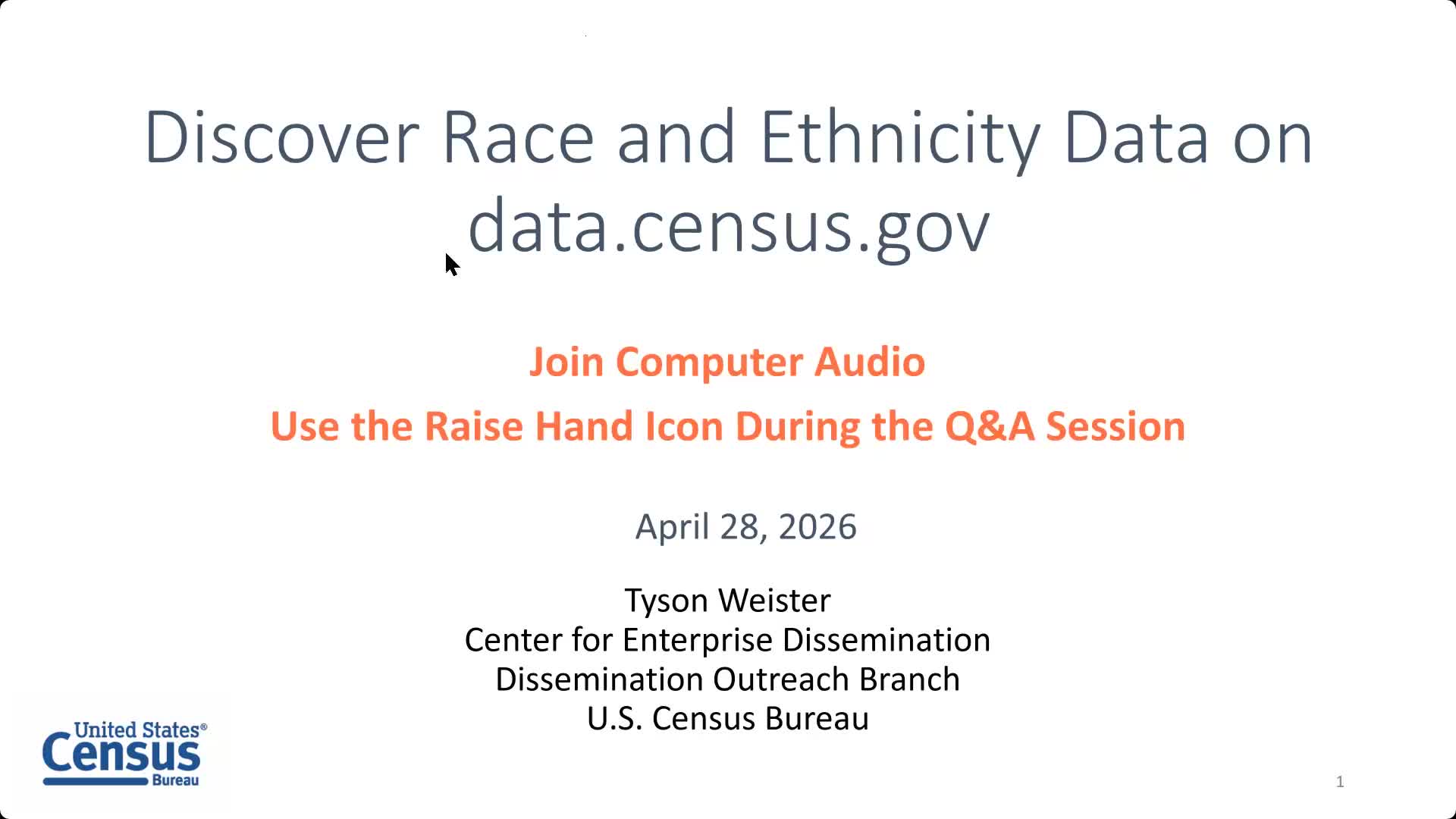
Faith Whittington, host for the webinar, opened the session and introduced Tyson Weister, who said he works in the Center for Enterprise Dissemination and leads demonstrations of data.census.gov.
Tyson Weister explained that the Census Bureau collects race and ethnicity according to Office of Management and Budget (OMB) 1997 standards and emphasized that "race and ethnicity are 2 separate concepts." He advised users to rely on the site27s Explore filters and the Tables view to locate population totals, characteristics, and cross-tabulations.
The webinar laid out two key pathways for users. Standard tables (identified by word filters added to the URL) provide the broadest geographic coverage and the most recent data, making them the recommended starting point for population totals and characteristics; iterated tables (identified by code-based filters and by options such as "alone" or "in combination" in the filter panel) produce columns for detailed population groups and are useful when researchers need specific subgroups.
To illustrate, Weister opened table B02001 (2024 ACS 1-year estimates) to show the national population total he read from the table as 340,110,990 and the seven common race categories. He also demonstrated table B03001 and a cross-tabulation B03002 to show Hispanic or Latino origin by race. Using standard tables, he pulled a 2024 ACS 1-year estimate that the American Indian and Alaska Native alone population totaled 3,433,243 in the United States.
The presenters also demonstrated local and iterated examples. Using place filters for Fishers, Indiana, and income filters, Weister identified table B19013 (median household income) and noted the median household income for Hispanic or Latino householders shown in the table during the demo as $152,807 (2024 ACS 1-year estimate) and asked users to verify specific table values on data.census.gov. In an iterated-table example, selecting Korean alone and New Jersey produced a selected population profile showing 80,843 people age 25 and over identifying as Korean alone in New Jersey and a bachelor's-degree-or-higher rate of 66.8%.
Weister explained that some detailed tables return "data not available" when population thresholds or minimum sample case requirements are not met, and he advised users to consult technical documentation or to move to a product with different thresholds (for example, five-year ACS products or selected population tables) if they need counts rather than percentages. On the 2020 decennial side, he used the decennial demographic and housing characteristics file A to show how iterated products work for tribal groups, citing 13,697 people identifying as the Gila River Indian community alone in the U.S. in the product shown.
The webinar closed with practical tips: use the Share button to save a table URL, use Excel for human-readable output or ZIP for machine-readable data, consult the dataset technical documentation when encountering thresholds, and contact census.data@census.gov or local data dissemination specialists for training or help.
Faith Whittington and Tyson Weister also encouraged attendees to sign up for the Census Academy newsletter and to consider hands-on workshops for deeper training; the session concluded with an invitation to complete the post-event survey and contact the Census outreach addresses provided.
Tyson Weister explained that the Census Bureau collects race and ethnicity according to Office of Management and Budget (OMB) 1997 standards and emphasized that "race and ethnicity are 2 separate concepts." He advised users to rely on the site27s Explore filters and the Tables view to locate population totals, characteristics, and cross-tabulations.
The webinar laid out two key pathways for users. Standard tables (identified by word filters added to the URL) provide the broadest geographic coverage and the most recent data, making them the recommended starting point for population totals and characteristics; iterated tables (identified by code-based filters and by options such as "alone" or "in combination" in the filter panel) produce columns for detailed population groups and are useful when researchers need specific subgroups.
To illustrate, Weister opened table B02001 (2024 ACS 1-year estimates) to show the national population total he read from the table as 340,110,990 and the seven common race categories. He also demonstrated table B03001 and a cross-tabulation B03002 to show Hispanic or Latino origin by race. Using standard tables, he pulled a 2024 ACS 1-year estimate that the American Indian and Alaska Native alone population totaled 3,433,243 in the United States.
The presenters also demonstrated local and iterated examples. Using place filters for Fishers, Indiana, and income filters, Weister identified table B19013 (median household income) and noted the median household income for Hispanic or Latino householders shown in the table during the demo as $152,807 (2024 ACS 1-year estimate) and asked users to verify specific table values on data.census.gov. In an iterated-table example, selecting Korean alone and New Jersey produced a selected population profile showing 80,843 people age 25 and over identifying as Korean alone in New Jersey and a bachelor's-degree-or-higher rate of 66.8%.
Weister explained that some detailed tables return "data not available" when population thresholds or minimum sample case requirements are not met, and he advised users to consult technical documentation or to move to a product with different thresholds (for example, five-year ACS products or selected population tables) if they need counts rather than percentages. On the 2020 decennial side, he used the decennial demographic and housing characteristics file A to show how iterated products work for tribal groups, citing 13,697 people identifying as the Gila River Indian community alone in the U.S. in the product shown.
The webinar closed with practical tips: use the Share button to save a table URL, use Excel for human-readable output or ZIP for machine-readable data, consult the dataset technical documentation when encountering thresholds, and contact census.data@census.gov or local data dissemination specialists for training or help.
Faith Whittington and Tyson Weister also encouraged attendees to sign up for the Census Academy newsletter and to consider hands-on workshops for deeper training; the session concluded with an invitation to complete the post-event survey and contact the Census outreach addresses provided.
View the Full Meeting & All Its Details
This article offers just a summary. Unlock complete video, transcripts, and insights as a Founder Member.
✓
Watch full, unedited meeting videos
✓
Search every word spoken in unlimited transcripts
✓
AI summaries & real-time alerts (all government levels)
✓
Permanent access to expanding government content
30-day money-back guarantee
