DOHMH demonstrates online Community Health Profiles, highlights health disparities in Queens
May 04, 2026 | Queens Borough, Queens County, New York
This article was created by AI summarizing key points discussed. AI makes mistakes, so for full details and context, please refer to the video of the full meeting. Please report any errors so we can fix them. Report an error »
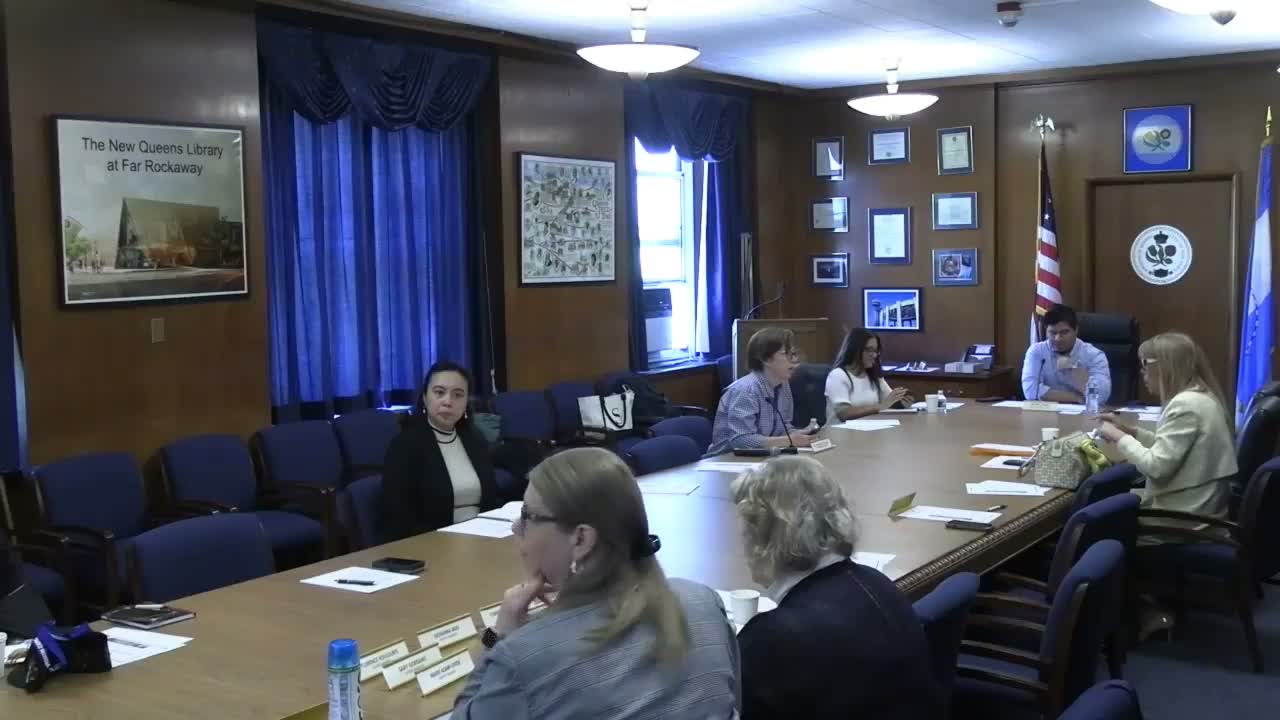
Martha Alexander, a data communications outreach analyst at the New York City Department of Health and Mental Hygiene, demonstrated the agency’s Community Health Profiles web application and walked borough cabinet members through neighborhood‑level health statistics and site features.
Alexander said the profiles "are designed to give a broad picture of New York City health," showing data for all 59 community districts that community boards, researchers and advocacy groups can use to support projects and grant applications. She demonstrated how to select a district, compare borough and city averages, view maps and download PDFs from the application (nyc.gov/health/profiles).
The presentation highlighted several measures for Queens: Alexander said life expectancy in Woodside and Sunnyside is 89.9 years compared with a citywide average she listed as 81.5 years; she reported the citywide uninsured rate as 10 percent and a Queens uninsured rate of 13 percent; and she summarized neighborhood differences in obesity, hypertension and diabetes. On public‑safety measures, Alexander said the rate of nonfatal‑assault hospitalizations is 59 per 100,000 citywide and 36 per 100,000 in Queens.
During a live demonstration, Alexander showed that users can download a PDF of a single district or select specific sheets for a custom export. In response to participants who urged a return to a printed booklet, she said the online format lets developers update data more frequently and that the team is working to make printing easier. "We're updating the tool now and it will be easier to print," she said.
Board members asked whether some indicators (for example, high‑school graduation rates) reflect school location or student residence; Alexander said the Department of Education data appear to be by school and she would confirm and follow up with the boards. She also said that the application’s data were being updated and "should be updated by next week." The presentation closed with an offer to provide the download/print instructions and to answer follow‑up questions.
The profiles and the demonstration are intended to help community boards and local stakeholders identify health inequities and support locally tailored outreach, planning and grant work. The borough cabinet said it would share the tool with health committee chairs and full boards and follow up with DOHMH where members requested clarifications on specific indicators.
Alexander said the profiles "are designed to give a broad picture of New York City health," showing data for all 59 community districts that community boards, researchers and advocacy groups can use to support projects and grant applications. She demonstrated how to select a district, compare borough and city averages, view maps and download PDFs from the application (nyc.gov/health/profiles).
The presentation highlighted several measures for Queens: Alexander said life expectancy in Woodside and Sunnyside is 89.9 years compared with a citywide average she listed as 81.5 years; she reported the citywide uninsured rate as 10 percent and a Queens uninsured rate of 13 percent; and she summarized neighborhood differences in obesity, hypertension and diabetes. On public‑safety measures, Alexander said the rate of nonfatal‑assault hospitalizations is 59 per 100,000 citywide and 36 per 100,000 in Queens.
During a live demonstration, Alexander showed that users can download a PDF of a single district or select specific sheets for a custom export. In response to participants who urged a return to a printed booklet, she said the online format lets developers update data more frequently and that the team is working to make printing easier. "We're updating the tool now and it will be easier to print," she said.
Board members asked whether some indicators (for example, high‑school graduation rates) reflect school location or student residence; Alexander said the Department of Education data appear to be by school and she would confirm and follow up with the boards. She also said that the application’s data were being updated and "should be updated by next week." The presentation closed with an offer to provide the download/print instructions and to answer follow‑up questions.
The profiles and the demonstration are intended to help community boards and local stakeholders identify health inequities and support locally tailored outreach, planning and grant work. The borough cabinet said it would share the tool with health committee chairs and full boards and follow up with DOHMH where members requested clarifications on specific indicators.
View the Full Meeting & All Its Details
This article offers just a summary. Unlock complete video, transcripts, and insights as a Founder Member.
✓
Watch full, unedited meeting videos
✓
Search every word spoken in unlimited transcripts
✓
AI summaries & real-time alerts (all government levels)
✓
Permanent access to expanding government content
30-day money-back guarantee
