Charleston workshop walks residents through rezoning, variances and design‑review steps
May 04, 2026 | Charleston City, Charleston County, South Carolina
This article was created by AI summarizing key points discussed. AI makes mistakes, so for full details and context, please refer to the video of the full meeting. Please report any errors so we can fix them. Report an error »
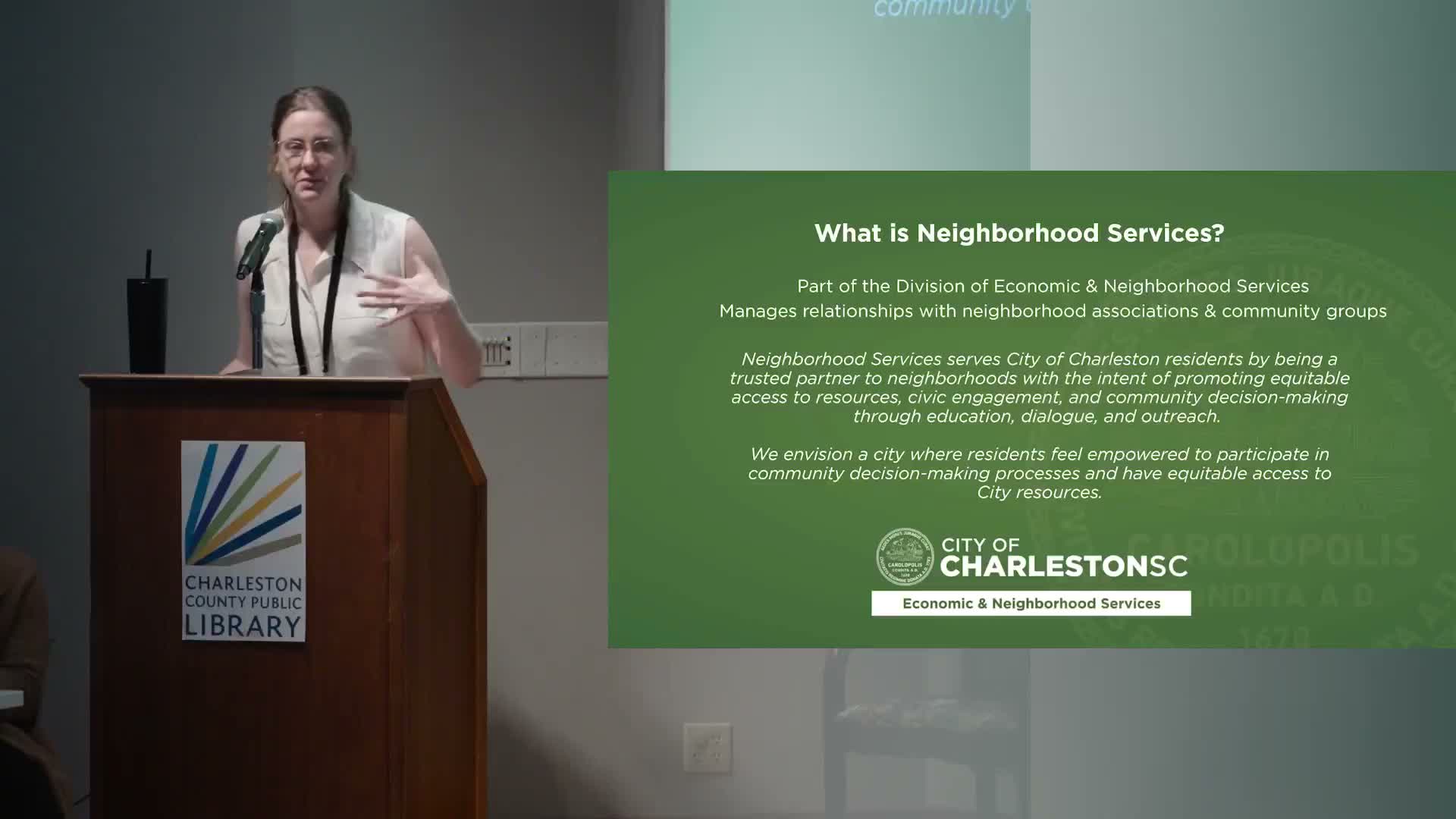
Amanda Cox, a planner with the City of Charleston Department of Livability and Tourism, led a residents’ workshop explaining how rezoning, variances and design‑review processes work and how citizens can take part.
"Zoning is like the act or process or partitioning a city, town or borough into different zones," Cox said, framing the session’s goal of making city processes more accessible. She and planning staff used a fictional "Potato Town" scenario to show how a property owner, neighborhood and multiple review bodies interact when a rezoning or variance is pursued.
Why it matters: The city’s rules determine whether a proposed project can proceed, whether it must seek a rezoning or a variance, and which board or commission will hear the matter. Those procedural steps shape outcomes for neighborhood character, parking and the feasibility of affordable housing.
Key steps explained
City staff review: Cox said applicants are required to meet with planning staff before filing a rezoning application so staff can offer information and a recommendation to the planning commission. Staff recommendations are guided by the comprehensive plan and local context, but the planning commission and, ultimately, city council make the final decision.
Public notice and timelines: Cox emphasized the legal notice requirements for rezonings and subdivisions. "We are required by state law. This is not an internal law. We are held to the state that 6 days before our meeting, we have to post on the property," she said, and added that the legal advertisement must run at least five days before the meeting. Cox also noted the city’s online "notify me" feature and that online public comments are due at noon the Tuesday before a commission meeting.
Differences among boards: The workshop clarified the separate roles of the planning commission (a recommendation body required by state law), the Board of Zoning Appeals (BZA, which considers variances and site‑specific hardships), and the Board of Architectural Review/Design Review Board (BAR/DRB, which handle design and preservation questions depending on the district). Cox described variances as exceptional and subject to a stringent hardship test.
Real example: 606 Savannah Highway
Cox told attendees that a real rezoning at 606 Savannah Highway in West Ashley passed planning commission in 2024 by a 7–2 vote. She said staff recommended approval in part because the residential‑office (RO) zone was compatible with the corridor, on‑site parking could meet requirements, and the site could retain a single‑family appearance that protected neighborhood character.
Public engagement and tradeoffs
During an interactive activity, small groups weighed context, applicant history and neighborhood outreach. One group voted unanimously to approve the hypothetical request after considering applicant commitment; another group opposed it (4–1), citing insufficient neighborhood engagement. Cox summarized the common trade‑off: parking rules can force a reduction in units, which affects affordability.
Residents’ questions
Attendees asked about GIS accuracy, how to verify that property posting signs were placed, and whether short‑term rentals require special zoning. Staff explained that surveys are the most legally accurate measure of property lines, that staff time‑stamp photos and can re‑post signs if missing, and that there is no separate zoning classification solely for short‑term rentals but properties must meet program requirements to operate.
What’s next
Cox urged residents to use the city’s MapNet and the "notify me" tool, attend planning commission and council hearings if they want to weigh in, and contact staff directly; she also invited feedback on future sessions.
The workshop combined step‑by‑step procedure, a mock case study and a real precedent (606 Savannah Highway) to show how technical rules and neighborhood input interact in Charleston’s land‑use process. The session concluded with staff offering follow‑up contact information and the prospect of additional educational sessions.
"Zoning is like the act or process or partitioning a city, town or borough into different zones," Cox said, framing the session’s goal of making city processes more accessible. She and planning staff used a fictional "Potato Town" scenario to show how a property owner, neighborhood and multiple review bodies interact when a rezoning or variance is pursued.
Why it matters: The city’s rules determine whether a proposed project can proceed, whether it must seek a rezoning or a variance, and which board or commission will hear the matter. Those procedural steps shape outcomes for neighborhood character, parking and the feasibility of affordable housing.
Key steps explained
City staff review: Cox said applicants are required to meet with planning staff before filing a rezoning application so staff can offer information and a recommendation to the planning commission. Staff recommendations are guided by the comprehensive plan and local context, but the planning commission and, ultimately, city council make the final decision.
Public notice and timelines: Cox emphasized the legal notice requirements for rezonings and subdivisions. "We are required by state law. This is not an internal law. We are held to the state that 6 days before our meeting, we have to post on the property," she said, and added that the legal advertisement must run at least five days before the meeting. Cox also noted the city’s online "notify me" feature and that online public comments are due at noon the Tuesday before a commission meeting.
Differences among boards: The workshop clarified the separate roles of the planning commission (a recommendation body required by state law), the Board of Zoning Appeals (BZA, which considers variances and site‑specific hardships), and the Board of Architectural Review/Design Review Board (BAR/DRB, which handle design and preservation questions depending on the district). Cox described variances as exceptional and subject to a stringent hardship test.
Real example: 606 Savannah Highway
Cox told attendees that a real rezoning at 606 Savannah Highway in West Ashley passed planning commission in 2024 by a 7–2 vote. She said staff recommended approval in part because the residential‑office (RO) zone was compatible with the corridor, on‑site parking could meet requirements, and the site could retain a single‑family appearance that protected neighborhood character.
Public engagement and tradeoffs
During an interactive activity, small groups weighed context, applicant history and neighborhood outreach. One group voted unanimously to approve the hypothetical request after considering applicant commitment; another group opposed it (4–1), citing insufficient neighborhood engagement. Cox summarized the common trade‑off: parking rules can force a reduction in units, which affects affordability.
Residents’ questions
Attendees asked about GIS accuracy, how to verify that property posting signs were placed, and whether short‑term rentals require special zoning. Staff explained that surveys are the most legally accurate measure of property lines, that staff time‑stamp photos and can re‑post signs if missing, and that there is no separate zoning classification solely for short‑term rentals but properties must meet program requirements to operate.
What’s next
Cox urged residents to use the city’s MapNet and the "notify me" tool, attend planning commission and council hearings if they want to weigh in, and contact staff directly; she also invited feedback on future sessions.
The workshop combined step‑by‑step procedure, a mock case study and a real precedent (606 Savannah Highway) to show how technical rules and neighborhood input interact in Charleston’s land‑use process. The session concluded with staff offering follow‑up contact information and the prospect of additional educational sessions.
View the Full Meeting & All Its Details
This article offers just a summary. Unlock complete video, transcripts, and insights as a Founder Member.
✓
Watch full, unedited meeting videos
✓
Search every word spoken in unlimited transcripts
✓
AI summaries & real-time alerts (all government levels)
✓
Permanent access to expanding government content
30-day money-back guarantee
