Fox Chapel board adopts 2026–27 budget with 3.1% property‑tax increase after hour‑long debate
May 05, 2026 | Fox Chapel Area SD, School Districts, Pennsylvania
This article was created by AI summarizing key points discussed. AI makes mistakes, so for full details and context, please refer to the video of the full meeting. Please report any errors so we can fix them. Report an error »
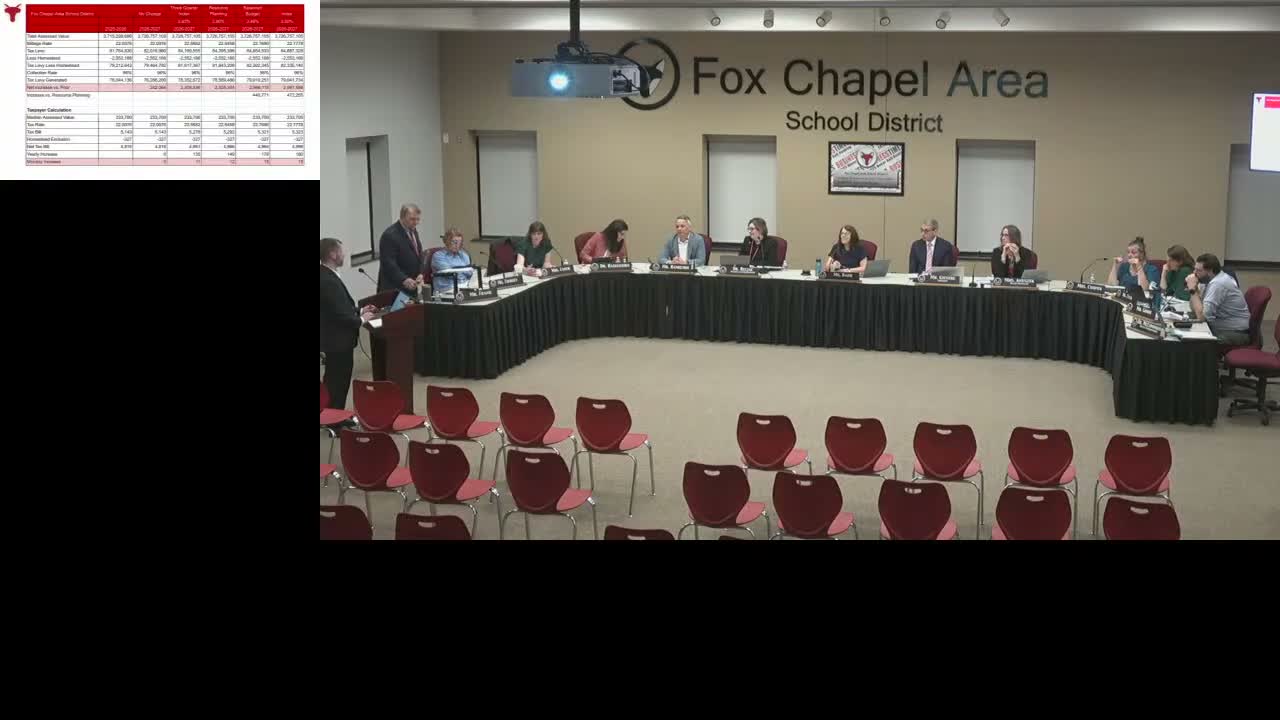
The Fox Chapel Area School District board on May 4 adopted its proposed final 2026–27 general fund budget after amending the administration's recommendation to raise the real‑estate millage by 3.1%, a change the board said will modestly increase the capital reserve transfer and reduce the need to draw on fund balance.
The amended budget totals $125,489,654, up from the packet figure of $125,332,236. Finance director Ryan Manzer told the board the administration initially included a 2.9% millage increase based on the Resource Planning Advisory Committee's recommendation but noted the district still faced an approximate $440,000 shortfall before changes. He said the extra revenue from 3.1% would raise roughly $157,000 above the 2.9% option and be applied to capital needs.
"That additional revenue gives us a little more room to move capital dollars and avoid taking as much from unassigned reserves," Manzer said during the presentation.
Board members spent more than an hour questioning assumptions and tradeoffs. Several trustees argued the district's capital transfer goal—discussed earlier as $2 million—remains below long‑term needs and that a higher tax increase would better align with planned projects and debt service coming from a recent $10 million bond.
"If we keep putting off capital, we simply dig the same hole deeper next year," a board member said, urging a larger baseline for capital transfers. Another trustee said she would not support the lower 2.9% proposal and instead backed an amendment to raise the rate to 3.1% to help address the capital shortfall.
Opponents of a larger increase focused on tax burden and fairness. Trustee Mrs. Lynch said she would not support the original 2.9% and later voted against the 3.1% amendment. Trustee Finley also voted no, citing concerns about household impacts.
The board amended the motion to a 3.1% real‑estate tax increase (0.6822 mills) and approved the amended budget in a final roll call vote: Yes — Frank, Good, Hamilton, Hasselcorn, Zitch, Cooper, Dadd; No — Lynch, Finley. The amendment vote had passed earlier 6–3.
The administration emphasized the decision changes revenue allocation rather than routine operating spending. Manzer said the largest expense pressures were personnel additions, debt service increases tied to the 2025 bond issuance, and contractual transportation costs. He also noted uncertainty in state funding and year‑to‑year variations in earned‑income taxes and assessment changes.
Board members asked the administration to deliver a clearer set of expenditure‑reduction options in future budget cycles and recommended earlier participatory discussions on priorities so that members could weigh tradeoffs well before May. Several directors also urged continued advocacy at the county and state level to reform assessment and appeal processes that have redistributed revenue unpredictably across districts.
Next steps: the district will post the proposed final budget for the required public display period and return in June for final adoption. The board also discussed taking a midyear look at revenues and making additional capital transfers if surplus becomes available.
The amended budget totals $125,489,654, up from the packet figure of $125,332,236. Finance director Ryan Manzer told the board the administration initially included a 2.9% millage increase based on the Resource Planning Advisory Committee's recommendation but noted the district still faced an approximate $440,000 shortfall before changes. He said the extra revenue from 3.1% would raise roughly $157,000 above the 2.9% option and be applied to capital needs.
"That additional revenue gives us a little more room to move capital dollars and avoid taking as much from unassigned reserves," Manzer said during the presentation.
Board members spent more than an hour questioning assumptions and tradeoffs. Several trustees argued the district's capital transfer goal—discussed earlier as $2 million—remains below long‑term needs and that a higher tax increase would better align with planned projects and debt service coming from a recent $10 million bond.
"If we keep putting off capital, we simply dig the same hole deeper next year," a board member said, urging a larger baseline for capital transfers. Another trustee said she would not support the lower 2.9% proposal and instead backed an amendment to raise the rate to 3.1% to help address the capital shortfall.
Opponents of a larger increase focused on tax burden and fairness. Trustee Mrs. Lynch said she would not support the original 2.9% and later voted against the 3.1% amendment. Trustee Finley also voted no, citing concerns about household impacts.
The board amended the motion to a 3.1% real‑estate tax increase (0.6822 mills) and approved the amended budget in a final roll call vote: Yes — Frank, Good, Hamilton, Hasselcorn, Zitch, Cooper, Dadd; No — Lynch, Finley. The amendment vote had passed earlier 6–3.
The administration emphasized the decision changes revenue allocation rather than routine operating spending. Manzer said the largest expense pressures were personnel additions, debt service increases tied to the 2025 bond issuance, and contractual transportation costs. He also noted uncertainty in state funding and year‑to‑year variations in earned‑income taxes and assessment changes.
Board members asked the administration to deliver a clearer set of expenditure‑reduction options in future budget cycles and recommended earlier participatory discussions on priorities so that members could weigh tradeoffs well before May. Several directors also urged continued advocacy at the county and state level to reform assessment and appeal processes that have redistributed revenue unpredictably across districts.
Next steps: the district will post the proposed final budget for the required public display period and return in June for final adoption. The board also discussed taking a midyear look at revenues and making additional capital transfers if surplus becomes available.
View the Full Meeting & All Its Details
This article offers just a summary. Unlock complete video, transcripts, and insights as a Founder Member.
✓
Watch full, unedited meeting videos
✓
Search every word spoken in unlimited transcripts
✓
AI summaries & real-time alerts (all government levels)
✓
Permanent access to expanding government content
30-day money-back guarantee
