Fox Chapel district reports steady high achievement, highlights middle‑school student‑led conferences
May 05, 2026 | Fox Chapel Area SD, School Districts, Pennsylvania
This article was created by AI summarizing key points discussed. AI makes mistakes, so for full details and context, please refer to the video of the full meeting. Please report any errors so we can fix them. Report an error »
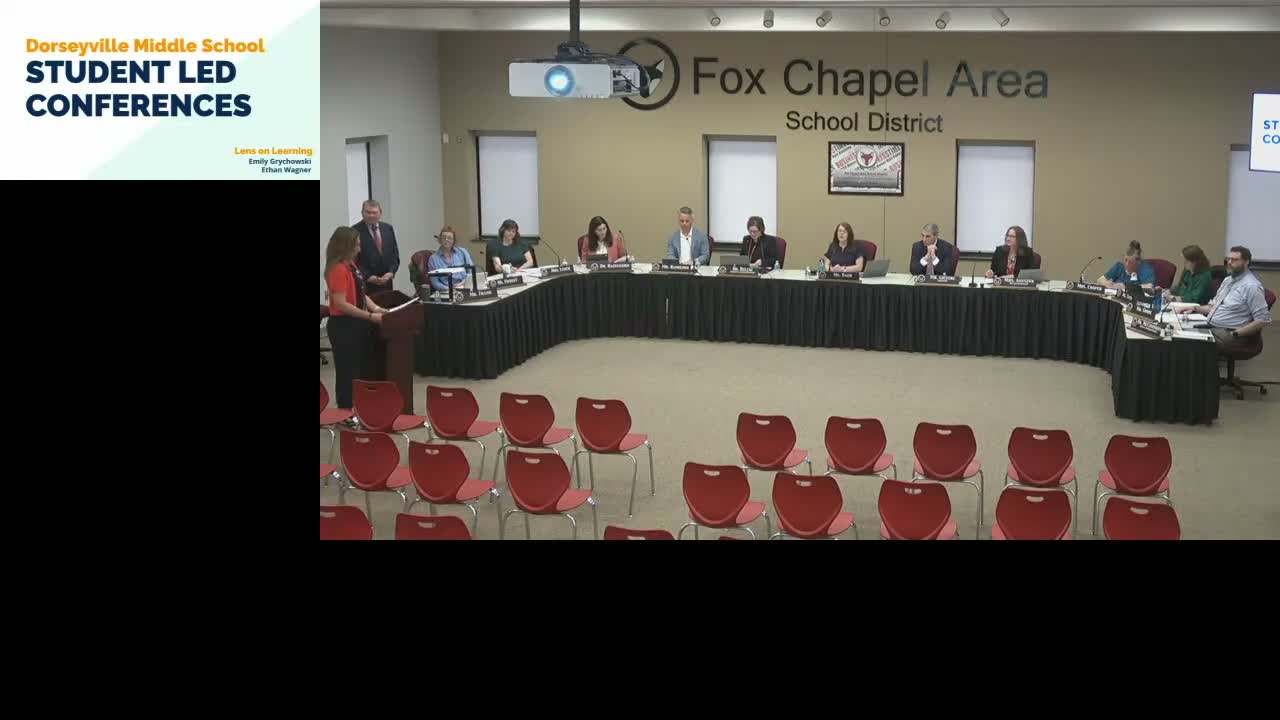
At its May 4 meeting the Fox Chapel Area School District presented a district‑level data review and a school demonstration of student‑led conferencing aimed at increasing student ownership of learning.
Dr. Edwards, the district's director of student achievement, summarized assessment trends: strong percentages of students scoring "advanced" on PSSA and Keystone assessments at elementary and middle grades (elementary math advanced rates near 60% in some grades; DMS demonstrated nearly 16 percentage points of gain across grades 6–8 since 2015) and an overall high rate of AP success — 921 AP exams with 80.67% of scores at 4 or 5 for 2024–25. He highlighted anchor‑level analysis (for example, text‑dependent analysis in ELA) as an instructional focus and noted that PVAS (PVAAS) growth results vary by grade and cohort and should be used alongside other local assessments.
"We do look at cohort by cohort and follow how individual students fare year to year," Dr. Edwards told trustees, adding that growth is a district priority and that some middle grades show dips the district is targeting through instructional adjustments.
Earlier, Dorseyville Middle School staff described a student‑led conferencing initiative where students curate artifacts from math, science, language and unified arts, reflect on them quarterly and present to adults in scheduled conferences. Presenters said the model produced stronger student reflection, increased confidence and improved adult‑student connections.
Ethan Wagner and Emily Grochowski, who led implementation at DMS, laid out a four‑step process: (1) quarterly classroom preparation, (2) artifact selection, (3) scheduled presentations to teachers/mentors, and (4) reflection and goal setting. Staff reported positive student feedback and recommended continuing the program next year.
Board members asked clarifying questions about how predictive models like PVAAS are communicated to parents and how the district reconciles middle‑school gains with high‑school trends. Dr. Edwards said the district uses multiple measures (STAR, interim assessments, curriculum‑based checks) in addition to PVAAS and cohorts are tracked diagonally (cohort over time) to monitor mobility into proficiency.
The board thanked teachers and students for the honors and the demonstration, and several trustees connected the instructional work to budgetary questions that followed later in the meeting.
Next steps: the district will continue anchor analysis in ELA and examine placement and scheduling using predictive indicators to identify students for advanced or extension opportunities.
Dr. Edwards, the district's director of student achievement, summarized assessment trends: strong percentages of students scoring "advanced" on PSSA and Keystone assessments at elementary and middle grades (elementary math advanced rates near 60% in some grades; DMS demonstrated nearly 16 percentage points of gain across grades 6–8 since 2015) and an overall high rate of AP success — 921 AP exams with 80.67% of scores at 4 or 5 for 2024–25. He highlighted anchor‑level analysis (for example, text‑dependent analysis in ELA) as an instructional focus and noted that PVAS (PVAAS) growth results vary by grade and cohort and should be used alongside other local assessments.
"We do look at cohort by cohort and follow how individual students fare year to year," Dr. Edwards told trustees, adding that growth is a district priority and that some middle grades show dips the district is targeting through instructional adjustments.
Earlier, Dorseyville Middle School staff described a student‑led conferencing initiative where students curate artifacts from math, science, language and unified arts, reflect on them quarterly and present to adults in scheduled conferences. Presenters said the model produced stronger student reflection, increased confidence and improved adult‑student connections.
Ethan Wagner and Emily Grochowski, who led implementation at DMS, laid out a four‑step process: (1) quarterly classroom preparation, (2) artifact selection, (3) scheduled presentations to teachers/mentors, and (4) reflection and goal setting. Staff reported positive student feedback and recommended continuing the program next year.
Board members asked clarifying questions about how predictive models like PVAAS are communicated to parents and how the district reconciles middle‑school gains with high‑school trends. Dr. Edwards said the district uses multiple measures (STAR, interim assessments, curriculum‑based checks) in addition to PVAAS and cohorts are tracked diagonally (cohort over time) to monitor mobility into proficiency.
The board thanked teachers and students for the honors and the demonstration, and several trustees connected the instructional work to budgetary questions that followed later in the meeting.
Next steps: the district will continue anchor analysis in ELA and examine placement and scheduling using predictive indicators to identify students for advanced or extension opportunities.
View the Full Meeting & All Its Details
This article offers just a summary. Unlock complete video, transcripts, and insights as a Founder Member.
✓
Watch full, unedited meeting videos
✓
Search every word spoken in unlimited transcripts
✓
AI summaries & real-time alerts (all government levels)
✓
Permanent access to expanding government content
30-day money-back guarantee
