Lee's Summit finance committee favors hiring-freeze approach to close FY27 budget gap
May 05, 2026 | Lee's Summit, Jackson County, Missouri
This article was created by AI summarizing key points discussed. AI makes mistakes, so for full details and context, please refer to the video of the full meeting. Please report any errors so we can fix them. Report an error »
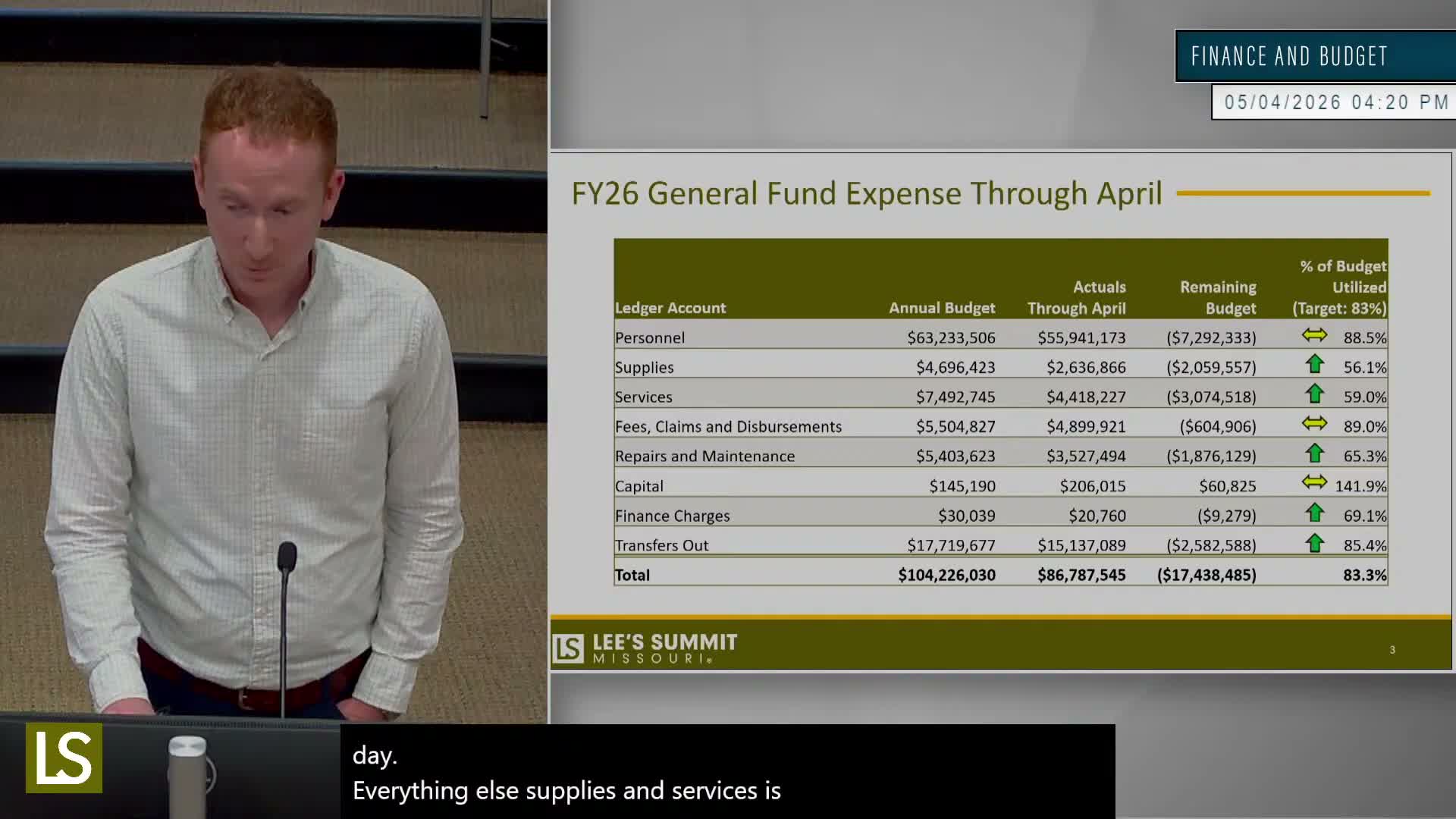
City staff presented three distinct approaches to close a projected FY2027 budget gap and the finance and budget committee signaled consensus for the approach known as Version C, a hiring-freeze–first strategy that prioritizes flexibility and seeks vacancy savings rather than immediate across-the-board staff cuts.
Mark Dunning, city manager, and Eric Stoyanov, budget manager, led a presentation showing total general fund revenue estimated at about $117 million and noting slower sales-tax growth (about 1.4%) alongside other revenue uncertainties. Stoyanov told the committee that overtime is running high this fiscal year, with roughly $3 million in overtime spending so far, and that ambulance fees (reported as roughly $800,000 per month) are not fully reflected in the nine months of data used for the presentation.
Dunning reviewed three scenarios. Version A would roll many departments back to FY25 spending levels and — as modeled in the exercise — could require large operational and personnel reductions (the staff exercise showed the equivalent of roughly 72 FTEs if fully implemented). Version B narrows public-safety cuts by increasing vacancy savings and including modest revenue assumptions such as an added $300,000 in property-tax revenue and pilot-payment estimates. Version C centers on a hiring freeze in core general departments (not public safety), phased police hiring to reflect academy timing and recruitment realities, and an estimated $2 million in vacancy savings over a year.
Committee members pressed staff on details including which departments faced reductions, the treatment of vacancy savings, and the assumptions for revenues tied to large development projects. Dunning said staff modeled conservative assumptions for projects and accounted for pilot payments and other one-time revenues where appropriate. He said Version C intentionally preserves flexibility for midyear adjustments and reduces the risk of irreversible cuts while factoring in needed pay adjustments such as the dispatcher pay disparity discussed earlier in the meeting.
Members asked for and received assurances that the plan would include periodic check-ins. The committee asked staff to return on May 18 with a refined version of the proposed FY27 budget and to advertise a public hearing for June 2 with a second reading scheduled June 9.
What happens next: staff will prepare a revised budget presentation for the special May 18 meeting; the committee intends to forward its recommendation and the public hearing will be scheduled as described.
Mark Dunning, city manager, and Eric Stoyanov, budget manager, led a presentation showing total general fund revenue estimated at about $117 million and noting slower sales-tax growth (about 1.4%) alongside other revenue uncertainties. Stoyanov told the committee that overtime is running high this fiscal year, with roughly $3 million in overtime spending so far, and that ambulance fees (reported as roughly $800,000 per month) are not fully reflected in the nine months of data used for the presentation.
Dunning reviewed three scenarios. Version A would roll many departments back to FY25 spending levels and — as modeled in the exercise — could require large operational and personnel reductions (the staff exercise showed the equivalent of roughly 72 FTEs if fully implemented). Version B narrows public-safety cuts by increasing vacancy savings and including modest revenue assumptions such as an added $300,000 in property-tax revenue and pilot-payment estimates. Version C centers on a hiring freeze in core general departments (not public safety), phased police hiring to reflect academy timing and recruitment realities, and an estimated $2 million in vacancy savings over a year.
Committee members pressed staff on details including which departments faced reductions, the treatment of vacancy savings, and the assumptions for revenues tied to large development projects. Dunning said staff modeled conservative assumptions for projects and accounted for pilot payments and other one-time revenues where appropriate. He said Version C intentionally preserves flexibility for midyear adjustments and reduces the risk of irreversible cuts while factoring in needed pay adjustments such as the dispatcher pay disparity discussed earlier in the meeting.
Members asked for and received assurances that the plan would include periodic check-ins. The committee asked staff to return on May 18 with a refined version of the proposed FY27 budget and to advertise a public hearing for June 2 with a second reading scheduled June 9.
What happens next: staff will prepare a revised budget presentation for the special May 18 meeting; the committee intends to forward its recommendation and the public hearing will be scheduled as described.
Don't Miss a Word: See the Full Meeting!
Go beyond summaries. Unlock every video, transcript, and key insight with a Founder Membership.
✓
Get instant access to full meeting videos
✓
Search and clip any phrase from complete transcripts
✓
Receive AI-powered summaries & custom alerts
✓
Enjoy lifetime, unrestricted access to government data
30-day money-back guarantee
