Pine-Richland board weighs up to 5.29% millage increase as CLR shrinks tax base
May 05, 2026 | Pine-Richland SD, School Districts, Pennsylvania
This article was created by AI summarizing key points discussed. AI makes mistakes, so for full details and context, please refer to the video of the full meeting. Please report any errors so we can fix them. Report an error »
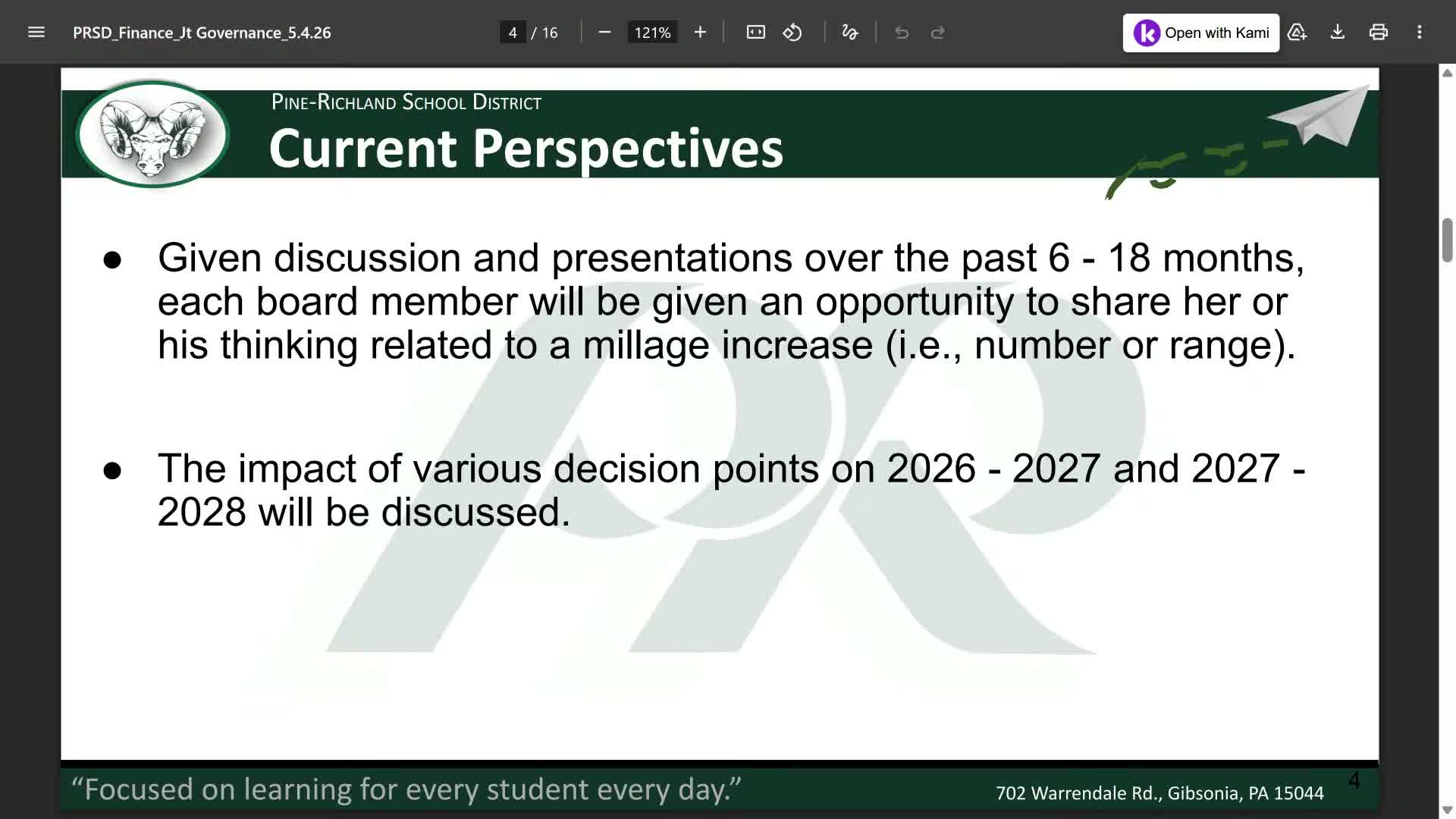
The Pine-Richland School Districtjoint finance governance board spent much of its May 4 meeting debating how to close a projected operating shortfall triggered in part by a drop in taxable assessed values after a county-level reassessment. Board member Mark Kashani proposed a 4.2% millage increase as a compromise; other trustees pushed for either the full 5.29% maximum or a smaller restoration to 2017 levels.
Why it matters: Dr. Miller told the board that roughly 79% of district revenue is local and largely dependent on real-estate tax receipts, and that the countylevel reassessment (CLR) has reduced assessed values and revenue. Facing rising costs and stagnant enrollment, district staff project a starting shortfall of about $3 million next year under current assumptions unless new revenue or structural cuts are adopted.
Kashani, who laid out a multi-year budget comparison and the revenue impact of the 2017 millage, said his 4.2% proposal "got us to a balanced budget, a little bit under," arguing it would close most of the gap without "overshoot[ing]" the district's needs. "I arrived at 4.2 because it got us to a balanced budget," he told the board.
Other trustees urged different approaches. One board member said the district should pursue the maximum 5.29% to "right set ourselves for the future," arguing CLR is an unknown that could force repeated tax increases if not addressed. Another member, citing the district's reserves, said she "cannot support a 5.29% increase" and preferred restoring the district to 2017 dollar levels (roughly 2.192%). That member noted the district is projected to have roughly $32 million in fund balance by June 30, 2026 and questioned asking taxpayers to finance projects not likely to occur for several years.
Finance staff and the administration warned of trade-offs. Chris, a finance staffer, noted that using fund balance to close recurring shortfalls could weaken the district's S&P rating and make future debt more expensive. The district's PFM long-range model showed that assuming no future millage increases and continued structural gaps could drive multi-year deficits; staff said the model is sensitive to assumptions and that the near-term projected starting deficit with a 5.29% increase would be about $3.0 million rather than eliminating longer-term pressure.
Board members repeatedly balanced two competing priorities: limiting immediate tax pain for households and protecting educational programs from cuts that could follow repeated underfunding. Several trustees emphasized program and staffing impacts if recurring revenue is not secured, while others emphasized that reserves already represent taxpayer dollars set aside for capital needs.
Next steps: No vote was taken at the May 4 session. Trustees asked staff to continue refining options (millage scenarios, structural expenditure reductions and debt scenarios) and to return with further detail; the board also flagged countywide reassessment advocacy as a parallel priority.
Why it matters: Dr. Miller told the board that roughly 79% of district revenue is local and largely dependent on real-estate tax receipts, and that the countylevel reassessment (CLR) has reduced assessed values and revenue. Facing rising costs and stagnant enrollment, district staff project a starting shortfall of about $3 million next year under current assumptions unless new revenue or structural cuts are adopted.
Kashani, who laid out a multi-year budget comparison and the revenue impact of the 2017 millage, said his 4.2% proposal "got us to a balanced budget, a little bit under," arguing it would close most of the gap without "overshoot[ing]" the district's needs. "I arrived at 4.2 because it got us to a balanced budget," he told the board.
Other trustees urged different approaches. One board member said the district should pursue the maximum 5.29% to "right set ourselves for the future," arguing CLR is an unknown that could force repeated tax increases if not addressed. Another member, citing the district's reserves, said she "cannot support a 5.29% increase" and preferred restoring the district to 2017 dollar levels (roughly 2.192%). That member noted the district is projected to have roughly $32 million in fund balance by June 30, 2026 and questioned asking taxpayers to finance projects not likely to occur for several years.
Finance staff and the administration warned of trade-offs. Chris, a finance staffer, noted that using fund balance to close recurring shortfalls could weaken the district's S&P rating and make future debt more expensive. The district's PFM long-range model showed that assuming no future millage increases and continued structural gaps could drive multi-year deficits; staff said the model is sensitive to assumptions and that the near-term projected starting deficit with a 5.29% increase would be about $3.0 million rather than eliminating longer-term pressure.
Board members repeatedly balanced two competing priorities: limiting immediate tax pain for households and protecting educational programs from cuts that could follow repeated underfunding. Several trustees emphasized program and staffing impacts if recurring revenue is not secured, while others emphasized that reserves already represent taxpayer dollars set aside for capital needs.
Next steps: No vote was taken at the May 4 session. Trustees asked staff to continue refining options (millage scenarios, structural expenditure reductions and debt scenarios) and to return with further detail; the board also flagged countywide reassessment advocacy as a parallel priority.
View the Full Meeting & All Its Details
This article offers just a summary. Unlock complete video, transcripts, and insights as a Founder Member.
✓
Watch full, unedited meeting videos
✓
Search every word spoken in unlimited transcripts
✓
AI summaries & real-time alerts (all government levels)
✓
Permanent access to expanding government content
30-day money-back guarantee
