Pine-Richland weighs tiered activity fees, booster venue fees and higher parking to raise revenue
May 05, 2026 | Pine-Richland SD, School Districts, Pennsylvania
This article was created by AI summarizing key points discussed. AI makes mistakes, so for full details and context, please refer to the video of the full meeting. Please report any errors so we can fix them. Report an error »
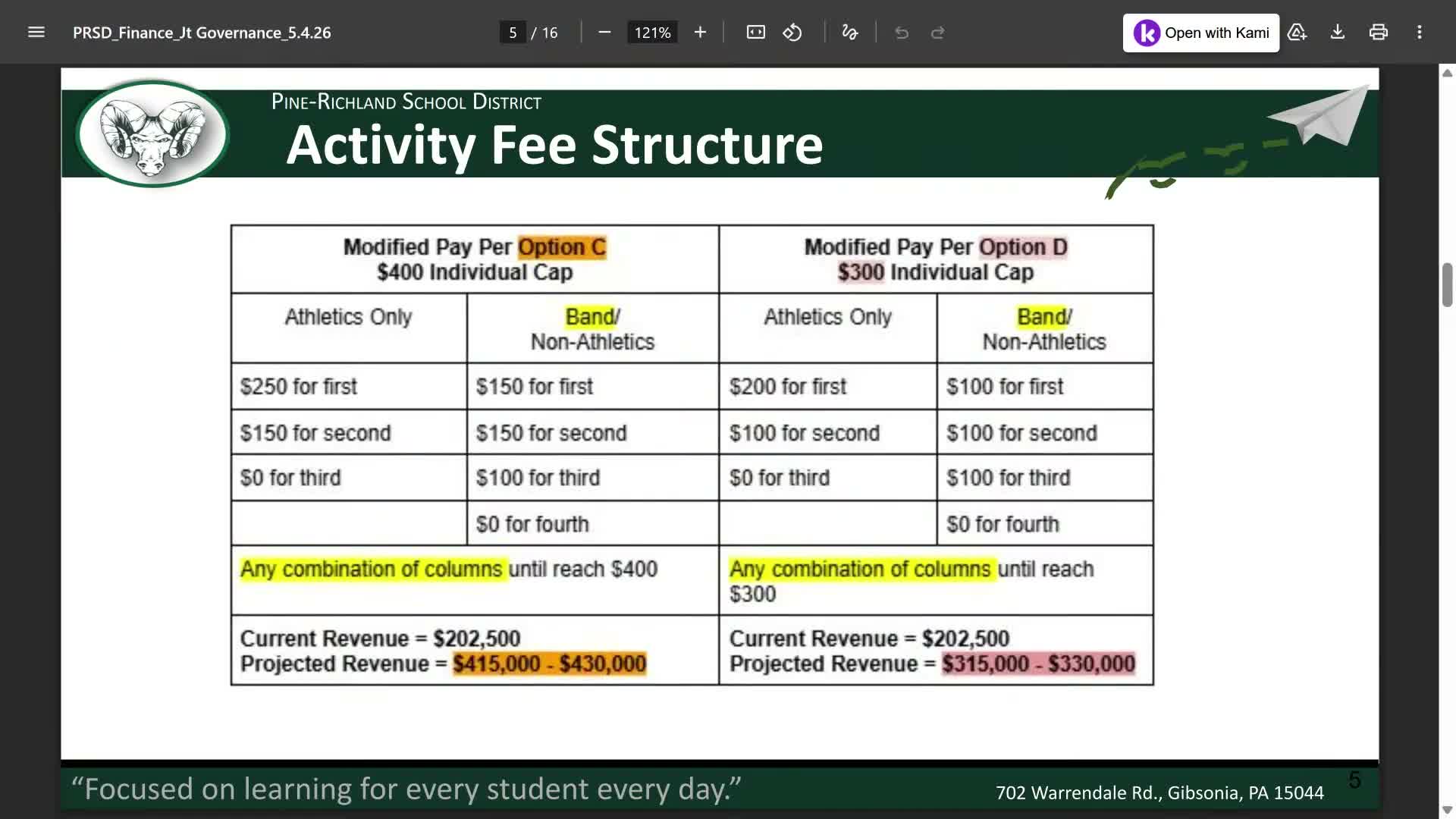
Board members and administrators discussed a package of smaller revenue measures — including tiered activity fees with individual caps, booster facility fees tied to digital-advertising access, and an increase in student parking fees — as part of a broader effort to preserve programs without relying solely on large millage increases.
Administrators presented option D for activity fees, suggesting an individual cap of $300 could raise about $100,000 and helped illustrate trade-offs between preserving programs and asking families for more out-of-pocket costs. Dr. Miller summarized model estimates and said option D was expected to generate additional revenue while preserving many programs.
The board also reviewed a tiered facility-fee schedule for booster or outside users: $3,500 for large venues (football stadium), $2,500 for gym/pool venues and $1,500 for smaller facilities, with the district guaranteeing a base fee and groups keeping revenue beyond that. "That's the recommendation," an administrator said, adding the fee scheme is intended to provide district revenue while letting booster groups retain most additional receipts.
Trustees repeatedly flagged the impact on middle-school sports if activity fees rise. One board member noted that adding $50 per family could present barriers; another asked for exact participation counts, and administrators estimated four affected teams with roughly 12–18 players each (about 48–72 students). A trustee warned that losing middle-school programming would reduce development of future varsity athletes and could close pathways to later success.
Student parking was also discussed: the board considered increasing the fee from $100 (after a prior rise from $60) to $125 or $150. Supporters said $125to150 is reasonable compared with peer districts and could be implemented; opponents said parking fees are a privilege and would have no material effect on the multi-million-dollar deficit but may disproportionately affect some families.
No final decisions were made. Administrators were asked to provide precise participation counts for affected middle-school teams and expected revenue tallies for each fee option so the board can weigh program impacts against revenue potential.
Administrators presented option D for activity fees, suggesting an individual cap of $300 could raise about $100,000 and helped illustrate trade-offs between preserving programs and asking families for more out-of-pocket costs. Dr. Miller summarized model estimates and said option D was expected to generate additional revenue while preserving many programs.
The board also reviewed a tiered facility-fee schedule for booster or outside users: $3,500 for large venues (football stadium), $2,500 for gym/pool venues and $1,500 for smaller facilities, with the district guaranteeing a base fee and groups keeping revenue beyond that. "That's the recommendation," an administrator said, adding the fee scheme is intended to provide district revenue while letting booster groups retain most additional receipts.
Trustees repeatedly flagged the impact on middle-school sports if activity fees rise. One board member noted that adding $50 per family could present barriers; another asked for exact participation counts, and administrators estimated four affected teams with roughly 12–18 players each (about 48–72 students). A trustee warned that losing middle-school programming would reduce development of future varsity athletes and could close pathways to later success.
Student parking was also discussed: the board considered increasing the fee from $100 (after a prior rise from $60) to $125 or $150. Supporters said $125to150 is reasonable compared with peer districts and could be implemented; opponents said parking fees are a privilege and would have no material effect on the multi-million-dollar deficit but may disproportionately affect some families.
No final decisions were made. Administrators were asked to provide precise participation counts for affected middle-school teams and expected revenue tallies for each fee option so the board can weigh program impacts against revenue potential.
Don't Miss a Word: See the Full Meeting!
Go beyond summaries. Unlock every video, transcript, and key insight with a Founder Membership.
✓
Get instant access to full meeting videos
✓
Search and clip any phrase from complete transcripts
✓
Receive AI-powered summaries & custom alerts
✓
Enjoy lifetime, unrestricted access to government data
30-day money-back guarantee
