Natural-resources staff reviews North Port's environmental code, notes some changes delayed by state rules
May 04, 2026 | North Port, Sarasota County, Florida
This article was created by AI summarizing key points discussed. AI makes mistakes, so for full details and context, please refer to the video of the full meeting. Please report any errors so we can fix them. Report an error »
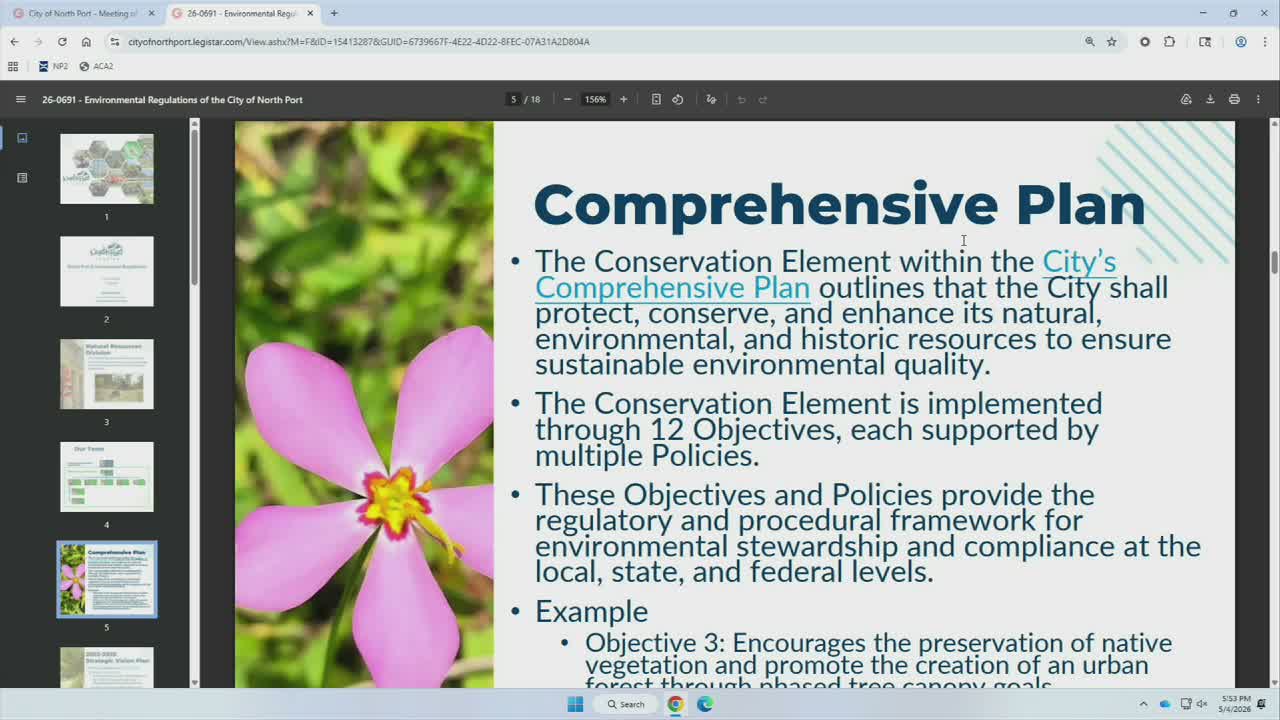
Stefan Caleb, natural resources manager and board liaison, presented an overview of North Port's environmental regulations to the Environmental Advisory Board on Monday, walking members through the Comprehensive Plan objectives, the Unified Land Development Code (ULDC), and chapter-level protections for natural resources.
Caleb highlighted plan objectives that encourage preserving native vegetation and increasing an urban tree canopy, citing a citywide tree-canopy goal and a strategic-vision pillar on environmental resilience and sustainability. He described how ULDC Chapter 4 focuses on natural-resources-sensitive site design and Chapter 6 addresses natural, cultural and historic resource protections including wetlands safeguards, archaeological surveys, and rules for listed or protected wildlife such as gopher tortoises.
Caleb said the ULDC is designed to avoid, minimize and, when necessary, mitigate environmental impacts, and he explained coordination with state and federal agencies for listed-species surveys and relocations. He also noted financial incentives exist to encourage developers to preserve habitat and trees.
On legal timing, Caleb told the board that if parts of a revised ULDC are more restrictive than prior code, state rules could delay their local effective date: "They may not take effect until 07/01/2027," he said, describing the state's intent to accommodate hurricane-related impacts and to limit retroactive restriction in some cases.
Board members asked which topics are locally controlled versus preempted by state statute; Caleb said tree and landscape buffer rules are primarily local while certain species and wetland protections often involve state or federal agencies. He recommended continued coordination with agencies such as the Florida Fish and Wildlife Conservation Commission and the U.S. Fish and Wildlife Service when listed species are involved.
The presentation concluded with an invitation for members to ask follow-up questions and a reminder that the ULDC and Comprehensive Plan are available online for deeper review.
Caleb highlighted plan objectives that encourage preserving native vegetation and increasing an urban tree canopy, citing a citywide tree-canopy goal and a strategic-vision pillar on environmental resilience and sustainability. He described how ULDC Chapter 4 focuses on natural-resources-sensitive site design and Chapter 6 addresses natural, cultural and historic resource protections including wetlands safeguards, archaeological surveys, and rules for listed or protected wildlife such as gopher tortoises.
Caleb said the ULDC is designed to avoid, minimize and, when necessary, mitigate environmental impacts, and he explained coordination with state and federal agencies for listed-species surveys and relocations. He also noted financial incentives exist to encourage developers to preserve habitat and trees.
On legal timing, Caleb told the board that if parts of a revised ULDC are more restrictive than prior code, state rules could delay their local effective date: "They may not take effect until 07/01/2027," he said, describing the state's intent to accommodate hurricane-related impacts and to limit retroactive restriction in some cases.
Board members asked which topics are locally controlled versus preempted by state statute; Caleb said tree and landscape buffer rules are primarily local while certain species and wetland protections often involve state or federal agencies. He recommended continued coordination with agencies such as the Florida Fish and Wildlife Conservation Commission and the U.S. Fish and Wildlife Service when listed species are involved.
The presentation concluded with an invitation for members to ask follow-up questions and a reminder that the ULDC and Comprehensive Plan are available online for deeper review.
View the Full Meeting & All Its Details
This article offers just a summary. Unlock complete video, transcripts, and insights as a Founder Member.
✓
Watch full, unedited meeting videos
✓
Search every word spoken in unlimited transcripts
✓
AI summaries & real-time alerts (all government levels)
✓
Permanent access to expanding government content
30-day money-back guarantee
