State racial‑equity director says federal actions are chilling Vermont DEI work
May 05, 2026 | Vermont States Colleges, Public Universities: Board of Trustees Meetings, School Districts, Vermont
This article was created by AI summarizing key points discussed. AI makes mistakes, so for full details and context, please refer to the video of the full meeting. Please report any errors so we can fix them. Report an error »
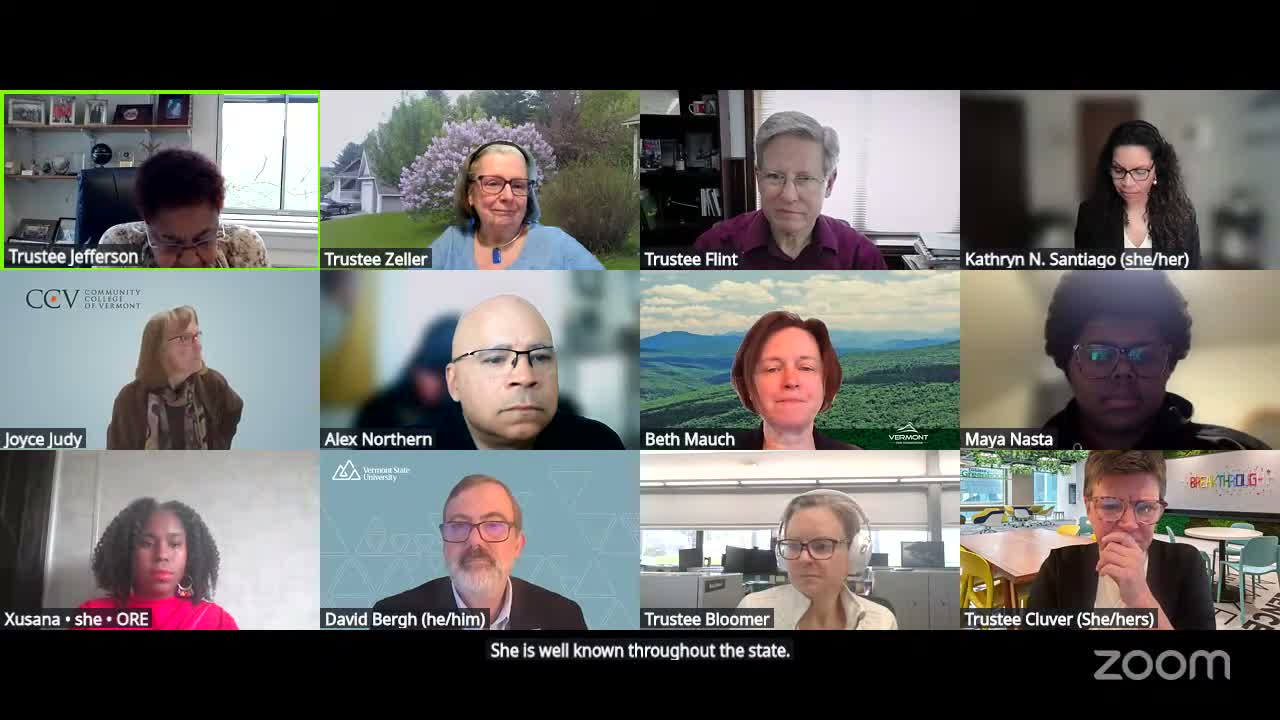
Susanna Davis, Executive Director of Racial Equity at the State of Vermont Office of Racial Equity, told the Vermont State Colleges’ Diversity, Equity and Inclusion Committee on May 4 that recent federal actions and rhetoric have created a "chilling effect" that is slowing or altering equity work across state agencies and campuses.
Davis, who spoke without slides in a conversational presentation, said the state’s response has been multilayered because different branches and independently elected officers respond in different ways. "Because Vermont is a small state, we're, I think, more able to speak to one another more clearly and get on the same page," she said, adding that the state nevertheless faces "a really multilayered, multifaceted, sometimes in concert and oftentimes disjointed set of responses happening to the federal government."
She described concrete consequences for state operations and higher education. Davis said a multiyear interagency grant tied to her office was flagged by a federal reviewer for using the words "racial" and "equity," and that the state was told it would have to change language or risk losing funds. "Our very title is flagged, which means really by federal standards our very existence is a problem for them," Davis said.
The director also said the attorney general’s office has pursued multiple suits challenging federal actions (she said she had counted roughly 49 at the time of her review) and that the state’s decisions to join or bring litigation have produced mixed reactions from constituents and agencies.
Davis argued that much federal action is "bluster" that may not withstand legal or statutory review but nevertheless deters agencies and institutions from continuing equity work. "Even if this executive order doesn't stick ... it's creating a chilling effect for people not to continue doing important work going forward," she said.
She urged a multisector approach to response and resilience: "It requires that we go back to basics ... and every branch of government lean into what your function is," she said. Davis recommended relationship building with peer states and coalitions, citing the Government Alliance on Race and Equity (GARE) as one resource, and advised careful drafting of policy language so local statutes and programs will hold up over time.
On higher education, Davis encouraged trustees and academic leaders to plan for demographic change and language access and to think beyond minimal compliance. When asked by a trustee about liaison work with immigrant and refugee organizations, Davis said the state works with groups including the Association of Africans Living in Vermont (AALV) and USCRI and participates in a statutorily created Office of New Americans study committee to develop recommendations for legislative action.
The committee thanked Davis for her presentation, which members said clarified how federal directives intersect with state practice and higher education operations. No formal action was taken; Davis invited follow‑up questions and offered to share a list of litigation and resources referenced during the presentation.
Davis, who spoke without slides in a conversational presentation, said the state’s response has been multilayered because different branches and independently elected officers respond in different ways. "Because Vermont is a small state, we're, I think, more able to speak to one another more clearly and get on the same page," she said, adding that the state nevertheless faces "a really multilayered, multifaceted, sometimes in concert and oftentimes disjointed set of responses happening to the federal government."
She described concrete consequences for state operations and higher education. Davis said a multiyear interagency grant tied to her office was flagged by a federal reviewer for using the words "racial" and "equity," and that the state was told it would have to change language or risk losing funds. "Our very title is flagged, which means really by federal standards our very existence is a problem for them," Davis said.
The director also said the attorney general’s office has pursued multiple suits challenging federal actions (she said she had counted roughly 49 at the time of her review) and that the state’s decisions to join or bring litigation have produced mixed reactions from constituents and agencies.
Davis argued that much federal action is "bluster" that may not withstand legal or statutory review but nevertheless deters agencies and institutions from continuing equity work. "Even if this executive order doesn't stick ... it's creating a chilling effect for people not to continue doing important work going forward," she said.
She urged a multisector approach to response and resilience: "It requires that we go back to basics ... and every branch of government lean into what your function is," she said. Davis recommended relationship building with peer states and coalitions, citing the Government Alliance on Race and Equity (GARE) as one resource, and advised careful drafting of policy language so local statutes and programs will hold up over time.
On higher education, Davis encouraged trustees and academic leaders to plan for demographic change and language access and to think beyond minimal compliance. When asked by a trustee about liaison work with immigrant and refugee organizations, Davis said the state works with groups including the Association of Africans Living in Vermont (AALV) and USCRI and participates in a statutorily created Office of New Americans study committee to develop recommendations for legislative action.
The committee thanked Davis for her presentation, which members said clarified how federal directives intersect with state practice and higher education operations. No formal action was taken; Davis invited follow‑up questions and offered to share a list of litigation and resources referenced during the presentation.
View the Full Meeting & All Its Details
This article offers just a summary. Unlock complete video, transcripts, and insights as a Founder Member.
✓
Watch full, unedited meeting videos
✓
Search every word spoken in unlimited transcripts
✓
AI summaries & real-time alerts (all government levels)
✓
Permanent access to expanding government content
30-day money-back guarantee
