Senate committee advances bill to align wind-turbine lighting rules with federal approvals
May 04, 2026 | 2026 Legislature CO, Colorado
This article was created by AI summarizing key points discussed. AI makes mistakes, so for full details and context, please refer to the video of the full meeting. Please report any errors so we can fix them. Report an error »
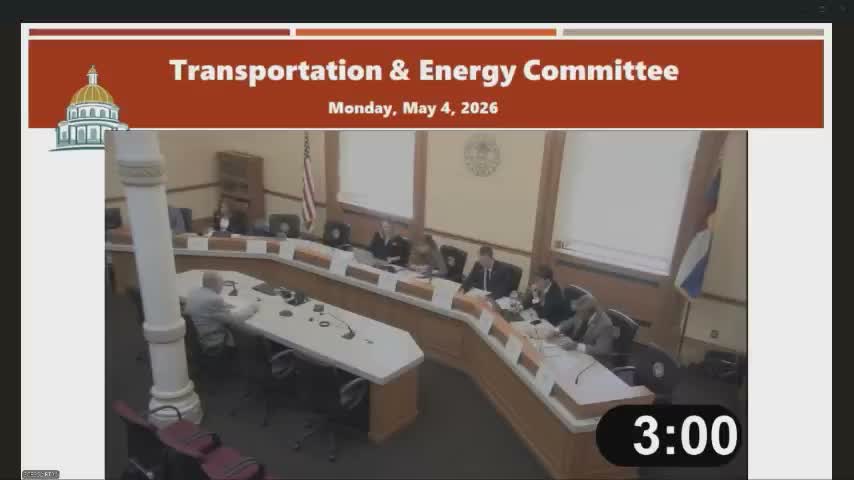
Senator R. Pelton moved House Bill 14-20 (HB1420) to the Committee of the Whole with a favorable recommendation after the committee heard testimony saying the bill aligns state requirements for aircraft-detection lighting systems (ADLS) on wind turbines with federal approvals and realistic installation timelines.
Supporters, including Peter Colucci of NextEra Energy, told the committee the proposal preserves Colorado’s goal of reducing nighttime light pollution while recognizing that approval and procurement steps — including Federal Aviation Administration (FAA) and Federal Communications Commission (FCC) reviews — can delay installation. Colucci said HB1420 would require local governments to provide extensions when federal agency approval is delayed and would ensure an installation period of at least 24 months when approvals are pending. “This bill is a narrow and practical update … that preserves the state’s policy goal of reducing nighttime lighting impacts while maintaining aviation safety,” Colucci said.
Kelly Sloan, representing the Colorado Agricultural Aviation Association and the Colorado Aviation Business Association, and Katie Furst, legislative director for Colorado Counties Inc., each voiced support. Sloan said ADLS are proven FAA-approved technology and that the current default — constant lights — poses no increased risk: “We just hope to be good neighbors and for that we support this bill.” Furst said the bill respects local permitting by requiring developers to return to local boards to request extensions and explain delays.
Senator Exum asked how emergency situations or software glitches would be handled if ADLS fail to operate as intended; the sponsor and witnesses said systems would default to flashing lights and facilities would remain subject to applicable federal lighting requirements until ADLS are approved and operational.
Senator Pelton moved the measure and the clerk polled the committee; the motion passed unanimously and the bill was placed on the consent calendar.
The committee did not adopt any amendments and took no further action; HB1420 now goes to the Committee of the Whole.
Supporters, including Peter Colucci of NextEra Energy, told the committee the proposal preserves Colorado’s goal of reducing nighttime light pollution while recognizing that approval and procurement steps — including Federal Aviation Administration (FAA) and Federal Communications Commission (FCC) reviews — can delay installation. Colucci said HB1420 would require local governments to provide extensions when federal agency approval is delayed and would ensure an installation period of at least 24 months when approvals are pending. “This bill is a narrow and practical update … that preserves the state’s policy goal of reducing nighttime lighting impacts while maintaining aviation safety,” Colucci said.
Kelly Sloan, representing the Colorado Agricultural Aviation Association and the Colorado Aviation Business Association, and Katie Furst, legislative director for Colorado Counties Inc., each voiced support. Sloan said ADLS are proven FAA-approved technology and that the current default — constant lights — poses no increased risk: “We just hope to be good neighbors and for that we support this bill.” Furst said the bill respects local permitting by requiring developers to return to local boards to request extensions and explain delays.
Senator Exum asked how emergency situations or software glitches would be handled if ADLS fail to operate as intended; the sponsor and witnesses said systems would default to flashing lights and facilities would remain subject to applicable federal lighting requirements until ADLS are approved and operational.
Senator Pelton moved the measure and the clerk polled the committee; the motion passed unanimously and the bill was placed on the consent calendar.
The committee did not adopt any amendments and took no further action; HB1420 now goes to the Committee of the Whole.
Don't Miss a Word: See the Full Meeting!
Go beyond summaries. Unlock every video, transcript, and key insight with a Founder Membership.
✓
Get instant access to full meeting videos
✓
Search and clip any phrase from complete transcripts
✓
Receive AI-powered summaries & custom alerts
✓
Enjoy lifetime, unrestricted access to government data
30-day money-back guarantee
