Committee advances Transit Access bill to require on-vehicle QR codes, reporting and language access
May 04, 2026 | 2026 Legislature CO, Colorado
This article was created by AI summarizing key points discussed. AI makes mistakes, so for full details and context, please refer to the video of the full meeting. Please report any errors so we can fix them. Report an error »
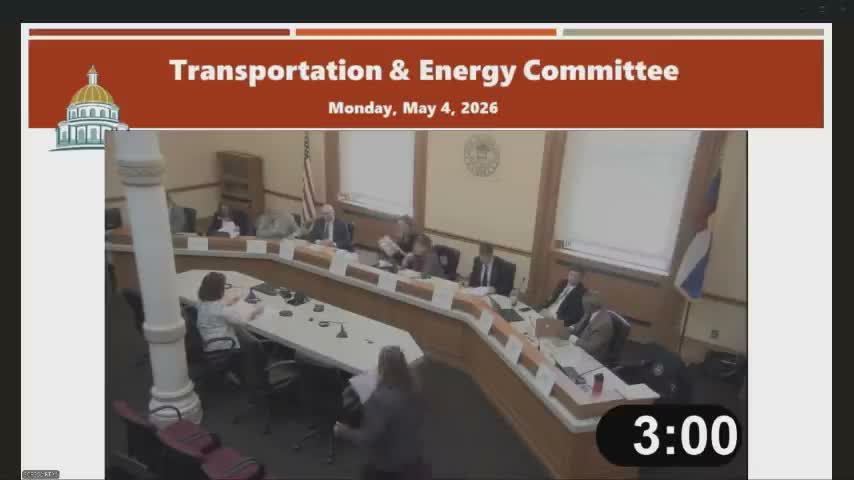
The Senate Transportation & Energy Committee voted 7–2 to advance House Bill 26-12-69, known in committee as the Transit Access bill, after an amendment that eases reporting burdens was adopted.
Sponsors described the measure as focused on practical steps to improve rider information and equity. Senator Benavides said the bill requires buses and other transit vehicles to display QR codes so riders can access schedules, route maps, fare information and language-accessible materials. The legislation also requires reporting by a subset of transit agencies to provide more route-level ridership and access data.
Witnesses included transit riders, board members and agency representatives. Andrew Fisher, a Denver resident and frequent rider, said the bill reduces “barriers of entry” by making basic information readily available at stops and stations. Chris Nicholson, an RTD board member, described the proposal as a thoughtful compromise that draws on best practices and said the nine non-RTD agencies covered delivered 21,000,000 rides in 2024. Jack Rosenthal and other advocates emphasized language access and the importance of posting clear, up-to-date maps and fare information at stations.
Anne Radjeski of CASTA (Colorado Association of Transit Agencies) testified in a neutral position of appreciation for the amendment; she noted the original draft could have imposed significant staff time and IT costs to produce machine-readable, ADA-compliant reports. The adopted amendment L009 allows medium-sized agencies to post links to existing federal reports such as the National Transit Database rather than creating entirely new datasets, which proponents said substantially reduces the compliance burden.
Following adoption of L009 without objection, Senator Marchman moved the bill as amended to the Committee of the Whole with a favorable recommendation. The committee poll recorded seven yeas and two nays; the bill will advance for further consideration.
Sponsors described the measure as focused on practical steps to improve rider information and equity. Senator Benavides said the bill requires buses and other transit vehicles to display QR codes so riders can access schedules, route maps, fare information and language-accessible materials. The legislation also requires reporting by a subset of transit agencies to provide more route-level ridership and access data.
Witnesses included transit riders, board members and agency representatives. Andrew Fisher, a Denver resident and frequent rider, said the bill reduces “barriers of entry” by making basic information readily available at stops and stations. Chris Nicholson, an RTD board member, described the proposal as a thoughtful compromise that draws on best practices and said the nine non-RTD agencies covered delivered 21,000,000 rides in 2024. Jack Rosenthal and other advocates emphasized language access and the importance of posting clear, up-to-date maps and fare information at stations.
Anne Radjeski of CASTA (Colorado Association of Transit Agencies) testified in a neutral position of appreciation for the amendment; she noted the original draft could have imposed significant staff time and IT costs to produce machine-readable, ADA-compliant reports. The adopted amendment L009 allows medium-sized agencies to post links to existing federal reports such as the National Transit Database rather than creating entirely new datasets, which proponents said substantially reduces the compliance burden.
Following adoption of L009 without objection, Senator Marchman moved the bill as amended to the Committee of the Whole with a favorable recommendation. The committee poll recorded seven yeas and two nays; the bill will advance for further consideration.
Don't Miss a Word: See the Full Meeting!
Go beyond summaries. Unlock every video, transcript, and key insight with a Founder Membership.
✓
Get instant access to full meeting videos
✓
Search and clip any phrase from complete transcripts
✓
Receive AI-powered summaries & custom alerts
✓
Enjoy lifetime, unrestricted access to government data
30-day money-back guarantee
