Assessor lays out 2026 revaluation; aldermen press office on alleged commercial underassessment
May 04, 2026 | Milwaukee , Milwaukee County, Wisconsin
This article was created by AI summarizing key points discussed. AI makes mistakes, so for full details and context, please refer to the video of the full meeting. Please report any errors so we can fix them. Report an error »
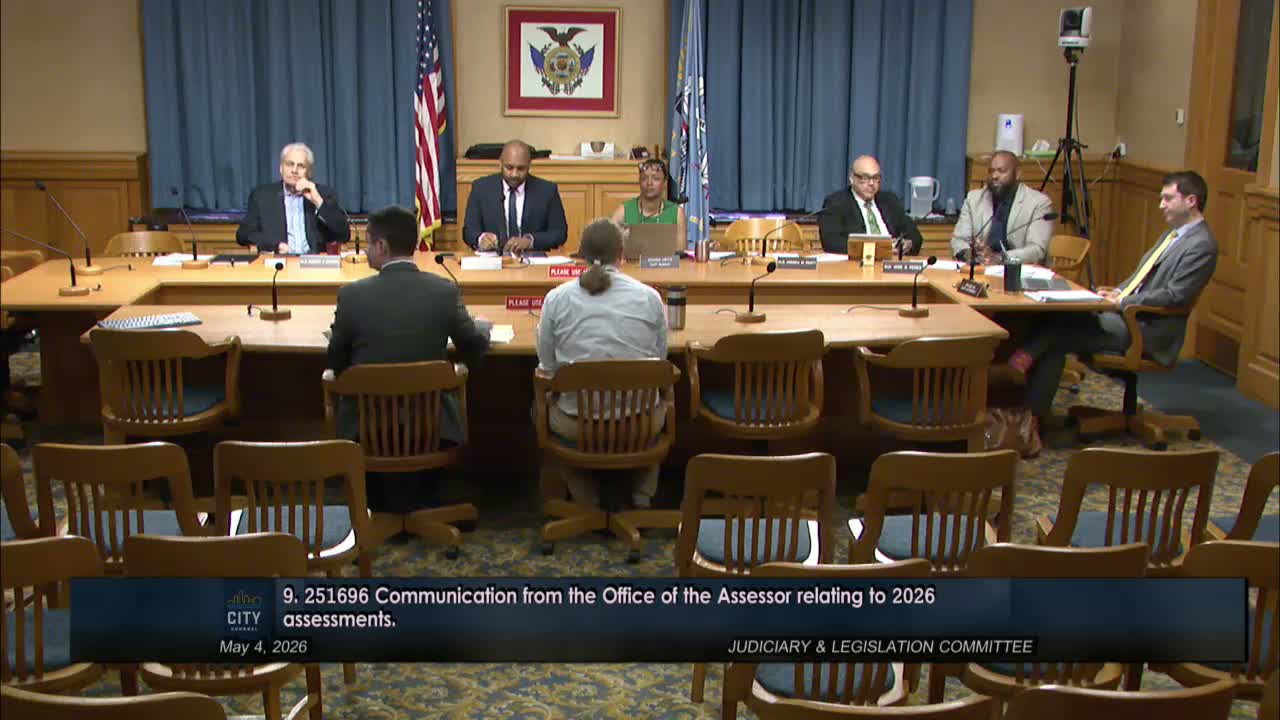
City Assessor’s Office staff described the 2026 revaluation process and fielded extensive questions about equity and apartment valuations during the Judiciary & Legislation Committee meeting on May 4.
Deputy Commissioner Ryan Rancher opened by explaining that revaluation reflects market conditions as of Jan. 1 and that the office follows Wisconsin statutes (70.05 and 70.32) and the Wisconsin Property Assessment Manual. He said the assessor’s office breaks the city into roughly 140 residential neighborhoods and applies statistical models and neighborhood-level adjustments so values reflect local market differences.
Colin Williams, the assessor’s real estate modeler, described the mass-appraisal workflow: collecting conveyance records and sales, validating arm’s-length transactions, running statistical models in R, and having neighborhood appraisers review and make targeted edits. Williams said the office reviews roughly 13,500 sales annually and integrates permit records, MLS data, and inspections to update property records.
Rancher and Williams reported the preliminary top-line change for 2026 assessments: a citywide increase of about 6% overall, with residential up about 6.43% and commercial about 5.31%. They said they expect state review will find values at or near 100% of market within an acceptable margin.
Committee members pressed on comparable selection, neighborhood boundaries, and the use of sales that were subsidized or atypical. Williams and Rancher described adjustments for atypical sales (flips, subsidized transactions) and emphasized neighborhood-level modeling to avoid applying outlier sales indiscriminately.
A turning point in the hearing came when a committee member cited a Marquette Law School analysis alleging that a large apartment owner’s portfolio (referenced as "Baratta" in the report) was assessed at a fraction of market-appraised values. The speaker read figures from the report comparing city assessments and prospectus appraisals and asked why the city’s assessed value appeared substantially lower.
Rancher acknowledged the report and said staff would review the prospectuses and public records provided by the author, and that they had already begun communicating with the study’s author to obtain supporting materials. "If this article unearths more information regarding these specific properties, we'll gladly apply it and update those records," Rancher said. The office said commercial valuation relies more on income approaches and that commercial owners frequently provide income/expense data only in appeals.
Staff outlined the open-book period (April 20 through the third Monday in May — this year ending May 18), the appeals process, and the board of assessors and board of review schedule (board of review begins May 29). They advised property owners to call (414) 286-6565 to discuss assessments with neighborhood appraisers, bring comparable sales or appraisals if they appeal, and noted that appeals commonly change assessments when property records are incomplete or incorrect.
When asked about the proportion of appeals that result in adjustments, staff estimated about 30% of formal appeals yield an adjustment and promised to confirm the statistic in writing. Several aldermen urged the assessor’s office to pursue public records such as prospectuses and mortgage filings to improve commercial valuation.
The committee voted to receive and place the communication on file. Staff said they will continue reviewing the Baratta-related records and will incorporate any verified information into next year’s modeling cycle if warranted.
Deputy Commissioner Ryan Rancher opened by explaining that revaluation reflects market conditions as of Jan. 1 and that the office follows Wisconsin statutes (70.05 and 70.32) and the Wisconsin Property Assessment Manual. He said the assessor’s office breaks the city into roughly 140 residential neighborhoods and applies statistical models and neighborhood-level adjustments so values reflect local market differences.
Colin Williams, the assessor’s real estate modeler, described the mass-appraisal workflow: collecting conveyance records and sales, validating arm’s-length transactions, running statistical models in R, and having neighborhood appraisers review and make targeted edits. Williams said the office reviews roughly 13,500 sales annually and integrates permit records, MLS data, and inspections to update property records.
Rancher and Williams reported the preliminary top-line change for 2026 assessments: a citywide increase of about 6% overall, with residential up about 6.43% and commercial about 5.31%. They said they expect state review will find values at or near 100% of market within an acceptable margin.
Committee members pressed on comparable selection, neighborhood boundaries, and the use of sales that were subsidized or atypical. Williams and Rancher described adjustments for atypical sales (flips, subsidized transactions) and emphasized neighborhood-level modeling to avoid applying outlier sales indiscriminately.
A turning point in the hearing came when a committee member cited a Marquette Law School analysis alleging that a large apartment owner’s portfolio (referenced as "Baratta" in the report) was assessed at a fraction of market-appraised values. The speaker read figures from the report comparing city assessments and prospectus appraisals and asked why the city’s assessed value appeared substantially lower.
Rancher acknowledged the report and said staff would review the prospectuses and public records provided by the author, and that they had already begun communicating with the study’s author to obtain supporting materials. "If this article unearths more information regarding these specific properties, we'll gladly apply it and update those records," Rancher said. The office said commercial valuation relies more on income approaches and that commercial owners frequently provide income/expense data only in appeals.
Staff outlined the open-book period (April 20 through the third Monday in May — this year ending May 18), the appeals process, and the board of assessors and board of review schedule (board of review begins May 29). They advised property owners to call (414) 286-6565 to discuss assessments with neighborhood appraisers, bring comparable sales or appraisals if they appeal, and noted that appeals commonly change assessments when property records are incomplete or incorrect.
When asked about the proportion of appeals that result in adjustments, staff estimated about 30% of formal appeals yield an adjustment and promised to confirm the statistic in writing. Several aldermen urged the assessor’s office to pursue public records such as prospectuses and mortgage filings to improve commercial valuation.
The committee voted to receive and place the communication on file. Staff said they will continue reviewing the Baratta-related records and will incorporate any verified information into next year’s modeling cycle if warranted.
View the Full Meeting & All Its Details
This article offers just a summary. Unlock complete video, transcripts, and insights as a Founder Member.
✓
Watch full, unedited meeting videos
✓
Search every word spoken in unlimited transcripts
✓
AI summaries & real-time alerts (all government levels)
✓
Permanent access to expanding government content
30-day money-back guarantee
