Iowa Senate passes health-and-education package after debate over SNAP and rural school impacts
April 27, 2026 | 2026 Senate, Legislative, Iowa
This article was created by AI summarizing key points discussed. AI makes mistakes, so for full details and context, please refer to the video of the full meeting. Please report any errors so we can fix them. Report an error »
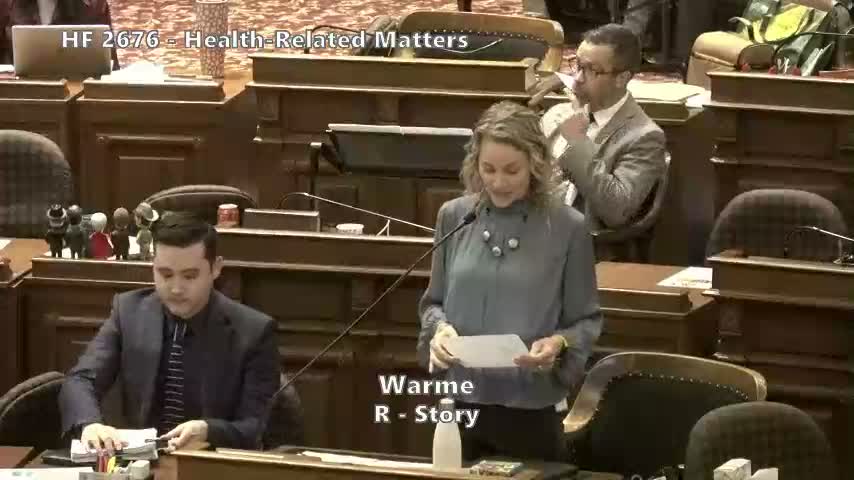
The Iowa Senate on April 8 concurred with a House amendment to House File 26‑76 and passed the amended health-and-education package after a floor debate that drew objections from several senators about costs to rural school districts and changes to SNAP eligibility.
Senator Warmie, who led the floor presentation, said the bill "aims to refocus our efforts to improve nutrition and physical activity with a focus on children," and described provisions that expand nutrition education, remove synthetic dyes from school foods and increase elementary physical activity. "They have made one addition, which is to increase the physical activity required for students in grades K through 4 from 30 minutes a day to 40 minutes a day," Warmie said, and moved that the Senate concur with House amendment S‑5202.
The bill drew sharp criticism from Senator Donoghue, who said she "rise[s] today in strong opposition" and argued the measure "shifts more financial pressure onto local districts" at a time when schools are already stretched by staffing and rising costs. "This bill doesn't strengthen public education. It strains it," Donoghue said, warning that rural districts without financial cushions would be hardest hit.
Senator Trung Garrett acknowledged that the extra 10 minutes of activity "is good" but said the broader bill "does not improve health outcomes." Garrett criticized proposed SNAP changes, calling them confusing and premature and saying restricting food options by taxable status "doesn't make anyone healthy."
Warmie told colleagues the package also ties to Iowa's application for rural health transformation funds and said the state's plan sought substantial federal funding; Warmie referenced an application figure of $1,000,000,000 and a first‑year award figure of $209,000,000 as part of the broader funding context for the bill.
The chair put the motion to concur and to place the bill on final passage. The roll-call recorded individual votes; the secretary reported 30 ayes and 16 nays and declared House File 26‑76 passed the Senate.
The Senate then ordered the bill messaged to the House. No implementation details, appropriation changes tied to local districts, or a specific phased timeline for new requirements were specified on the floor during this session.
Senator Warmie, who led the floor presentation, said the bill "aims to refocus our efforts to improve nutrition and physical activity with a focus on children," and described provisions that expand nutrition education, remove synthetic dyes from school foods and increase elementary physical activity. "They have made one addition, which is to increase the physical activity required for students in grades K through 4 from 30 minutes a day to 40 minutes a day," Warmie said, and moved that the Senate concur with House amendment S‑5202.
The bill drew sharp criticism from Senator Donoghue, who said she "rise[s] today in strong opposition" and argued the measure "shifts more financial pressure onto local districts" at a time when schools are already stretched by staffing and rising costs. "This bill doesn't strengthen public education. It strains it," Donoghue said, warning that rural districts without financial cushions would be hardest hit.
Senator Trung Garrett acknowledged that the extra 10 minutes of activity "is good" but said the broader bill "does not improve health outcomes." Garrett criticized proposed SNAP changes, calling them confusing and premature and saying restricting food options by taxable status "doesn't make anyone healthy."
Warmie told colleagues the package also ties to Iowa's application for rural health transformation funds and said the state's plan sought substantial federal funding; Warmie referenced an application figure of $1,000,000,000 and a first‑year award figure of $209,000,000 as part of the broader funding context for the bill.
The chair put the motion to concur and to place the bill on final passage. The roll-call recorded individual votes; the secretary reported 30 ayes and 16 nays and declared House File 26‑76 passed the Senate.
The Senate then ordered the bill messaged to the House. No implementation details, appropriation changes tied to local districts, or a specific phased timeline for new requirements were specified on the floor during this session.
Don't Miss a Word: See the Full Meeting!
Go beyond summaries. Unlock every video, transcript, and key insight with a Founder Membership.
✓
Get instant access to full meeting videos
✓
Search and clip any phrase from complete transcripts
✓
Receive AI-powered summaries & custom alerts
✓
Enjoy lifetime, unrestricted access to government data
30-day money-back guarantee
