Attorney General's office urges removing enforcement language from H.650 EdTech registry
May 05, 2026 | Education, SENATE, Committees, Legislative , Vermont
This article was created by AI summarizing key points discussed. AI makes mistakes, so for full details and context, please refer to the video of the full meeting. Please report any errors so we can fix them. Report an error »
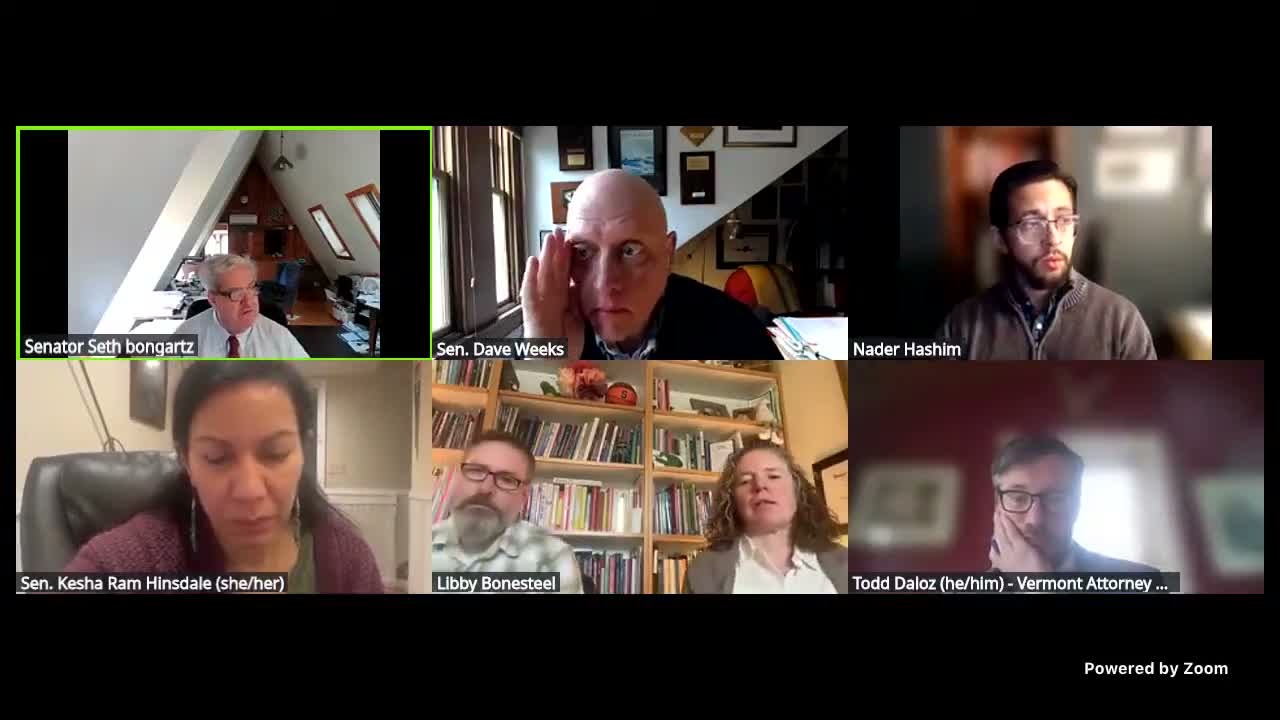
Todd Delos, assistant attorney general, told the Senate Education Committee on May 4 that while his office supports legislation to protect students and student data, the enforcement language added to H.650 in the Senate could undercut the bill's main goal of gathering information about educational-technology products.
Delos said the House'passed version relied on a study/registry approach without direct AG enforcement; the Senate draft adds Consumer Protection Act authority and a 60-day notice requirement before civil action. "As a practical matter, that is how we operate," Delos said of providing notice, but he cautioned that legislatively circumscribing enforcement authority could hamper responses to willful misconduct.
The bill's sponsor told the committee the registry's purpose is to understand the marketplace and that he does not want potential civil actions to scare companies away from registering. Rick Sagal of legislative counsel summarized the bill's history, saying the House'passed bill had no enforcement while the Senate language reintroduced a CPA connection and a 60-day AG enforcement provision.
Delos recommended either removing the enforcement provisions entirely if the committee's aim is to collect data, or replacing full CPA litigation with narrower administrative penalties to avoid creating disproportionate sanctions for registration failures. He flagged resource constraints and said the AG's office generally acts on complaints and rarely pursues civil actions for one-off registration lapses.
Committee members responded that they were inclined to remove the enforcement language for now, preserve the registry as a building block, and focus on clearer definitions and mechanisms to capture advertising and data-collection information. Several members said they want model guidance and clearer definitions before authorizing enforcement.
The committee concluded by asking the sponsor and AOE representatives to continue working on draft language to clarify definitions, enforcement scope and any penalty scheme. No formal vote on the bill took place at the hearing; the committee adjourned after agreeing to further revisions.
Delos said the House'passed version relied on a study/registry approach without direct AG enforcement; the Senate draft adds Consumer Protection Act authority and a 60-day notice requirement before civil action. "As a practical matter, that is how we operate," Delos said of providing notice, but he cautioned that legislatively circumscribing enforcement authority could hamper responses to willful misconduct.
The bill's sponsor told the committee the registry's purpose is to understand the marketplace and that he does not want potential civil actions to scare companies away from registering. Rick Sagal of legislative counsel summarized the bill's history, saying the House'passed bill had no enforcement while the Senate language reintroduced a CPA connection and a 60-day AG enforcement provision.
Delos recommended either removing the enforcement provisions entirely if the committee's aim is to collect data, or replacing full CPA litigation with narrower administrative penalties to avoid creating disproportionate sanctions for registration failures. He flagged resource constraints and said the AG's office generally acts on complaints and rarely pursues civil actions for one-off registration lapses.
Committee members responded that they were inclined to remove the enforcement language for now, preserve the registry as a building block, and focus on clearer definitions and mechanisms to capture advertising and data-collection information. Several members said they want model guidance and clearer definitions before authorizing enforcement.
The committee concluded by asking the sponsor and AOE representatives to continue working on draft language to clarify definitions, enforcement scope and any penalty scheme. No formal vote on the bill took place at the hearing; the committee adjourned after agreeing to further revisions.
Don't Miss a Word: See the Full Meeting!
Go beyond summaries. Unlock every video, transcript, and key insight with a Founder Membership.
✓
Get instant access to full meeting videos
✓
Search and clip any phrase from complete transcripts
✓
Receive AI-powered summaries & custom alerts
✓
Enjoy lifetime, unrestricted access to government data
30-day money-back guarantee
