Iowa Senate approves wide-ranging school-choice bill after rejecting six amendments
April 27, 2026 | 2026 Senate, Legislative, Iowa
This article was created by AI summarizing key points discussed. AI makes mistakes, so for full details and context, please refer to the video of the full meeting. Please report any errors so we can fix them. Report an error »
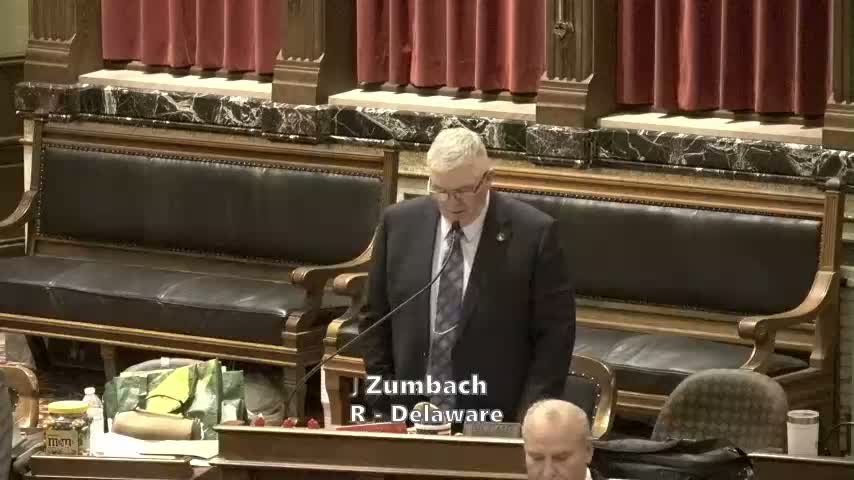
The Iowa Senate passed House File 27-54 on April 27, 2026, advancing a broad school-choice and education reform package after rejecting six Senate amendments that would have narrowed key provisions.
Senator Green, sponsor on the floor, framed the bill as a decades-long effort to expand educational options and support educators. "With the right strategy, I say yes" to innovation in education, Green said, listing 14 divisions including state charter authorizing, teacher-supplement funding, a charter facilities revolving loan fund, education savings accounts and an expansion of preschool options.
Opponents pressed the chamber on accountability and fiscal impacts. Senator Donoghue argued Amendment 52-19 — which would have removed a provision extending the teacher salary supplement to charter schools — was necessary because "accountability must come before allocation," asserting charter schools are not held to the same salary and transparency standards as traditional public districts. Donoghue moved the amendment but it failed on a roll-call vote.
Other defeated amendments included measures on extracurricular fees (Amendment 52-20), limits on charter facilities credit-enhancement agreements (Amendment 52-21), parity in preschool capacity funding for public preschools (Amendment 52-22), a requirement that nonpublic and charter students pay the difference for concurrent-enrollment costs (Amendment 52-23), and a proposal to delete the independent private instruction (IPI) language that would have allowed unlimited enrollments and tuition in certain private/home instruction programs (Amendment 52-24).
Senator Blake urged striking the bill's loan-support provisions, saying they create an unbacked liability for taxpayers and noting there was no appropriation attached to the revolving loan language. "If we are putting the thumb on the scale for sometimes corporate-run schools and using taxpayer dollars to make that bet, we should strike this section," Blake said.
Senator Peterson criticized provisions affecting preschool funding, calling Amendment 52-22 a parity fix and contending the bill created "two different classes of 4-year-olds" by providing front-end capacity dollars to some private preschools while public preschools were paid in arrears. Peterson said many districts have waiting lists and urged lawmakers to treat public and private preschool providers equitably.
Senator Winkler and Senator Zimmer highlighted fiscal consequences for resident districts when charter or nonpublic students access concurrent enrollment at community colleges. Zimmer cited the example of a three-credit community-college course costing about $400 while district supplemental funding may cover only $100 to $150, leaving a significant uncovered per-student cost that could burden district general funds.
Senator Kornbach pressed Amendment 52-24 to delete the IPI language, warning the proposal would allow "diplomas [to be] handed out willy nilly" and permit instructors without accreditation or minimum qualifications to issue credentials. Senator Green and other supporters of the bill defended the IPI provisions as protections for homeschooling families and existing programs.
All six amendments were defeated on recorded roll-call votes (each amendment recorded as 16 ayes and 30 nays in the announced tallies). After closing debate, the Senate read House File 27-54 for final passage; the clerk recorded the final action and the chamber declared the bill passed. The Senate ordered the bill messaged to the House.
The Senate also approved withdrawal of a related Senate file and the clerk read a list of additional House and Senate bills for the record before the chamber adjourned until April 28, 2026.
What comes next: Because the Senate voted to message the bill to the House, the House will receive notice of passage and may proceed according to its own scheduling and procedures. The bill's substantive changes on charter authorizing, funding flows, preschool capacity, retirement access, and IPI rules will proceed only if enacted through the full legislative process.
Senator Green, sponsor on the floor, framed the bill as a decades-long effort to expand educational options and support educators. "With the right strategy, I say yes" to innovation in education, Green said, listing 14 divisions including state charter authorizing, teacher-supplement funding, a charter facilities revolving loan fund, education savings accounts and an expansion of preschool options.
Opponents pressed the chamber on accountability and fiscal impacts. Senator Donoghue argued Amendment 52-19 — which would have removed a provision extending the teacher salary supplement to charter schools — was necessary because "accountability must come before allocation," asserting charter schools are not held to the same salary and transparency standards as traditional public districts. Donoghue moved the amendment but it failed on a roll-call vote.
Other defeated amendments included measures on extracurricular fees (Amendment 52-20), limits on charter facilities credit-enhancement agreements (Amendment 52-21), parity in preschool capacity funding for public preschools (Amendment 52-22), a requirement that nonpublic and charter students pay the difference for concurrent-enrollment costs (Amendment 52-23), and a proposal to delete the independent private instruction (IPI) language that would have allowed unlimited enrollments and tuition in certain private/home instruction programs (Amendment 52-24).
Senator Blake urged striking the bill's loan-support provisions, saying they create an unbacked liability for taxpayers and noting there was no appropriation attached to the revolving loan language. "If we are putting the thumb on the scale for sometimes corporate-run schools and using taxpayer dollars to make that bet, we should strike this section," Blake said.
Senator Peterson criticized provisions affecting preschool funding, calling Amendment 52-22 a parity fix and contending the bill created "two different classes of 4-year-olds" by providing front-end capacity dollars to some private preschools while public preschools were paid in arrears. Peterson said many districts have waiting lists and urged lawmakers to treat public and private preschool providers equitably.
Senator Winkler and Senator Zimmer highlighted fiscal consequences for resident districts when charter or nonpublic students access concurrent enrollment at community colleges. Zimmer cited the example of a three-credit community-college course costing about $400 while district supplemental funding may cover only $100 to $150, leaving a significant uncovered per-student cost that could burden district general funds.
Senator Kornbach pressed Amendment 52-24 to delete the IPI language, warning the proposal would allow "diplomas [to be] handed out willy nilly" and permit instructors without accreditation or minimum qualifications to issue credentials. Senator Green and other supporters of the bill defended the IPI provisions as protections for homeschooling families and existing programs.
All six amendments were defeated on recorded roll-call votes (each amendment recorded as 16 ayes and 30 nays in the announced tallies). After closing debate, the Senate read House File 27-54 for final passage; the clerk recorded the final action and the chamber declared the bill passed. The Senate ordered the bill messaged to the House.
The Senate also approved withdrawal of a related Senate file and the clerk read a list of additional House and Senate bills for the record before the chamber adjourned until April 28, 2026.
What comes next: Because the Senate voted to message the bill to the House, the House will receive notice of passage and may proceed according to its own scheduling and procedures. The bill's substantive changes on charter authorizing, funding flows, preschool capacity, retirement access, and IPI rules will proceed only if enacted through the full legislative process.
View the Full Meeting & All Its Details
This article offers just a summary. Unlock complete video, transcripts, and insights as a Founder Member.
✓
Watch full, unedited meeting videos
✓
Search every word spoken in unlimited transcripts
✓
AI summaries & real-time alerts (all government levels)
✓
Permanent access to expanding government content
30-day money-back guarantee
