City staff outline new citywide density bonus; residents urge stronger displacement protections
May 05, 2026 | Austin, Travis County, Texas
This article was created by AI summarizing key points discussed. AI makes mistakes, so for full details and context, please refer to the video of the full meeting. Please report any errors so we can fix them. Report an error »
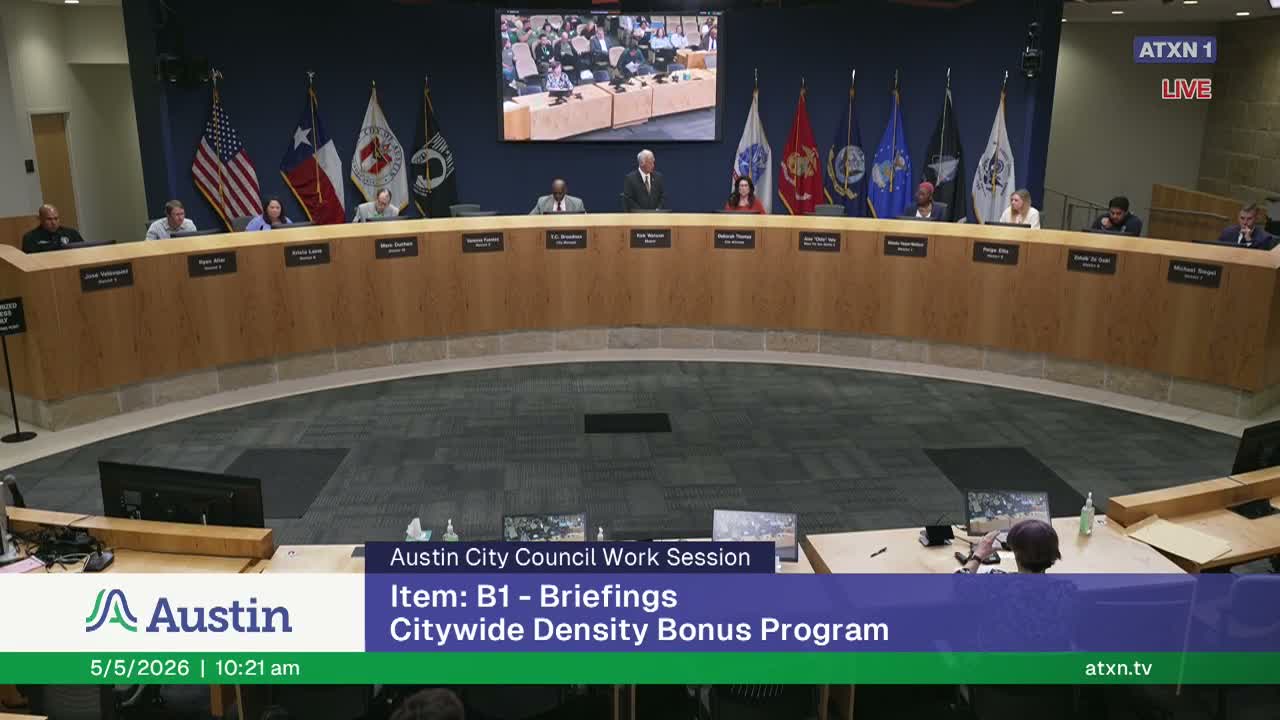
City planning staff on May 5 outlined a new "citywide density bonus" that would replace some existing bonus tools and offer up to 60 feet of additional height in exchange for affordable housing and other community benefits.
Stevie Greathouse, a planning division manager, and Warner Cook, principal planner, told the Austin City Council the proposal creates five new height tiers and sets affordability requirements that differ by tenure: for rental projects, staff recommends 10% of units be restricted at 50% of median family income (MFI) for 40 years with on‑site units and no fee‑in‑lieu; for ownership projects, staff recommended 10% at 80% MFI for 99 years with a fee‑in‑lieu option. "We are looking to encourage the creation of new affordable housing without any additional city subsidy," Cook said.
The presentation also proposes stronger unit‑replacement obligations for redevelopment of existing multifamily housing and tenant protections drawn from city code, including notice and moving assistance. Staff said the program would apply to commercial and office‑zoned parcels and that existing entitlements under DB‑90 and VMU would be grandfathered for projects that already hold those approvals.
In public comment, Betsy Greenberg of District 9 urged the council to prioritize preventing displacement. "I live in District 9 and I'm opposed to the citywide density bonus program as drafted," she said, citing the Acacia Cliffs rezoning and saying the current draft risks replacing naturally occurring affordable housing with market units.
Council members asked detailed implementation questions. Councilmember Ryan Alter suggested allowing a fee‑in‑lieu while ensuring geographic dispersion of the dollars and urged consideration of deeper affordability in the highest‑need areas. Staff answered that some fee‑in‑lieu provisions (ownership) are retained to protect low‑income homeowners from HOA cost shocks, and that the rental requirements are designed to address the identified greatest need at 50% MFI and below.
Staff also described follow‑up steps: the planning commission recommended several amendments; staff will post a planning commission and a staff ordinance version as late backup for the May 21 council agenda; and the council will consider the item at that meeting. Cook said staff will provide additional cost, feasibility and design details in written backup.
The item remains in the briefing stage; councilmembers indicated they want more data on financial feasibility, the effect of rounding rules for fractional unit requirements and how replacement thresholds interact with projects that are currently affordable but aging.
Stevie Greathouse, a planning division manager, and Warner Cook, principal planner, told the Austin City Council the proposal creates five new height tiers and sets affordability requirements that differ by tenure: for rental projects, staff recommends 10% of units be restricted at 50% of median family income (MFI) for 40 years with on‑site units and no fee‑in‑lieu; for ownership projects, staff recommended 10% at 80% MFI for 99 years with a fee‑in‑lieu option. "We are looking to encourage the creation of new affordable housing without any additional city subsidy," Cook said.
The presentation also proposes stronger unit‑replacement obligations for redevelopment of existing multifamily housing and tenant protections drawn from city code, including notice and moving assistance. Staff said the program would apply to commercial and office‑zoned parcels and that existing entitlements under DB‑90 and VMU would be grandfathered for projects that already hold those approvals.
In public comment, Betsy Greenberg of District 9 urged the council to prioritize preventing displacement. "I live in District 9 and I'm opposed to the citywide density bonus program as drafted," she said, citing the Acacia Cliffs rezoning and saying the current draft risks replacing naturally occurring affordable housing with market units.
Council members asked detailed implementation questions. Councilmember Ryan Alter suggested allowing a fee‑in‑lieu while ensuring geographic dispersion of the dollars and urged consideration of deeper affordability in the highest‑need areas. Staff answered that some fee‑in‑lieu provisions (ownership) are retained to protect low‑income homeowners from HOA cost shocks, and that the rental requirements are designed to address the identified greatest need at 50% MFI and below.
Staff also described follow‑up steps: the planning commission recommended several amendments; staff will post a planning commission and a staff ordinance version as late backup for the May 21 council agenda; and the council will consider the item at that meeting. Cook said staff will provide additional cost, feasibility and design details in written backup.
The item remains in the briefing stage; councilmembers indicated they want more data on financial feasibility, the effect of rounding rules for fractional unit requirements and how replacement thresholds interact with projects that are currently affordable but aging.
View the Full Meeting & All Its Details
This article offers just a summary. Unlock complete video, transcripts, and insights as a Founder Member.
✓
Watch full, unedited meeting videos
✓
Search every word spoken in unlimited transcripts
✓
AI summaries & real-time alerts (all government levels)
✓
Permanent access to expanding government content
30-day money-back guarantee
