Hundreds of city employees urge council to pause '1 ATS' IT consolidation over safety and oversight concerns
May 05, 2026 | Austin, Travis County, Texas
This article was created by AI summarizing key points discussed. AI makes mistakes, so for full details and context, please refer to the video of the full meeting. Please report any errors so we can fix them. Report an error »
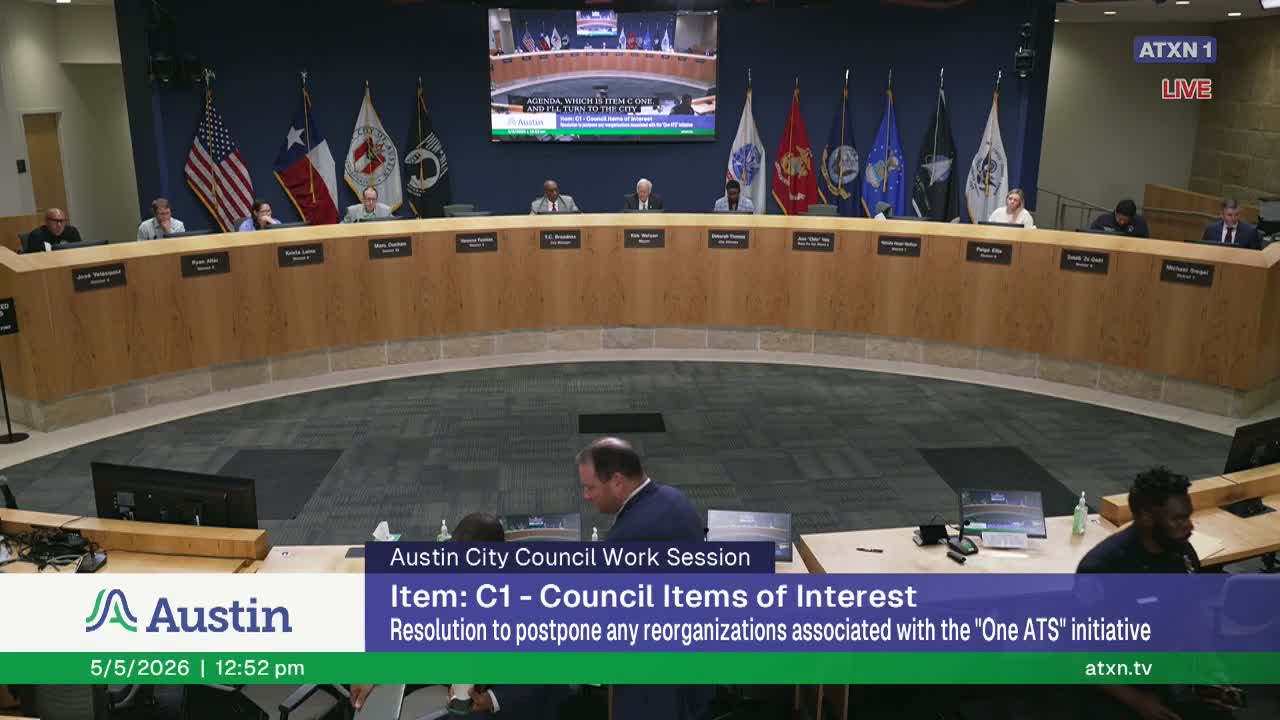
Dozens of Austin city employees, union leaders and specialists pressed the City Council on May 5 to halt or tightly condition a plan to consolidate many departmental IT staff into a single Austin Technology Services (ATS) organization known as "1 ATS." Speakers, representing AFSCME and a cross‑section of departments, raised cybersecurity, operational continuity and workforce governance concerns.
Ramsey Bissick, a senior software engineer with Austin Fire, said a petition signed by hundreds of employees opposes the consolidation. "Our petition is demanding that this consolidation cease," he said, delivering the petition during public comment.
Speakers argued that many departmental IT staff are embedded subject‑matter experts whose work supports time‑sensitive public safety and service delivery. Braniff Davis, a wildfire scientist with Austin Fire, said consolidating public‑safety IT specialists into an enterprise pool could weaken emergency response: "ATS and the Gartner report have treated public safety IT staff as plug and play personnel who can easily be consolidated," he said, adding his team's situational‑awareness platform saves the city substantial operating costs.
Other commenters raised cybersecurity and continuity questions. Brian Weldon said centralization could increase the "blast radius" of a ransomware attack and noted private insurance markets sometimes favor segmented networks to reduce risk. Several speakers pointed to costs already spent on consultants (Gartner, Loblolly, Parzalvo) and said a clear return‑on‑investment, risk assessment and a complete inventory of contracts were missing from the public materials.
Director Kara Kalecki (ATS) and the city's CFO responded in the council discussion. Kalecki said phase 1 will bring enterprise functions — information security, vendor management, business‑relationship managers and enterprise architects — into ATS to support application rationalization and vendor consolidation. "We feel that this is extremely important at the point of doing our application rationalization work," she said.
City staff and consultants acknowledged the benchmarking process is not a perfect apples‑to‑apples comparison, but said adjusted peer analysis (excluding operational technology) shows Austin spends about 6.7% of its operating budget on IT while peer medians are nearer 4.2%, providing scope for savings through rationalization. Staff said the list of roughly 189 estimated FTEs in phase 1 is subject to human‑resources vetting and director review and that some staff would remain operationally embedded even if administratively part of ATS.
Councilmembers asked for clarity on how operational technology (OT) is defined and excluded, how department directors can appeal staff designations, and how the city will protect domain‑specific expertise (GIS, public safety systems) that has produced measurable public benefits. Several councilmembers and speakers urged a pause or stronger council oversight language, and AFSCME leaders said they would work with council offices on potential compromise language to provide additional checks before transfers proceed.
Ramsey Bissick, a senior software engineer with Austin Fire, said a petition signed by hundreds of employees opposes the consolidation. "Our petition is demanding that this consolidation cease," he said, delivering the petition during public comment.
Speakers argued that many departmental IT staff are embedded subject‑matter experts whose work supports time‑sensitive public safety and service delivery. Braniff Davis, a wildfire scientist with Austin Fire, said consolidating public‑safety IT specialists into an enterprise pool could weaken emergency response: "ATS and the Gartner report have treated public safety IT staff as plug and play personnel who can easily be consolidated," he said, adding his team's situational‑awareness platform saves the city substantial operating costs.
Other commenters raised cybersecurity and continuity questions. Brian Weldon said centralization could increase the "blast radius" of a ransomware attack and noted private insurance markets sometimes favor segmented networks to reduce risk. Several speakers pointed to costs already spent on consultants (Gartner, Loblolly, Parzalvo) and said a clear return‑on‑investment, risk assessment and a complete inventory of contracts were missing from the public materials.
Director Kara Kalecki (ATS) and the city's CFO responded in the council discussion. Kalecki said phase 1 will bring enterprise functions — information security, vendor management, business‑relationship managers and enterprise architects — into ATS to support application rationalization and vendor consolidation. "We feel that this is extremely important at the point of doing our application rationalization work," she said.
City staff and consultants acknowledged the benchmarking process is not a perfect apples‑to‑apples comparison, but said adjusted peer analysis (excluding operational technology) shows Austin spends about 6.7% of its operating budget on IT while peer medians are nearer 4.2%, providing scope for savings through rationalization. Staff said the list of roughly 189 estimated FTEs in phase 1 is subject to human‑resources vetting and director review and that some staff would remain operationally embedded even if administratively part of ATS.
Councilmembers asked for clarity on how operational technology (OT) is defined and excluded, how department directors can appeal staff designations, and how the city will protect domain‑specific expertise (GIS, public safety systems) that has produced measurable public benefits. Several councilmembers and speakers urged a pause or stronger council oversight language, and AFSCME leaders said they would work with council offices on potential compromise language to provide additional checks before transfers proceed.
View the Full Meeting & All Its Details
This article offers just a summary. Unlock complete video, transcripts, and insights as a Founder Member.
✓
Watch full, unedited meeting videos
✓
Search every word spoken in unlimited transcripts
✓
AI summaries & real-time alerts (all government levels)
✓
Permanent access to expanding government content
30-day money-back guarantee
