Board votes to open rulemaking on pharmacy quality‑assurance rules after sharp debate over error reporting
May 04, 2026 | California State Board of Pharmacy, Other State Agencies, Executive, California
This article was created by AI summarizing key points discussed. AI makes mistakes, so for full details and context, please refer to the video of the full meeting. Please report any errors so we can fix them. Report an error »
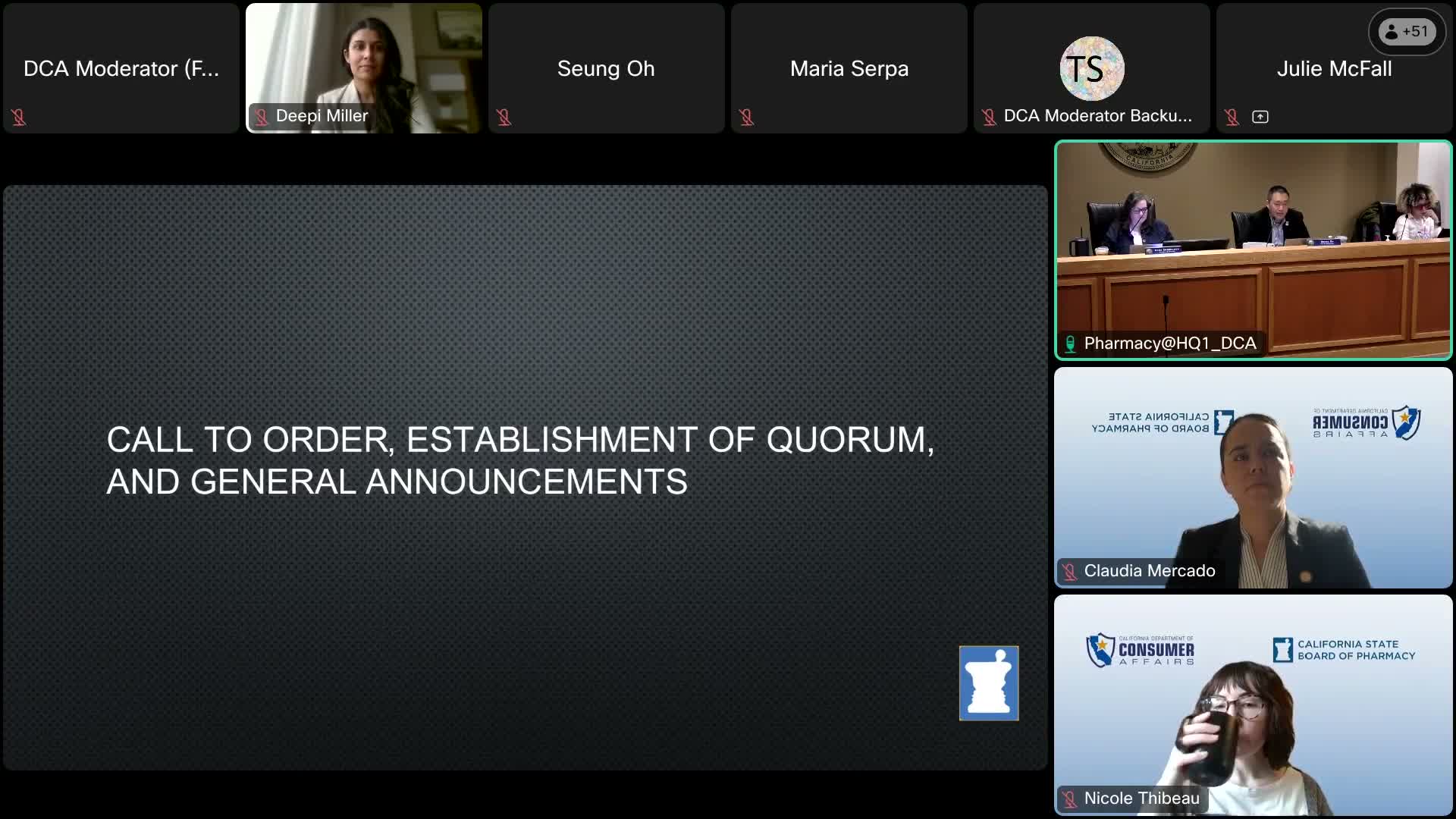
The California State Board of Pharmacy voted April 30 to initiate formal rulemaking to amend California Code of Regulations, title 16, section 17.11, the board said, advancing a package that would clarify quality‑assurance program requirements for pharmacies across the state.
Board chair Maria Serpa presented committee‑recommended language to require pharmacies to define quality‑assurance policies that include both individual and aggregate medication‑error analysis. Members spent extensive time debating whether facilities operating under common ownership should be allowed to meet the rule’s requirements through joint, aggregated reviews rather than individual pharmacy reports.
Several members said documentation and communication processes should remain flexible and determined in each site’s policies and procedures. Legal staff explained the board’s current practice: licensed automated drug delivery systems that cause specified errors must be reported to the board within 30 days, while reporting for unlicensed devices is collected during license renewal and triaged by staff to determine whether an investigation is needed.
Industry commenters urged narrower reporting and protections for patient‑safety data. Sarah Polamu of the California Retailers Association and the California Community Pharmacy Coalition told the board that the proposed subsection giving the board access to both individual and aggregate medication‑error reports could force pharmacies and patient‑safety organizations to duplicate work and could undermine federal PSO protections. “Enforcing pharmacists to sign in to KAMER will create unnecessary fear around reporting, which will negatively impact patient safety,” she said.
Supporters countered that access to reliable, aggregated information helps the board identify systemic risks. After amendments were proposed to clarify the language and to task the chair to work with staff on distinctions — including separating language that applies to contracting from language that applies to joint ownership — the motion to begin the formal rulemaking process passed. Vice president Jesse Crowley voted no; all other voting members present voted yes.
The motion authorizes staff to submit the text to the Director of the Department of Consumer Affairs and the Business, Consumer Services and Housing Agency for review, permits technical edits, and allows the executive officer to complete the rulemaking if no adverse comments or hearing requests are received during the 45‑day public comment period. The board said it expects a robust comment period and further revisions before any final regulation is adopted.
What happens next: staff will post the regulation package for public comment; members said they expect multiple rounds of revision and public feedback before any final adoption.
Note on attribution: quotes and attributions in this article come from speakers who self‑identified or were introduced in the meeting record, including Chair Maria Serpa and public commenter Sarah Polamu.
Board chair Maria Serpa presented committee‑recommended language to require pharmacies to define quality‑assurance policies that include both individual and aggregate medication‑error analysis. Members spent extensive time debating whether facilities operating under common ownership should be allowed to meet the rule’s requirements through joint, aggregated reviews rather than individual pharmacy reports.
Several members said documentation and communication processes should remain flexible and determined in each site’s policies and procedures. Legal staff explained the board’s current practice: licensed automated drug delivery systems that cause specified errors must be reported to the board within 30 days, while reporting for unlicensed devices is collected during license renewal and triaged by staff to determine whether an investigation is needed.
Industry commenters urged narrower reporting and protections for patient‑safety data. Sarah Polamu of the California Retailers Association and the California Community Pharmacy Coalition told the board that the proposed subsection giving the board access to both individual and aggregate medication‑error reports could force pharmacies and patient‑safety organizations to duplicate work and could undermine federal PSO protections. “Enforcing pharmacists to sign in to KAMER will create unnecessary fear around reporting, which will negatively impact patient safety,” she said.
Supporters countered that access to reliable, aggregated information helps the board identify systemic risks. After amendments were proposed to clarify the language and to task the chair to work with staff on distinctions — including separating language that applies to contracting from language that applies to joint ownership — the motion to begin the formal rulemaking process passed. Vice president Jesse Crowley voted no; all other voting members present voted yes.
The motion authorizes staff to submit the text to the Director of the Department of Consumer Affairs and the Business, Consumer Services and Housing Agency for review, permits technical edits, and allows the executive officer to complete the rulemaking if no adverse comments or hearing requests are received during the 45‑day public comment period. The board said it expects a robust comment period and further revisions before any final regulation is adopted.
What happens next: staff will post the regulation package for public comment; members said they expect multiple rounds of revision and public feedback before any final adoption.
Note on attribution: quotes and attributions in this article come from speakers who self‑identified or were introduced in the meeting record, including Chair Maria Serpa and public commenter Sarah Polamu.
Don't Miss a Word: See the Full Meeting!
Go beyond summaries. Unlock every video, transcript, and key insight with a Founder Membership.
✓
Get instant access to full meeting videos
✓
Search and clip any phrase from complete transcripts
✓
Receive AI-powered summaries & custom alerts
✓
Enjoy lifetime, unrestricted access to government data
30-day money-back guarantee
