Experts tell Delaware task force SMRs face long timelines, high costs and licensing hurdles; options include nuclear credits and site readiness
May 04, 2026 | 2026 Legislature DE, Legislative, Delaware
This article was created by AI summarizing key points discussed. AI makes mistakes, so for full details and context, please refer to the video of the full meeting. Please report any errors so we can fix them. Report an error »
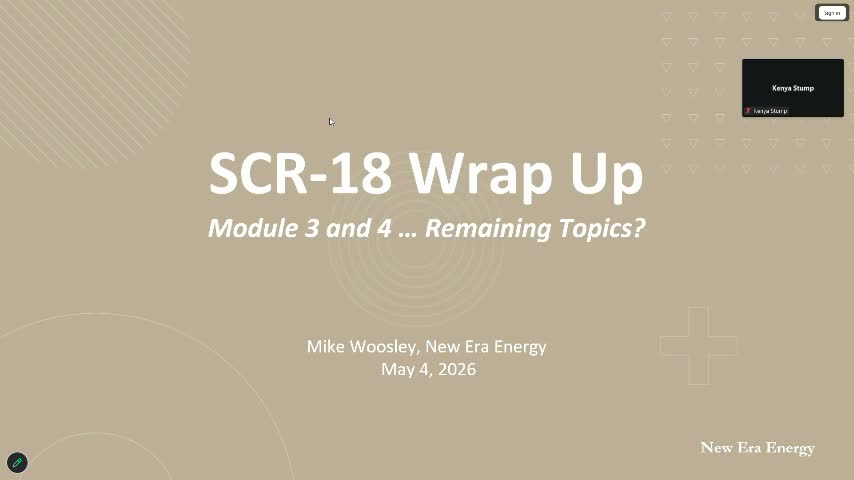
Two outside experts, Dr. Mike Woosley and Professor Allison McFarlane (former NRC chair), gave technical and economic briefings that emphasized both opportunities and constraints for small modular reactors (SMRs).
Woosley summarized federal requirements and timelines: NRC licensing pathways include 10 CFR Part 50 (traditional plants), Part 52 (combined construction and operating license), and the recently effective Part 53 intended to be technology‑neutral for advanced reactors. He said the NRC often performs the environmental review and estimated about six months to prepare an application and up to 18 months for NRC review in accelerated scenarios, but advised planning roughly two years for permitting and 50–60 months for construction of a conventional project. "For sites that already have power... generally they may not need an environmental impact statement; they may need an environmental assessment," Woosley said, noting the NRC performs the EIS for license applications.
Woosley and others discussed market and policy tools. He described renewable portfolio structures and existing "nuclear energy credit" programs in states such as New York and Illinois, explained how credits are often sized using a social‑cost‑of‑carbon adder, and proposed making nuclear credits fungible with renewable energy credits to simplify market treatment and help Delaware meet RPS targets. He also noted federal production and investment tax credits exist but many require construction starts by 2028, a tight window for new projects.
Professor Allison McFarlane cautioned that SMRs are largely unproven at commercial scale and that economies of scale still favor large reactors. "There's a reason that we only have large reactors in all countries in the world, and that is simply an economy‑of‑scale reason," she said, adding that early cost estimates for modular projects have often risen considerably once construction and supply‑chain issues manifest. She also warned that some SMR types could increase intermediate‑level waste volumes or produce challenging waste streams.
Both presenters emphasized practical state actions: identify and screen potential sites, invest in workforce training, structure utility–developer partnerships, and consider market signals or credit mechanisms to make projects financeable.
Why it matters: The briefings framed SMRs as a possible tool for longer‑term decarbonization and resilience but not a quick fix. Delaware faces tradeoffs: rapid near‑term needs favor deployable renewables and storage, while SMRs — if pursued — require early site readiness, planned workforce development and careful financial structures to limit ratepayer exposure.
What’s next: Task Force members asked staff to follow up on floodplain guidance and transmission constraints and to circulate referenced reports and slides.
Woosley summarized federal requirements and timelines: NRC licensing pathways include 10 CFR Part 50 (traditional plants), Part 52 (combined construction and operating license), and the recently effective Part 53 intended to be technology‑neutral for advanced reactors. He said the NRC often performs the environmental review and estimated about six months to prepare an application and up to 18 months for NRC review in accelerated scenarios, but advised planning roughly two years for permitting and 50–60 months for construction of a conventional project. "For sites that already have power... generally they may not need an environmental impact statement; they may need an environmental assessment," Woosley said, noting the NRC performs the EIS for license applications.
Woosley and others discussed market and policy tools. He described renewable portfolio structures and existing "nuclear energy credit" programs in states such as New York and Illinois, explained how credits are often sized using a social‑cost‑of‑carbon adder, and proposed making nuclear credits fungible with renewable energy credits to simplify market treatment and help Delaware meet RPS targets. He also noted federal production and investment tax credits exist but many require construction starts by 2028, a tight window for new projects.
Professor Allison McFarlane cautioned that SMRs are largely unproven at commercial scale and that economies of scale still favor large reactors. "There's a reason that we only have large reactors in all countries in the world, and that is simply an economy‑of‑scale reason," she said, adding that early cost estimates for modular projects have often risen considerably once construction and supply‑chain issues manifest. She also warned that some SMR types could increase intermediate‑level waste volumes or produce challenging waste streams.
Both presenters emphasized practical state actions: identify and screen potential sites, invest in workforce training, structure utility–developer partnerships, and consider market signals or credit mechanisms to make projects financeable.
Why it matters: The briefings framed SMRs as a possible tool for longer‑term decarbonization and resilience but not a quick fix. Delaware faces tradeoffs: rapid near‑term needs favor deployable renewables and storage, while SMRs — if pursued — require early site readiness, planned workforce development and careful financial structures to limit ratepayer exposure.
What’s next: Task Force members asked staff to follow up on floodplain guidance and transmission constraints and to circulate referenced reports and slides.
Don't Miss a Word: See the Full Meeting!
Go beyond summaries. Unlock every video, transcript, and key insight with a Founder Membership.
✓
Get instant access to full meeting videos
✓
Search and clip any phrase from complete transcripts
✓
Receive AI-powered summaries & custom alerts
✓
Enjoy lifetime, unrestricted access to government data
30-day money-back guarantee
