Robin Holmes urges Special School District families to build autonomy through leisure activities
May 04, 2026 | SPECL. SCH. DST. ST. LOUIS CO., School Districts, Missouri
This article was created by AI summarizing key points discussed. AI makes mistakes, so for full details and context, please refer to the video of the full meeting. Please report any errors so we can fix them. Report an error »
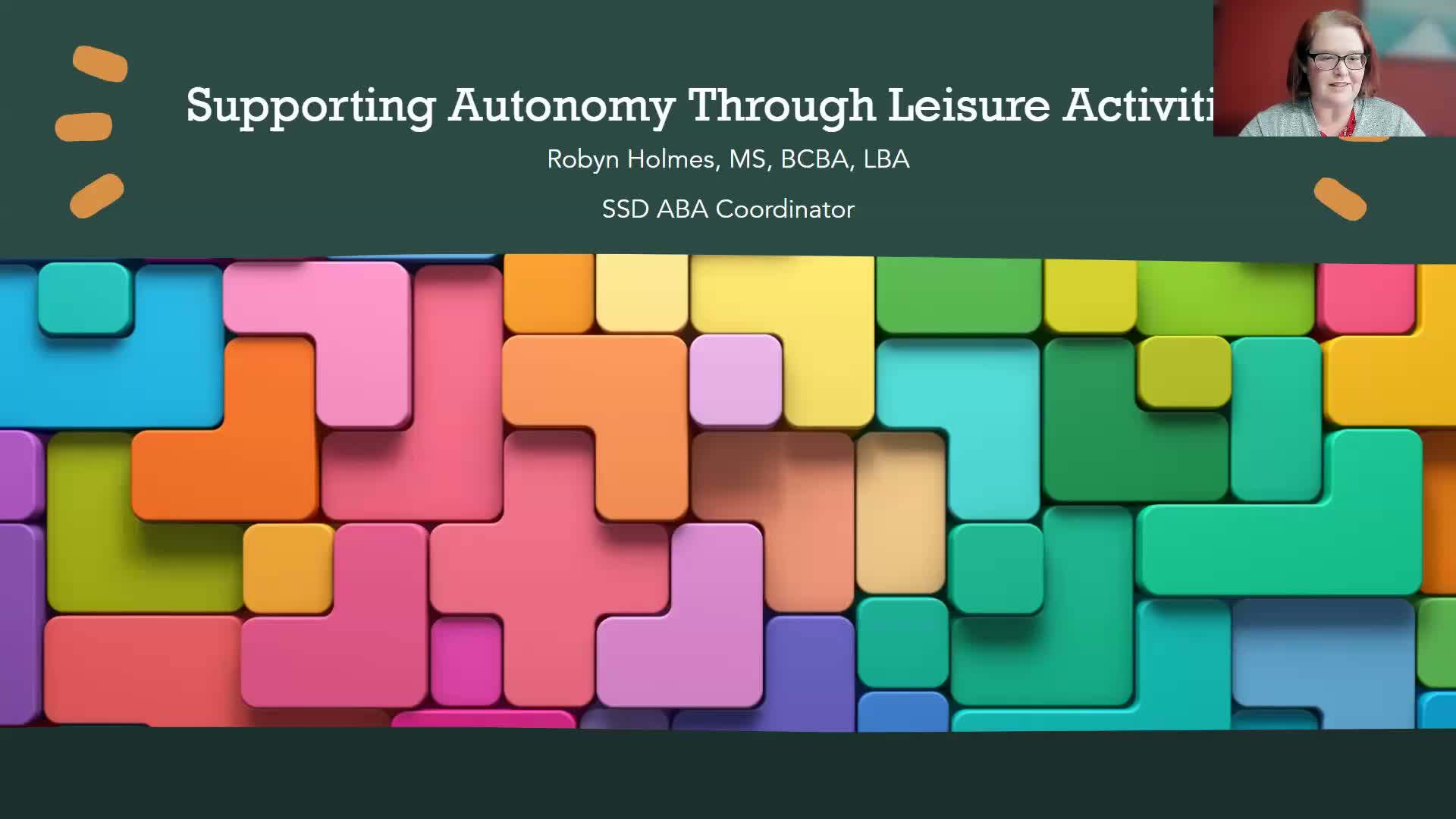
Robin Holmes, an applied behavior analysis coordinator with the Special School District, told a Family and Community Engagement (FACE) webinar that teaching leisure skills can give students meaningful choice and help them develop autonomy.
"Autonomy refers to having that agency and choice," Holmes said, distinguishing autonomy from mere independence. "You can do something independently, but did you have a say in what that would be?" She argued autonomy can be supported at any level of assistance and, when paired with leisure skills, can improve motivation, satisfaction and students' quality of life.
Holmes described leisure skills as hobbies and activities—reading, crafts, music, games, sports and community events—that students can pursue during downtime. She said those activities are a low-stakes way for families and school teams to practice choice, teach social and cognitive skills, and provide safe, self-directed time for students who otherwise struggle with unstructured periods.
To select activities, Holmes recommended starting with familiar family resources and accessible community options: libraries that loan instruments, neighborhood parks, local clubs, and portable activities families can take across settings. She advised observing what a child already enjoys and then expanding that interest into deeper opportunities (for example, moving from looking at family photos to a photography class or from a favorite TV character to character-based crafts and games).
On teaching methods, Holmes advised breaking skills into small, teachable components ("If you want to play a board game, first practice rolling dice"), using interviews or published tools such as the reinforcer assessment for individuals with severe disabilities to gauge preferences, and trying video modeling or demonstrations to build interest. She said repeated trials are normal when testing new activities: "I don't necessarily expect the first time I try something with my daughter that she's just gonna love it."
Holmes emphasized communication and choice-making supports so students can express likes and dislikes using speech, augmentative devices or sign language. She recommended visual choice boards and accommodations—adapted equipment, modified materials, or shorter versions of activities—when needed, and encouraged celebrating small progress as students discover new interests.
Jessica, a FACE ambassador who hosted the webinar, closed the session with announcements of upcoming FACE events: a lunch-and-learn with Epworth Children and Family Services on Tuesday, May 5, 2026, from 11:30 a.m. to noon; a virtual SSD open house on Tuesday, May 12, 2026, at 9:30 a.m.; and hub huddles on Friday, May 15, 2026, at North Tech High School in Florissant. FACE provided follow-up contact details in the chat and on its webpage (face@ssdmo.org; phone (314) 989-8460).
Holmes offered to answer chat questions and pointed attendees toward the citations and resources she included in her slides. The webinar concluded with the host thanking Holmes and sharing FACE's newsletter QR code for further engagement.
"Autonomy refers to having that agency and choice," Holmes said, distinguishing autonomy from mere independence. "You can do something independently, but did you have a say in what that would be?" She argued autonomy can be supported at any level of assistance and, when paired with leisure skills, can improve motivation, satisfaction and students' quality of life.
Holmes described leisure skills as hobbies and activities—reading, crafts, music, games, sports and community events—that students can pursue during downtime. She said those activities are a low-stakes way for families and school teams to practice choice, teach social and cognitive skills, and provide safe, self-directed time for students who otherwise struggle with unstructured periods.
To select activities, Holmes recommended starting with familiar family resources and accessible community options: libraries that loan instruments, neighborhood parks, local clubs, and portable activities families can take across settings. She advised observing what a child already enjoys and then expanding that interest into deeper opportunities (for example, moving from looking at family photos to a photography class or from a favorite TV character to character-based crafts and games).
On teaching methods, Holmes advised breaking skills into small, teachable components ("If you want to play a board game, first practice rolling dice"), using interviews or published tools such as the reinforcer assessment for individuals with severe disabilities to gauge preferences, and trying video modeling or demonstrations to build interest. She said repeated trials are normal when testing new activities: "I don't necessarily expect the first time I try something with my daughter that she's just gonna love it."
Holmes emphasized communication and choice-making supports so students can express likes and dislikes using speech, augmentative devices or sign language. She recommended visual choice boards and accommodations—adapted equipment, modified materials, or shorter versions of activities—when needed, and encouraged celebrating small progress as students discover new interests.
Jessica, a FACE ambassador who hosted the webinar, closed the session with announcements of upcoming FACE events: a lunch-and-learn with Epworth Children and Family Services on Tuesday, May 5, 2026, from 11:30 a.m. to noon; a virtual SSD open house on Tuesday, May 12, 2026, at 9:30 a.m.; and hub huddles on Friday, May 15, 2026, at North Tech High School in Florissant. FACE provided follow-up contact details in the chat and on its webpage (face@ssdmo.org; phone (314) 989-8460).
Holmes offered to answer chat questions and pointed attendees toward the citations and resources she included in her slides. The webinar concluded with the host thanking Holmes and sharing FACE's newsletter QR code for further engagement.
View the Full Meeting & All Its Details
This article offers just a summary. Unlock complete video, transcripts, and insights as a Founder Member.
✓
Watch full, unedited meeting videos
✓
Search every word spoken in unlimited transcripts
✓
AI summaries & real-time alerts (all government levels)
✓
Permanent access to expanding government content
30-day money-back guarantee
