Assembly passes bill expanding inspector general authority for high‑speed rail after heated debate
May 04, 2026 | California State Assembly, House, Legislative, California
This article was created by AI summarizing key points discussed. AI makes mistakes, so for full details and context, please refer to the video of the full meeting. Please report any errors so we can fix them. Report an error »
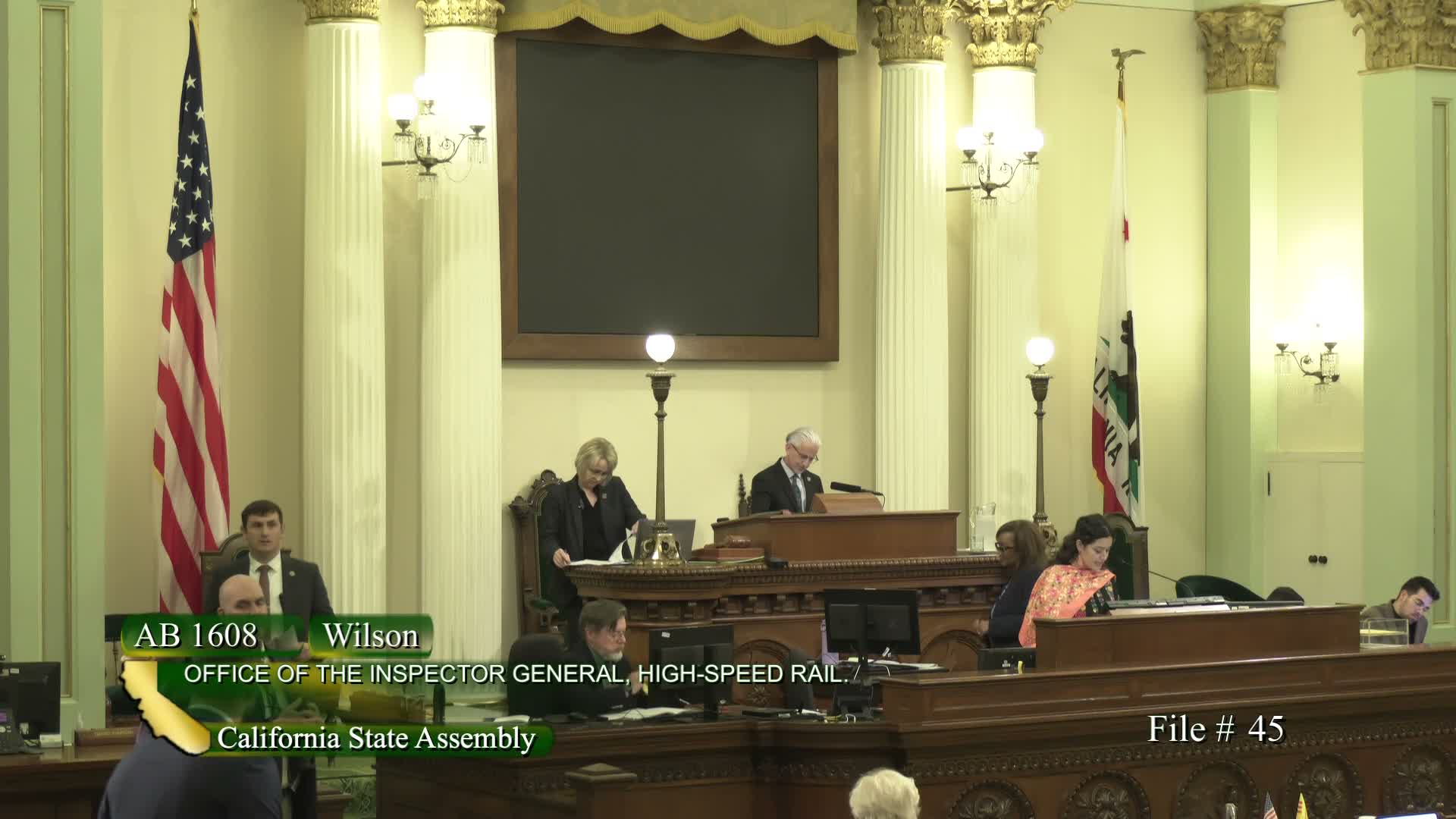
The California State Assembly on April 28 passed AB 16 08, a bill to strengthen the Office of Inspector General for the California High‑Speed Rail project by permitting new position classifications and allowing the inspector general to temporarily keep portions of some reports confidential under narrowly defined circumstances. The measure passed on a 45–18 roll call.
Assemblymember Wilson, the bill’s sponsor, said the legislation "requires the inspector general to make its reports public," and argued the measure would improve oversight by giving the inspector general the staffing and procurement tools needed to complete timely audits and investigations. Wilson told colleagues that her office and the inspector general had worked with the First Amendment Coalition to balance public disclosure with safety and whistleblower protections.
Opponents, including Assemblymember De Maio and Assemblymember Dixon, pressed that portions of the bill allow information to be kept confidential and that the statute could be used to hide weaknesses or fiscal mismanagement. Assemblymember Dixon argued, "If the state is spending billions upon billions of taxpayer dollars on a project that is significantly behind schedule, I think the taxpayers are entitled to know how their money is being spent." Assemblymember De Maio said the measure "allows secrets" and urged colleagues to oppose the bill.
Other members disputed those characterizations on the floor. Assemblymember Carrillo and Assemblymember Jackson said the intent of the bill is to provide needed resources and to publish inspector general reports except for narrowly defined material that could pose security risks; supporters noted the measure requires periodic review and justification for any confidentiality. Several members emphasized the bill’s purpose was to ensure the independent inspector general had adequate staffing and authority to hold the project accountable.
After extended debate the clerk closed the roll and recorded Ayes 45, Noes 18. The measure passed the Assembly; the clerk recorded the vote and the bill will proceed following legislative order for further steps in the process.
Assemblymember Wilson, the bill’s sponsor, said the legislation "requires the inspector general to make its reports public," and argued the measure would improve oversight by giving the inspector general the staffing and procurement tools needed to complete timely audits and investigations. Wilson told colleagues that her office and the inspector general had worked with the First Amendment Coalition to balance public disclosure with safety and whistleblower protections.
Opponents, including Assemblymember De Maio and Assemblymember Dixon, pressed that portions of the bill allow information to be kept confidential and that the statute could be used to hide weaknesses or fiscal mismanagement. Assemblymember Dixon argued, "If the state is spending billions upon billions of taxpayer dollars on a project that is significantly behind schedule, I think the taxpayers are entitled to know how their money is being spent." Assemblymember De Maio said the measure "allows secrets" and urged colleagues to oppose the bill.
Other members disputed those characterizations on the floor. Assemblymember Carrillo and Assemblymember Jackson said the intent of the bill is to provide needed resources and to publish inspector general reports except for narrowly defined material that could pose security risks; supporters noted the measure requires periodic review and justification for any confidentiality. Several members emphasized the bill’s purpose was to ensure the independent inspector general had adequate staffing and authority to hold the project accountable.
After extended debate the clerk closed the roll and recorded Ayes 45, Noes 18. The measure passed the Assembly; the clerk recorded the vote and the bill will proceed following legislative order for further steps in the process.
View the Full Meeting & All Its Details
This article offers just a summary. Unlock complete video, transcripts, and insights as a Founder Member.
✓
Watch full, unedited meeting videos
✓
Search every word spoken in unlimited transcripts
✓
AI summaries & real-time alerts (all government levels)
✓
Permanent access to expanding government content
30-day money-back guarantee
