Barstow Unified outlines culturally responsive PBIS framework and asks parents to help reinforce expectations
May 03, 2026 | Barstow Unified, School Districts, California
This article was created by AI summarizing key points discussed. AI makes mistakes, so for full details and context, please refer to the video of the full meeting. Please report any errors so we can fix them. Report an error »
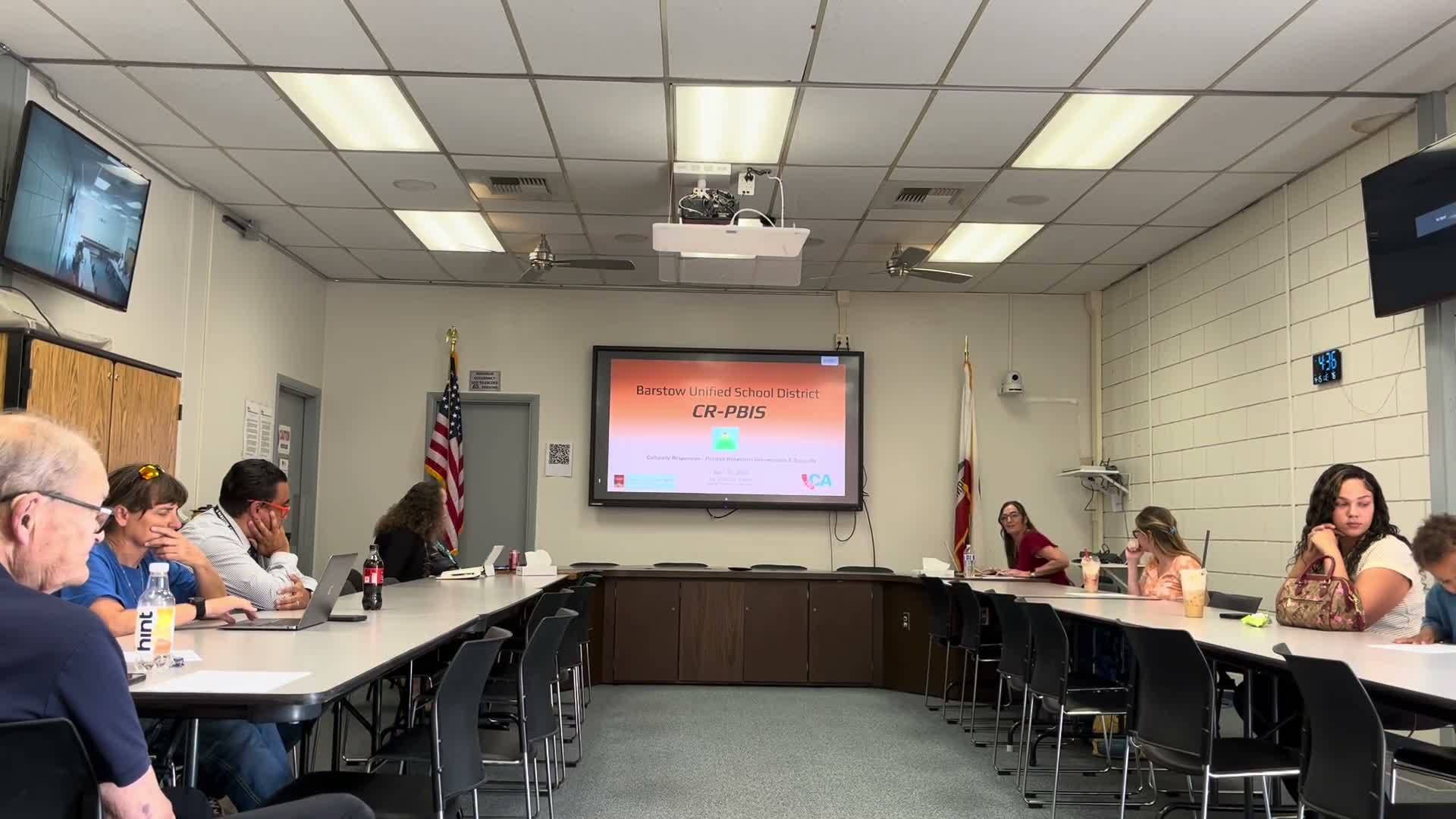
Superintendent Diane Spernjic opened a parent alliance meeting by introducing district staff and invited parents to take part in district work on behavior supports.
Shanda Barela, the district s CR PBIS external coach, said CRPBIS is a framework, not a program designed to create safe, supportive and inclusive school environments. "CRPBIS stands for culturally responsive positive behavioral interventions and supports. It's not a program; it's a framework," Barela said.
Barela described the approach as a three-tiered system: a universal tier that sets schoolwide expectations for all students, a targeted tier for groups needing extra support, and an intensive tier for a few students needing individualized interventions. She described tools used across the district s 12 school sites: expectation matrices that list behaviors by location, acknowledgement systems (she cited a site s breakthrough card ), monthly data teams, lesson plans for teaching expectations and a consistent behavior flowchart to guide staff responses.
The district uses a Tiered Fidelity Inventory (TFI) as a self-assessment tool to monitor implementation. Barela said the TFI and monthly data reviews help teams identify trends (the who, what, when and where of behaviors) and shape action plans such as retraining staff, adjusting procedures or adding monitors where needed.
Superintendent Spernjic and other staff emphasized that CRPBIS works best when families reinforce expectations at home. Spernjic encouraged parents to complete district surveys and join school teams, such as PBIS site teams or ELAC, to ensure family voice is included. She also noted the district posts a complaint/feedback QR code on its website and distributes contact information for follow-up.
The district said implementation will continue with coaching, data-driven reviews and parent outreach; staff offered to provide the presentation materials on request and to meet individually with parents who raised concerns.
Shanda Barela, the district s CR PBIS external coach, said CRPBIS is a framework, not a program designed to create safe, supportive and inclusive school environments. "CRPBIS stands for culturally responsive positive behavioral interventions and supports. It's not a program; it's a framework," Barela said.
Barela described the approach as a three-tiered system: a universal tier that sets schoolwide expectations for all students, a targeted tier for groups needing extra support, and an intensive tier for a few students needing individualized interventions. She described tools used across the district s 12 school sites: expectation matrices that list behaviors by location, acknowledgement systems (she cited a site s breakthrough card ), monthly data teams, lesson plans for teaching expectations and a consistent behavior flowchart to guide staff responses.
The district uses a Tiered Fidelity Inventory (TFI) as a self-assessment tool to monitor implementation. Barela said the TFI and monthly data reviews help teams identify trends (the who, what, when and where of behaviors) and shape action plans such as retraining staff, adjusting procedures or adding monitors where needed.
Superintendent Spernjic and other staff emphasized that CRPBIS works best when families reinforce expectations at home. Spernjic encouraged parents to complete district surveys and join school teams, such as PBIS site teams or ELAC, to ensure family voice is included. She also noted the district posts a complaint/feedback QR code on its website and distributes contact information for follow-up.
The district said implementation will continue with coaching, data-driven reviews and parent outreach; staff offered to provide the presentation materials on request and to meet individually with parents who raised concerns.
Don't Miss a Word: See the Full Meeting!
Go beyond summaries. Unlock every video, transcript, and key insight with a Founder Membership.
✓
Get instant access to full meeting videos
✓
Search and clip any phrase from complete transcripts
✓
Receive AI-powered summaries & custom alerts
✓
Enjoy lifetime, unrestricted access to government data
30-day money-back guarantee
