Panel updates CEIC and Career Education Master Plan; agencies point to data integration (C2C, eTranscript)
May 05, 2026 | California State Assembly, House, Legislative, California
This article was created by AI summarizing key points discussed. AI makes mistakes, so for full details and context, please refer to the video of the full meeting. Please report any errors so we can fix them. Report an error »
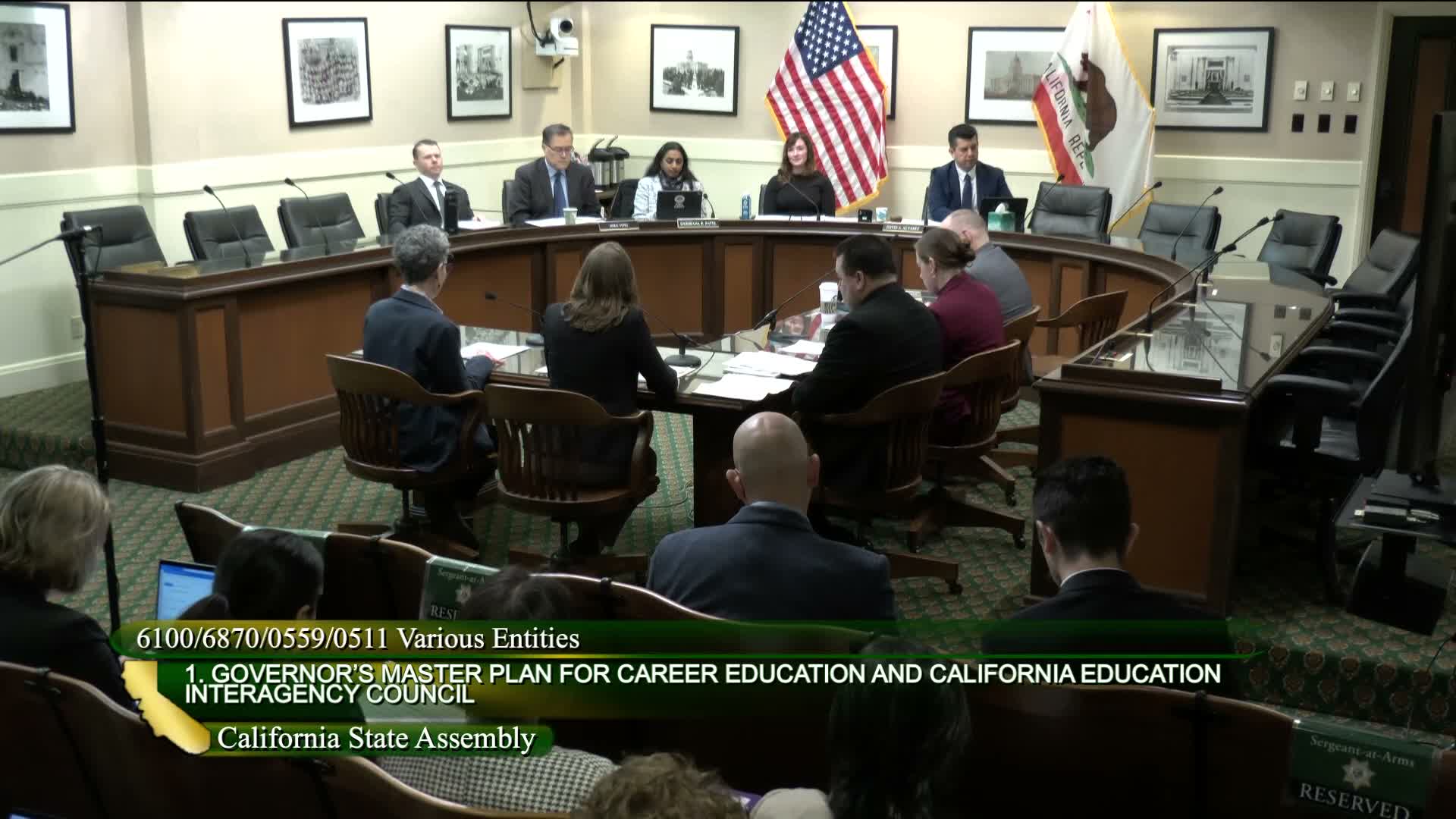
State agencies told the subcommittee they are building tools and governance to connect TK‑12, higher education and workforce data and to operationalize the Career Education Master Plan.
Maryann Bates, executive director of the California Cradle to Career Data System, said C2C added more than 150 workforce data elements and now ingests data from 16 providers across TK‑12, higher education, workforce and social services. "By adding over 150 new workforce data elements to C2C, the state can better understand outcomes, pathways, and earnings for job training programs," she said, and added that a secure data enclave will allow vetted research access while keeping identifiable data protected.
Chancellor's Office officials described eTranscript California (noting $12,000,000 allocated to support development of eTranscript 2) and a separate $25,000,000 career passport initiative intended to allow employers and colleges to recognize skills earned through apprenticeships, military service, prior learning and noncredit programs. The Chancellor's Office emphasized that the career passport and eTranscript procurements must integrate to avoid siloed technology systems.
Justin Howard from the Government Operations Agency summarized the startup of the California Education Interagency Council (CEIC), funded at $1,500,000 in the budget to stand up an executive office and staff. He said the council has hired an executive officer who "started officially yesterday" and that the statute requires a strategic plan to be completed by November, with the council convening its first meeting by June in accordance with statute.
Members asked how the CEIC will set near‑term outcomes; DOF said its role is administrative and the council and executive officer will develop the strategic plan and work plan with Assembly and Senate education committees. Agencies said the interagency work will aim to reduce data silos and better connect workforce outcomes to student pathways.
Maryann Bates, executive director of the California Cradle to Career Data System, said C2C added more than 150 workforce data elements and now ingests data from 16 providers across TK‑12, higher education, workforce and social services. "By adding over 150 new workforce data elements to C2C, the state can better understand outcomes, pathways, and earnings for job training programs," she said, and added that a secure data enclave will allow vetted research access while keeping identifiable data protected.
Chancellor's Office officials described eTranscript California (noting $12,000,000 allocated to support development of eTranscript 2) and a separate $25,000,000 career passport initiative intended to allow employers and colleges to recognize skills earned through apprenticeships, military service, prior learning and noncredit programs. The Chancellor's Office emphasized that the career passport and eTranscript procurements must integrate to avoid siloed technology systems.
Justin Howard from the Government Operations Agency summarized the startup of the California Education Interagency Council (CEIC), funded at $1,500,000 in the budget to stand up an executive office and staff. He said the council has hired an executive officer who "started officially yesterday" and that the statute requires a strategic plan to be completed by November, with the council convening its first meeting by June in accordance with statute.
Members asked how the CEIC will set near‑term outcomes; DOF said its role is administrative and the council and executive officer will develop the strategic plan and work plan with Assembly and Senate education committees. Agencies said the interagency work will aim to reduce data silos and better connect workforce outcomes to student pathways.
View the Full Meeting & All Its Details
This article offers just a summary. Unlock complete video, transcripts, and insights as a Founder Member.
✓
Watch full, unedited meeting videos
✓
Search every word spoken in unlimited transcripts
✓
AI summaries & real-time alerts (all government levels)
✓
Permanent access to expanding government content
30-day money-back guarantee
