Senate confirms six CDCR leaders and clears bills on AI, refunds and detention commissary limits
May 04, 2026 | California State Senate, Senate, Legislative, California
This article was created by AI summarizing key points discussed. AI makes mistakes, so for full details and context, please refer to the video of the full meeting. Please report any errors so we can fix them. Report an error »
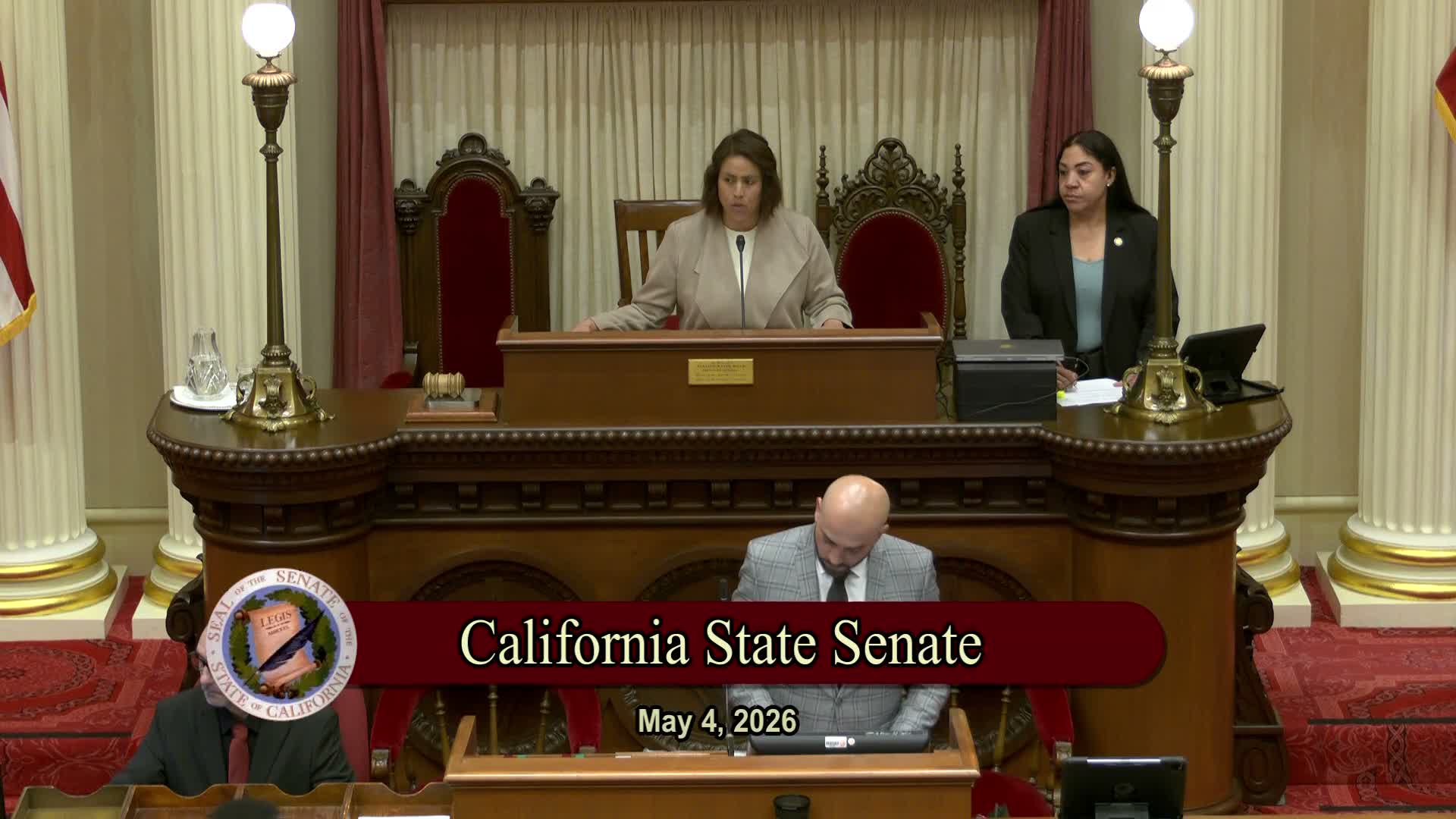
The California State Senate on May 4 confirmed six Department of Corrections and Rehabilitation appointees and approved a series of bills that senators said update rules for modern technology, consumer refunds and detention facility practices.
Senator Grove (file items 3–7) led consideration of five appointment files covering six nominees: Kathleen Ratliff and Joseph Tuggle (file item 3); Jason Johnson (file item 4); Madeline MacLean (file item 5); Brian Bishop (file item 6); and Sarah Larson (file item 7). The Senate recorded approvals on each item; for example, the first set of confirmations was recorded as 40 ayes and 0 noes. Senator Grove registered a procedural protest on the block but asked members to vote their conscience, saying, "I take up all of these file items in protest." The presiding officer announced each appointment was confirmed after roll‑call votes.
The Senate then moved through a cluster of bills on the daily file. Senator Cabaldon, author of SB 1159, told colleagues the bill "simply declares that for purposes of the Bagley‑Keene Act, the Bagley‑Keene Act, the Public Records Act, and other critical opportunities for members of the public to be able to participate ... that artificial intelligence agents are not themselves human." Sponsors said the measure is intended to preserve the integrity of public comment and prevent AI agents from being treated as persons under those statutes. The measure passed on a recorded vote (recorded as "ayes 37, no 0" in routine roll call language).
Other bills passed during third reading with little floor debate. Highlights included SB 1416, which shortens the timeframe for physicians or dentists to refund duplicate consumer payments from 30 to 21 days (adopted unanimously); SB 1273, which adjusts a limited element of tied‑house advertising rules for wineries and vintners and was adopted on a unanimous roll call; and SB 1099, which limits commissary markups in private detention facilities to no more than a 35% markup above vendor cost and was presented as mirroring a prior framework for state facilities.
Votes at a glance: SB 1159 (Cabaldon) — passed (recorded ayes 37, no 0); SB 1416 (Wahab) — passed (ayes 39, nos 0); SB 1273 (Cabaldon) — passed (unanimous); SB 1099 (Padilla) — passed (unanimous). Detailed tallies are recorded in the Senate roll calls.
What happens next: Appointees will assume their departmental duties per executive branch timing and agency needs; bills approved on third reading will move forward according to legislative process and enrolled copy procedures. The Senate adjourned until May 7, 2026.
Senator Grove (file items 3–7) led consideration of five appointment files covering six nominees: Kathleen Ratliff and Joseph Tuggle (file item 3); Jason Johnson (file item 4); Madeline MacLean (file item 5); Brian Bishop (file item 6); and Sarah Larson (file item 7). The Senate recorded approvals on each item; for example, the first set of confirmations was recorded as 40 ayes and 0 noes. Senator Grove registered a procedural protest on the block but asked members to vote their conscience, saying, "I take up all of these file items in protest." The presiding officer announced each appointment was confirmed after roll‑call votes.
The Senate then moved through a cluster of bills on the daily file. Senator Cabaldon, author of SB 1159, told colleagues the bill "simply declares that for purposes of the Bagley‑Keene Act, the Bagley‑Keene Act, the Public Records Act, and other critical opportunities for members of the public to be able to participate ... that artificial intelligence agents are not themselves human." Sponsors said the measure is intended to preserve the integrity of public comment and prevent AI agents from being treated as persons under those statutes. The measure passed on a recorded vote (recorded as "ayes 37, no 0" in routine roll call language).
Other bills passed during third reading with little floor debate. Highlights included SB 1416, which shortens the timeframe for physicians or dentists to refund duplicate consumer payments from 30 to 21 days (adopted unanimously); SB 1273, which adjusts a limited element of tied‑house advertising rules for wineries and vintners and was adopted on a unanimous roll call; and SB 1099, which limits commissary markups in private detention facilities to no more than a 35% markup above vendor cost and was presented as mirroring a prior framework for state facilities.
Votes at a glance: SB 1159 (Cabaldon) — passed (recorded ayes 37, no 0); SB 1416 (Wahab) — passed (ayes 39, nos 0); SB 1273 (Cabaldon) — passed (unanimous); SB 1099 (Padilla) — passed (unanimous). Detailed tallies are recorded in the Senate roll calls.
What happens next: Appointees will assume their departmental duties per executive branch timing and agency needs; bills approved on third reading will move forward according to legislative process and enrolled copy procedures. The Senate adjourned until May 7, 2026.
View the Full Meeting & All Its Details
This article offers just a summary. Unlock complete video, transcripts, and insights as a Founder Member.
✓
Watch full, unedited meeting videos
✓
Search every word spoken in unlimited transcripts
✓
AI summaries & real-time alerts (all government levels)
✓
Permanent access to expanding government content
30-day money-back guarantee
