County outlines ARPA‑funded wastewater surveillance pilot; staff commit to sustainability discussions
April 27, 2026 | Alameda County, California
This article was created by AI summarizing key points discussed. AI makes mistakes, so for full details and context, please refer to the video of the full meeting. Please report any errors so we can fix them. Report an error »
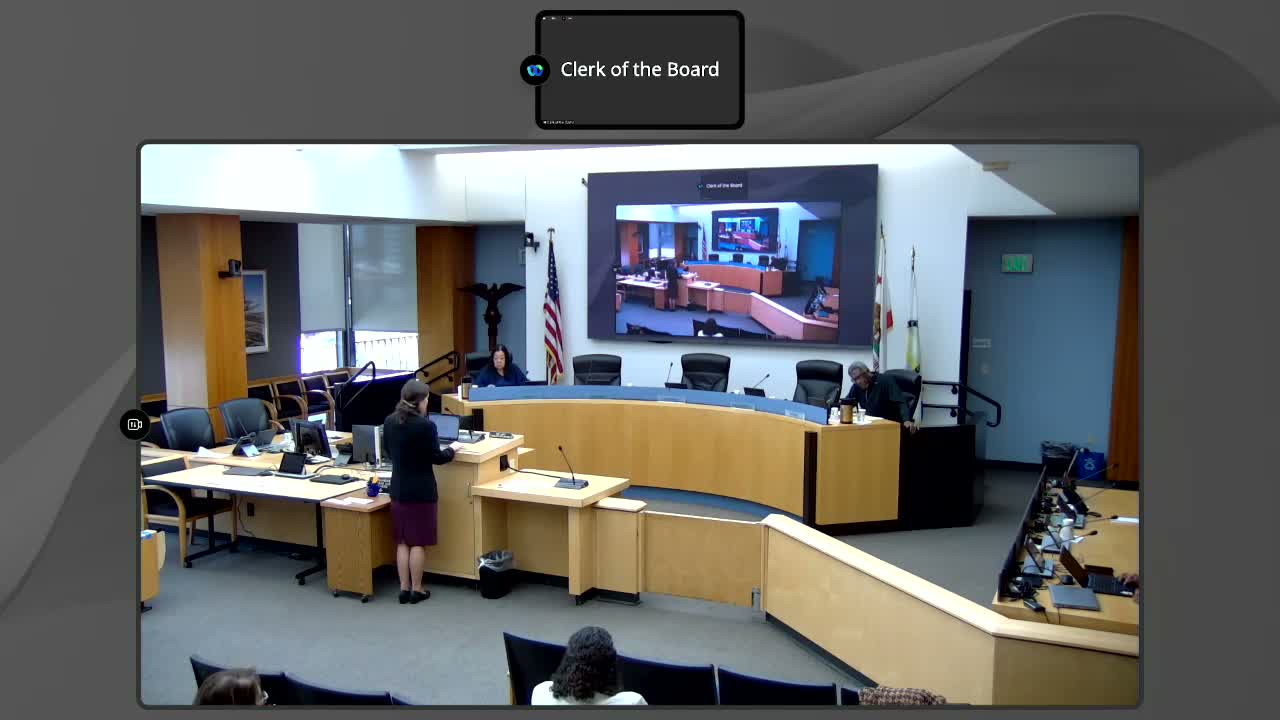
Eileen Dunn of Alameda County Public Health presented the county’s wastewater surveillance pilot, describing a two‑year, ARPA‑funded contract with Verily (budget $750,000) that began in January 2025 and samples selected sewer sheds twice per week. The sampling plan covers community sewer sheds and a facility, including Oro Loma, Hayward, Livermore, East Bay Municipal Utility District subsewersheds, East and West Oakland, and Santa Rita Jail.
Dunn said the pilot’s testing panel includes SARS‑CoV‑2, mpox, influenza A and B, RSV, measles, avian influenza H5 and Candida auris. She reported the sampling represents roughly 950,000 people — more than 50% of the county population — and that results are posted publicly on county, state and CDC dashboards with a roughly four‑day turnaround from sample to result.
She described use cases: wastewater non‑detection reassured investigators during a nearby measles contact investigation; in a neighboring county, persistent wastewater detection prompted testing that uncovered a human measles case; and mpox wastewater non‑detection in Alameda County helped indicate limited spread. Dunn emphasized wastewater data are used in combination with hospitalization, syndromic, and sentinel surveillance to guide communications, provider outreach, targeted vaccination and local interventions.
Supervisors asked technical and sustainability questions. Supervisor Tam recalled prior state‑funded EBMUD participation and asked whether the pilot will be sustained if county funds end; staff said the state continues funding EBMUD through 2027 and the county is exploring options to sustain the local pilot, including continued state requests and Sanitary District engagement. County staff said the public‑health lab currently contracts the specialized laboratory work because building in‑house wastewater capacity would require substantial infrastructure and ongoing commitment.
Supervisors also asked whether wastewater monitoring can be applied to chemical contaminants such as PFAS; staff said they were not aware of routine PFAS wastewater detection in the pilot and would follow up with environmental health colleagues and Dr. Moss about potential testing and county roles on PFAS detection and outreach.
The committee heard no formal action; staff offered to return with updates on sustainability options, lab capacity tradeoffs and any potential expansion of the testing panel.
Dunn said the pilot’s testing panel includes SARS‑CoV‑2, mpox, influenza A and B, RSV, measles, avian influenza H5 and Candida auris. She reported the sampling represents roughly 950,000 people — more than 50% of the county population — and that results are posted publicly on county, state and CDC dashboards with a roughly four‑day turnaround from sample to result.
She described use cases: wastewater non‑detection reassured investigators during a nearby measles contact investigation; in a neighboring county, persistent wastewater detection prompted testing that uncovered a human measles case; and mpox wastewater non‑detection in Alameda County helped indicate limited spread. Dunn emphasized wastewater data are used in combination with hospitalization, syndromic, and sentinel surveillance to guide communications, provider outreach, targeted vaccination and local interventions.
Supervisors asked technical and sustainability questions. Supervisor Tam recalled prior state‑funded EBMUD participation and asked whether the pilot will be sustained if county funds end; staff said the state continues funding EBMUD through 2027 and the county is exploring options to sustain the local pilot, including continued state requests and Sanitary District engagement. County staff said the public‑health lab currently contracts the specialized laboratory work because building in‑house wastewater capacity would require substantial infrastructure and ongoing commitment.
Supervisors also asked whether wastewater monitoring can be applied to chemical contaminants such as PFAS; staff said they were not aware of routine PFAS wastewater detection in the pilot and would follow up with environmental health colleagues and Dr. Moss about potential testing and county roles on PFAS detection and outreach.
The committee heard no formal action; staff offered to return with updates on sustainability options, lab capacity tradeoffs and any potential expansion of the testing panel.
View the Full Meeting & All Its Details
This article offers just a summary. Unlock complete video, transcripts, and insights as a Founder Member.
✓
Watch full, unedited meeting videos
✓
Search every word spoken in unlimited transcripts
✓
AI summaries & real-time alerts (all government levels)
✓
Permanent access to expanding government content
30-day money-back guarantee
