San Mateo council advances historic-preservation package after extended public comment; staffs to scope 1989 survey update
May 05, 2026 | San Mateo City, San Mateo County, California
This article was created by AI summarizing key points discussed. AI makes mistakes, so for full details and context, please refer to the video of the full meeting. Please report any errors so we can fix them. Report an error »
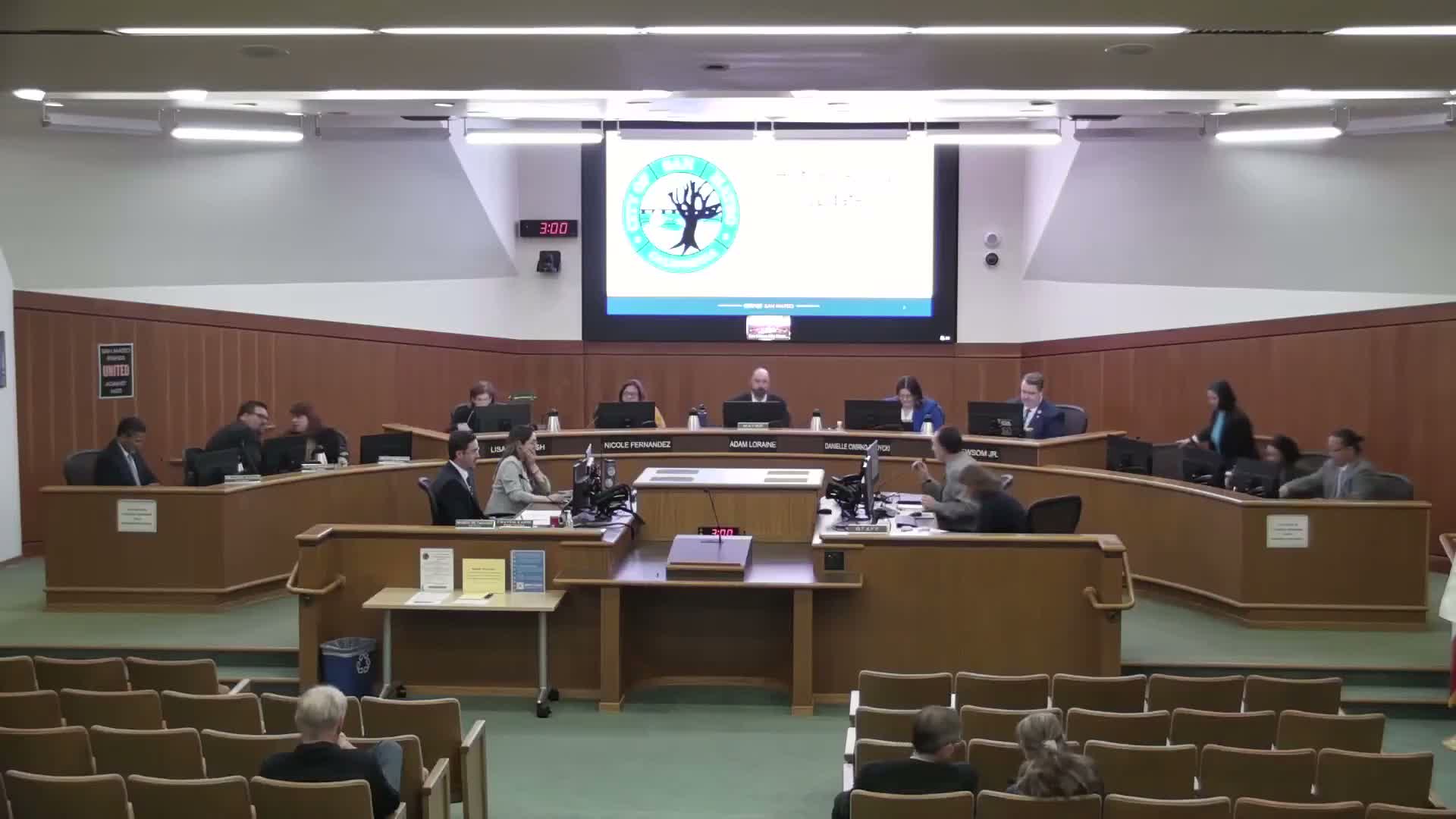
San Mateo City Council spent more than three hours on a proposed historic-preservation package on May 4, hearing passionate public comment and then directing staff to move forward with an updated ordinance and related materials.
The package presented by Community Development Director Zachary Dahl and architectural historian Julianne Murphy includes a new historic-preservation ordinance establishing a local historic-resources inventory and clearer review criteria, a draft historic resources commission, a citywide historic context statement and updates to the city
dministration of the Mills Act program. Dahl said the 1989 building survey remains an important resource but that it is out of date and needs targeted follow-up work.
The public comment period was long and sharply focused. Ashley Zirpa, representing an organized presentation, told the council the draft ordinance "annihilates" local preservation because it limits mandatory review to properties the city formally lists and "removes enforcement" that previously protected eligible resources. Several speakers, including longtime preservation advocates and neighborhood residents, urged the council to incorporate the 1989 survey results into the local inventory or to adopt a clear path for considering those surveyed properties for protection. Young speakers also said preservation matters for future generations: "If those places go away, we can't get them back," said Thomas McCarra, age 10.
Staff responded with a set of practical options. Dahl said the draft already includes a "review required" step for properties over 50 years old that are potentially eligible for designation; that process would trigger planning review and, where appropriate, a historic-resources evaluation. He provided a range estimate to update the 1989 survey: a basic update could cost roughly $50,000–$100,000 and take 6–9 months; full historic-resource evaluations might cost on the order of $3,000 per property. Dahl offered a specific pathway—contained in the materials provided to council—for the council to nominate properties from the 1989 survey for consideration, with owner notification and public hearings.
Council members expressed a mix of priorities: strong support for a clear, citywide context statement and for creating a Historic Resources Commission (five members; council consensus also favored adding two nonvoting youth commissioners and review of the commission's role after four years), while emphasizing owner consent and the need to avoid unintended legal exposure. Several council members asked staff to return with more exact costs, a public-engagement plan and recommended changes to Mills Act implementation and penalties/enforcement.
The council irected staff to:
- Advance the ordinance and context statement package with the planning commission recommendations the council supported;
- Return quickly with a scope and budget for updating the 1989 survey so the council can decide how to fold that work into implementation; and
- Explore changes to the Mills Act program incentives and enforcement and report back on feasible options.
The next procedural step is for staff to incorporate the requested clarifications and to return with firm costs and a recommended schedule for the 1989 survey update and for recruitment and onboarding of the Historic Resources Commission. Council members repeatedly emphasized they wanted an implementation approach that includes owner notification, predictable review pathways and clear outreach to neighborhoods most affected by any potential designations.
What happens next: staff will scope the survey update and return to council with a budget and timetable; staff also plans a public informational workshop to roll out the new program and answer homeowner questions.
The package presented by Community Development Director Zachary Dahl and architectural historian Julianne Murphy includes a new historic-preservation ordinance establishing a local historic-resources inventory and clearer review criteria, a draft historic resources commission, a citywide historic context statement and updates to the city
dministration of the Mills Act program. Dahl said the 1989 building survey remains an important resource but that it is out of date and needs targeted follow-up work.
The public comment period was long and sharply focused. Ashley Zirpa, representing an organized presentation, told the council the draft ordinance "annihilates" local preservation because it limits mandatory review to properties the city formally lists and "removes enforcement" that previously protected eligible resources. Several speakers, including longtime preservation advocates and neighborhood residents, urged the council to incorporate the 1989 survey results into the local inventory or to adopt a clear path for considering those surveyed properties for protection. Young speakers also said preservation matters for future generations: "If those places go away, we can't get them back," said Thomas McCarra, age 10.
Staff responded with a set of practical options. Dahl said the draft already includes a "review required" step for properties over 50 years old that are potentially eligible for designation; that process would trigger planning review and, where appropriate, a historic-resources evaluation. He provided a range estimate to update the 1989 survey: a basic update could cost roughly $50,000–$100,000 and take 6–9 months; full historic-resource evaluations might cost on the order of $3,000 per property. Dahl offered a specific pathway—contained in the materials provided to council—for the council to nominate properties from the 1989 survey for consideration, with owner notification and public hearings.
Council members expressed a mix of priorities: strong support for a clear, citywide context statement and for creating a Historic Resources Commission (five members; council consensus also favored adding two nonvoting youth commissioners and review of the commission's role after four years), while emphasizing owner consent and the need to avoid unintended legal exposure. Several council members asked staff to return with more exact costs, a public-engagement plan and recommended changes to Mills Act implementation and penalties/enforcement.
The council irected staff to:
- Advance the ordinance and context statement package with the planning commission recommendations the council supported;
- Return quickly with a scope and budget for updating the 1989 survey so the council can decide how to fold that work into implementation; and
- Explore changes to the Mills Act program incentives and enforcement and report back on feasible options.
The next procedural step is for staff to incorporate the requested clarifications and to return with firm costs and a recommended schedule for the 1989 survey update and for recruitment and onboarding of the Historic Resources Commission. Council members repeatedly emphasized they wanted an implementation approach that includes owner notification, predictable review pathways and clear outreach to neighborhoods most affected by any potential designations.
What happens next: staff will scope the survey update and return to council with a budget and timetable; staff also plans a public informational workshop to roll out the new program and answer homeowner questions.
View the Full Meeting & All Its Details
This article offers just a summary. Unlock complete video, transcripts, and insights as a Founder Member.
✓
Watch full, unedited meeting videos
✓
Search every word spoken in unlimited transcripts
✓
AI summaries & real-time alerts (all government levels)
✓
Permanent access to expanding government content
30-day money-back guarantee
