Tippecanoe County adopts stricter large‑scale solar ordinance after months of study and public comment
May 05, 2026 | Tippecanoe County, Indiana
This article was created by AI summarizing key points discussed. AI makes mistakes, so for full details and context, please refer to the video of the full meeting. Please report any errors so we can fix them. Report an error »
The Tippecanoe County Board of Commissioners voted 3‑0 on May 4 to adopt Ordinance 2026‑12, a revised large‑scale solar ordinance the board and staff said responds to concerns raised during a moratorium study and several public hearings.
APC staff told the board the moratorium passed last summer was intended to allow a deeper study of the county's solar rules and that a study group, ordinance committee and public hearings resulted in a stricter code. APC forwarded the draft to the board after a 13‑3 vote at the Area Planning Commission.
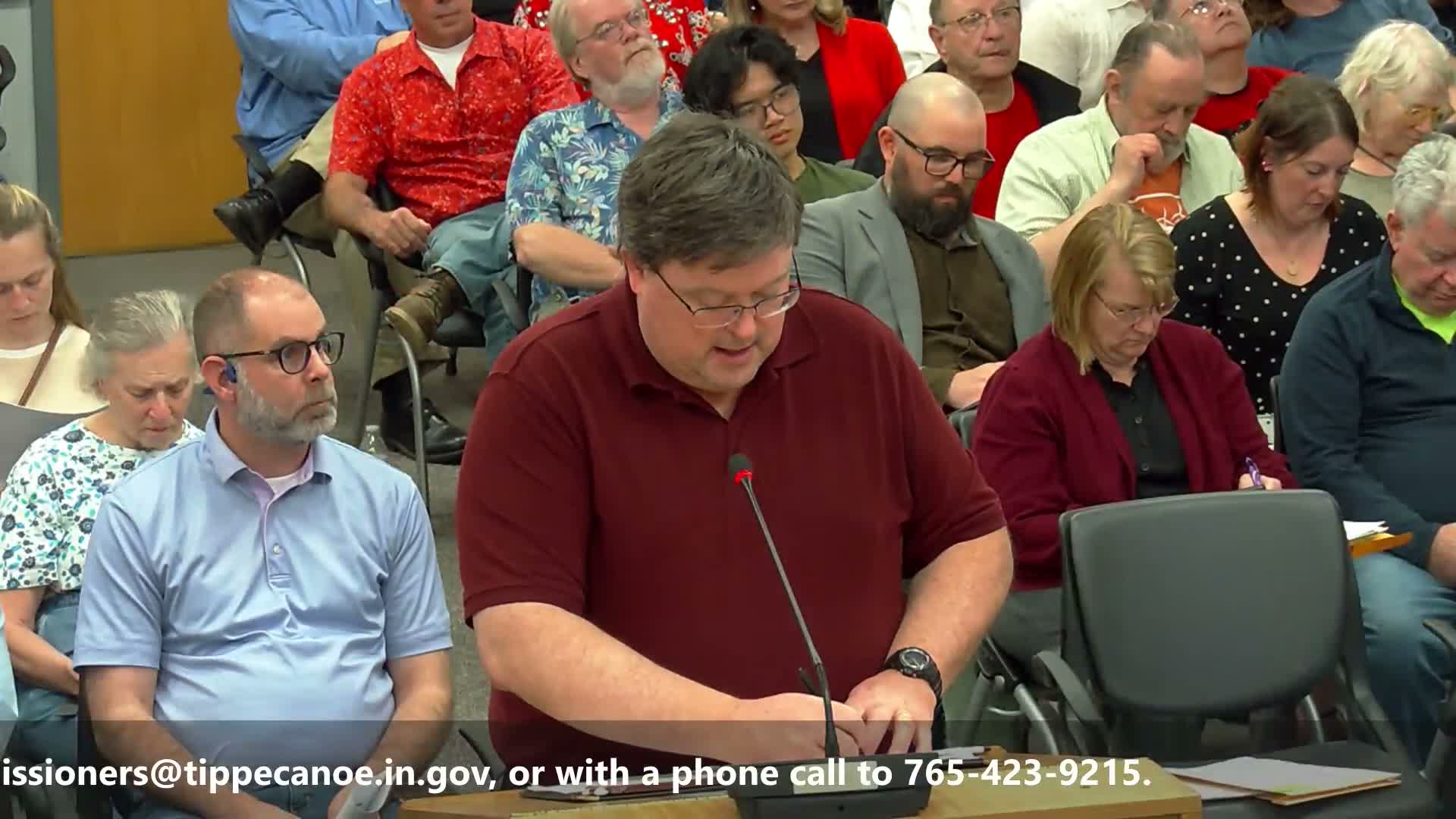
Residents offered competing views during the public hearing. Alicia Ade Reed, who said her family has farmed in Shelby Township for 145 years, urged the board to approve the ordinances while noting the draft "still needs improvement in several areas" and asking the commission to "vote to approve these ordinances." Rachel Stevens told the board larger setbacks would protect property values and reduce noise and glare for nearby homeowners. Donna Scanlon, president of the Tippecanoe County Farm Bureau, supported acreage caps but warned that removing productive farmland carries significant local economic costs, citing Purdue data on gross revenue per acre.
Opponents and proponents traded technical and economic claims during the hearing. Nicole Dutlinger rejected arguments that a 400‑acre cap is a de facto ban, saying such a cap requires better planning but does not prevent viable projects. Other speakers cited studies and local experiments at Purdue to argue both that agrivoltaics can coexist with crops and that prime farmland deserves special protection.
Key provisions in the adopted ordinance, as discussed in the hearing, include larger setbacks for nonparticipating properties, increased setback protections for electrical substations, a county cap discussed at 400 acres per installation and a stated prohibition on battery energy storage systems in the draft presented to the board. Commissioners and staff repeatedly noted ordinances can be amended as the county gains more experience.
The board's recorded action was brief: after public comment and discussion, the clerk announced that Ordinance 2026‑12 "passes 3 to 0." Commissioners moved on to other business after the vote.
What happens next: The ordinance was adopted on May 4; commissioners and staff said future amendments are possible as the county monitors outcomes and industry practice.
APC staff told the board the moratorium passed last summer was intended to allow a deeper study of the county's solar rules and that a study group, ordinance committee and public hearings resulted in a stricter code. APC forwarded the draft to the board after a 13‑3 vote at the Area Planning Commission.
Residents offered competing views during the public hearing. Alicia Ade Reed, who said her family has farmed in Shelby Township for 145 years, urged the board to approve the ordinances while noting the draft "still needs improvement in several areas" and asking the commission to "vote to approve these ordinances." Rachel Stevens told the board larger setbacks would protect property values and reduce noise and glare for nearby homeowners. Donna Scanlon, president of the Tippecanoe County Farm Bureau, supported acreage caps but warned that removing productive farmland carries significant local economic costs, citing Purdue data on gross revenue per acre.
Opponents and proponents traded technical and economic claims during the hearing. Nicole Dutlinger rejected arguments that a 400‑acre cap is a de facto ban, saying such a cap requires better planning but does not prevent viable projects. Other speakers cited studies and local experiments at Purdue to argue both that agrivoltaics can coexist with crops and that prime farmland deserves special protection.
Key provisions in the adopted ordinance, as discussed in the hearing, include larger setbacks for nonparticipating properties, increased setback protections for electrical substations, a county cap discussed at 400 acres per installation and a stated prohibition on battery energy storage systems in the draft presented to the board. Commissioners and staff repeatedly noted ordinances can be amended as the county gains more experience.
The board's recorded action was brief: after public comment and discussion, the clerk announced that Ordinance 2026‑12 "passes 3 to 0." Commissioners moved on to other business after the vote.
What happens next: The ordinance was adopted on May 4; commissioners and staff said future amendments are possible as the county monitors outcomes and industry practice.
View the Full Meeting & All Its Details
This article offers just a summary. Unlock complete video, transcripts, and insights as a Founder Member.
✓
Watch full, unedited meeting videos
✓
Search every word spoken in unlimited transcripts
✓
AI summaries & real-time alerts (all government levels)
✓
Permanent access to expanding government content
30-day money-back guarantee
