Zoning board approves demolition at 112–114 North 8th Street; applicant to build seven‑story apartments
April 27, 2026 | Allentown City, Lehigh County, Pennsylvania
This article was created by AI summarizing key points discussed. AI makes mistakes, so for full details and context, please refer to the video of the full meeting. Please report any errors so we can fix them. Report an error »
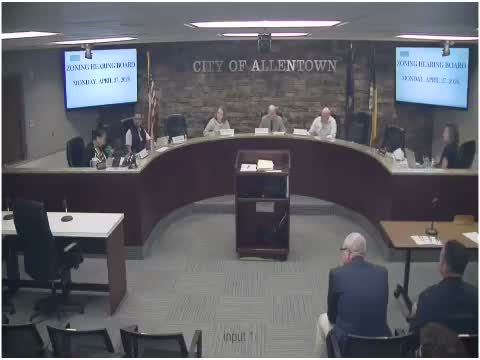
The Allentown Zoning Hearing Board on April 27 approved a special‑exception request to demolish two mixed‑use buildings at 112–114 North 8th Street and authorized the applicant to proceed toward a seven‑story, 23‑unit multifamily replacement, subject to a condition that the design be maintained except as required by other city departments.
The applicant, represented by attorney Jeff Fleischaker of Gross McGinley, presented testimony from Alex Wright, a member of the owning LLC, who said the company has held the properties for about 10 years. Wright described recurring mechanical and structural problems and testified the buildings are difficult to rent. "They're just dilapidated," Wright said, arguing upkeep had become a cycle of constant repair.
The architect, Carlos Tovar of Urban Design, described a design that places pedestrian‑scaled materials on the lower stories and continues a modernized yet context‑sensitive elevation upward. Tovar said the proposed building would be seven stories and about 80 feet tall and would include ground‑floor amenity space and small commercial frontage intended to activate the street.
Neighbors and interested parties gave mixed testimony. Long‑time resident Charlie Versaggi objected to the demolition on grounds of density and neighborhood character, saying the seven‑story massing "would stick out like a sore thumb." By contrast, co‑owner and manager Ruth Rachel Green, who manages the properties, said she has invested in maintenance but that the buildings’ age and configuration limit their market viability. Neighbor Peters Sposato described safety problems on the block and said new construction could help.
Philip Hart, speaking on behalf of the Historic Architectural Review Board (HARB), read HARB’s comments supporting the proposed project’s massing and pedestrian focus but urged sensitivity to historic character in facade details and suggested modest step‑backs above the third story.
Board members questioned whether the applicant had provided the written contractor estimate or engineer’s report the demolition overlay requires to show that rehabilitation is infeasible. Several members said they had not seen a formal cost estimate but found the applicant’s testimony persuasive about recurring expenses and narrow unit layouts. One member noted the ordinance language requiring credible evidence such as a contractor estimate but said the total record could justify approval in this case.
A motion to approve the special exception for demolition was made and seconded; the board voted in favor by voice. The board attached a condition that the project be constructed as presented or only modified as required by third‑party agencies and departments, a condition the applicant accepted. The board admitted the applicant’s exhibits and took public notice of selections from the City of Allentown comprehensive plan (Allentown Vision 2030) offered by the applicant as supportive context.
Next steps: the decision allows the applicant to continue through the land‑development process with city planning and zoning staff; additional zoning relief or technical approvals may be required before building permits are issued.
The applicant, represented by attorney Jeff Fleischaker of Gross McGinley, presented testimony from Alex Wright, a member of the owning LLC, who said the company has held the properties for about 10 years. Wright described recurring mechanical and structural problems and testified the buildings are difficult to rent. "They're just dilapidated," Wright said, arguing upkeep had become a cycle of constant repair.
The architect, Carlos Tovar of Urban Design, described a design that places pedestrian‑scaled materials on the lower stories and continues a modernized yet context‑sensitive elevation upward. Tovar said the proposed building would be seven stories and about 80 feet tall and would include ground‑floor amenity space and small commercial frontage intended to activate the street.
Neighbors and interested parties gave mixed testimony. Long‑time resident Charlie Versaggi objected to the demolition on grounds of density and neighborhood character, saying the seven‑story massing "would stick out like a sore thumb." By contrast, co‑owner and manager Ruth Rachel Green, who manages the properties, said she has invested in maintenance but that the buildings’ age and configuration limit their market viability. Neighbor Peters Sposato described safety problems on the block and said new construction could help.
Philip Hart, speaking on behalf of the Historic Architectural Review Board (HARB), read HARB’s comments supporting the proposed project’s massing and pedestrian focus but urged sensitivity to historic character in facade details and suggested modest step‑backs above the third story.
Board members questioned whether the applicant had provided the written contractor estimate or engineer’s report the demolition overlay requires to show that rehabilitation is infeasible. Several members said they had not seen a formal cost estimate but found the applicant’s testimony persuasive about recurring expenses and narrow unit layouts. One member noted the ordinance language requiring credible evidence such as a contractor estimate but said the total record could justify approval in this case.
A motion to approve the special exception for demolition was made and seconded; the board voted in favor by voice. The board attached a condition that the project be constructed as presented or only modified as required by third‑party agencies and departments, a condition the applicant accepted. The board admitted the applicant’s exhibits and took public notice of selections from the City of Allentown comprehensive plan (Allentown Vision 2030) offered by the applicant as supportive context.
Next steps: the decision allows the applicant to continue through the land‑development process with city planning and zoning staff; additional zoning relief or technical approvals may be required before building permits are issued.
Don't Miss a Word: See the Full Meeting!
Go beyond summaries. Unlock every video, transcript, and key insight with a Founder Membership.
✓
Get instant access to full meeting videos
✓
Search and clip any phrase from complete transcripts
✓
Receive AI-powered summaries & custom alerts
✓
Enjoy lifetime, unrestricted access to government data
30-day money-back guarantee
