Zoning board denies demolition for 138–142 North 9th Street after neighbors and board cite missing feasibility evidence
April 27, 2026 | Allentown City, Lehigh County, Pennsylvania
This article was created by AI summarizing key points discussed. AI makes mistakes, so for full details and context, please refer to the video of the full meeting. Please report any errors so we can fix them. Report an error »
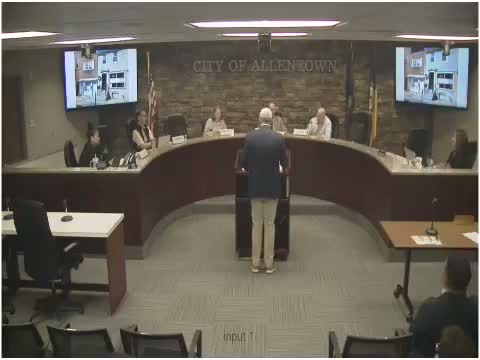
The Allentown Zoning Hearing Board on April 27 denied a special‑exception request to demolish three residential buildings at 138–142 North 9th Street, concluding that the record did not provide sufficient written evidence (for example, a contractor estimate or engineer report) that rehabilitation of the existing buildings is infeasible under the demolition overlay standards.
The applicant’s witnesses—co‑owner/manager Ruth Rachel Green and owner Alex Wright—testified about age‑related mechanical and electrical problems, recurring repair costs, and challenges keeping long‑term tenants. Wright estimated that the owner needs a larger unit count to make redevelopment financially viable and proposed a seven‑story, 40‑unit building with some ground‑floor retail and amenities. Architect Carlos Tovar described an 80‑foot, 40‑unit proposal emphasizing pedestrian activation and said he would work with HARB to refine facade details.
Opponents included Philip Hart for the Historic Architectural Review Board (HARB) and other neighbors who said the three buildings contribute character to the block and that demolition would set a harmful precedent. Hart urged preservation and recommended selecting an alternate infill site rather than removing character‑defining facades. Long‑time neighbor Charlie Versaggi reiterated concerns about density and parking loss.
Board members focused on the demolition overlay’s evidentiary requirements. Several members said applicant testimony contained useful cost and condition information but lacked the written contractor’s estimate or engineering report the ordinance cites as typical evidence that reuse is infeasible. One board member explicitly moved to deny the application on those grounds. The motion passed by voice vote; the Chair and staff discussed denying without prejudice so the applicant could revise and return with additional documentation.
Next steps: the denial leaves in place the existing buildings; the applicant may choose to gather the requested written cost estimates or structural reports and present a materially different application at a later hearing.
The applicant’s witnesses—co‑owner/manager Ruth Rachel Green and owner Alex Wright—testified about age‑related mechanical and electrical problems, recurring repair costs, and challenges keeping long‑term tenants. Wright estimated that the owner needs a larger unit count to make redevelopment financially viable and proposed a seven‑story, 40‑unit building with some ground‑floor retail and amenities. Architect Carlos Tovar described an 80‑foot, 40‑unit proposal emphasizing pedestrian activation and said he would work with HARB to refine facade details.
Opponents included Philip Hart for the Historic Architectural Review Board (HARB) and other neighbors who said the three buildings contribute character to the block and that demolition would set a harmful precedent. Hart urged preservation and recommended selecting an alternate infill site rather than removing character‑defining facades. Long‑time neighbor Charlie Versaggi reiterated concerns about density and parking loss.
Board members focused on the demolition overlay’s evidentiary requirements. Several members said applicant testimony contained useful cost and condition information but lacked the written contractor’s estimate or engineering report the ordinance cites as typical evidence that reuse is infeasible. One board member explicitly moved to deny the application on those grounds. The motion passed by voice vote; the Chair and staff discussed denying without prejudice so the applicant could revise and return with additional documentation.
Next steps: the denial leaves in place the existing buildings; the applicant may choose to gather the requested written cost estimates or structural reports and present a materially different application at a later hearing.
View the Full Meeting & All Its Details
This article offers just a summary. Unlock complete video, transcripts, and insights as a Founder Member.
✓
Watch full, unedited meeting videos
✓
Search every word spoken in unlimited transcripts
✓
AI summaries & real-time alerts (all government levels)
✓
Permanent access to expanding government content
30-day money-back guarantee
