Austin Police Oversight describes voluntary mediation program; commissioners press for measurable outcomes
May 04, 2026 | Austin, Travis County, Texas
This article was created by AI summarizing key points discussed. AI makes mistakes, so for full details and context, please refer to the video of the full meeting. Please report any errors so we can fix them. Report an error »
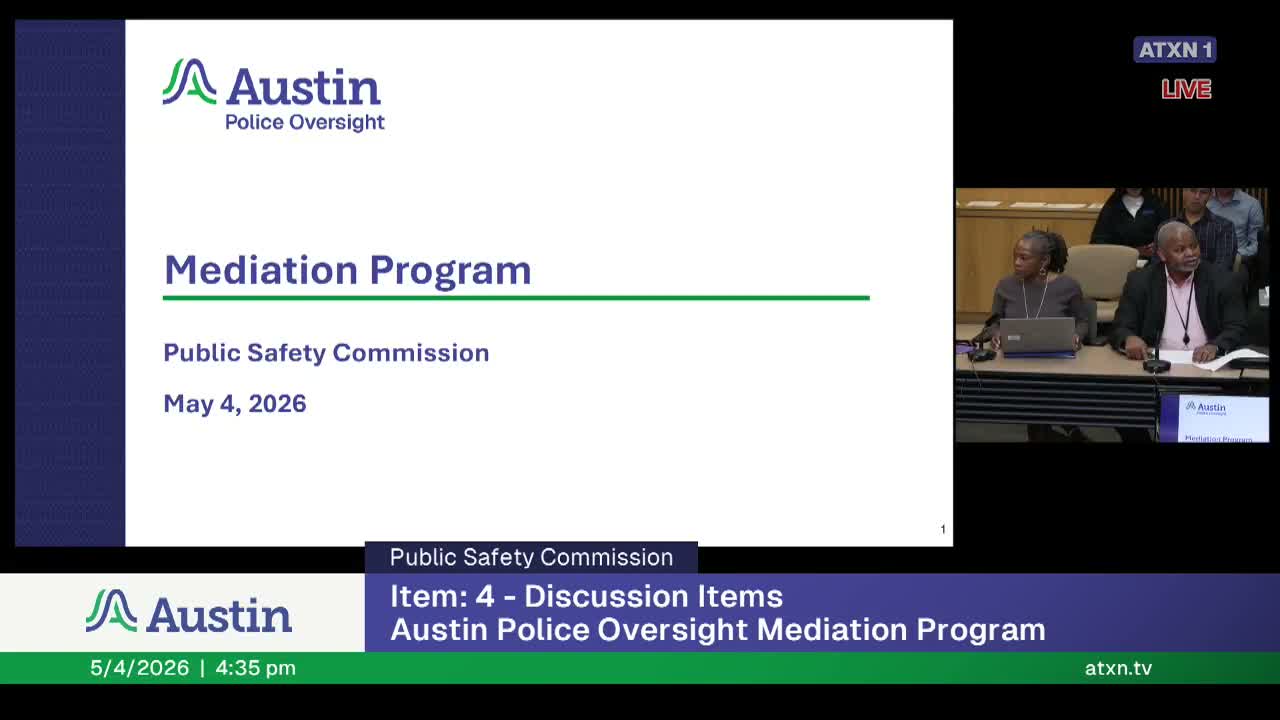
Austin Police Oversight Director Gail McCant and Deputy Director Kevin Masters presented a proposed mediation program that would offer voluntary, confidential virtual mediation for certain administrative complaints.
"Mediation obviously is a voluntary and confidential process in which a neutral third party mediator facilitates dialogue between community members and a police officer to resolve concerns," Kevin Masters said while outlining program basics and the memorandum of agreement with the Dispute Resolution Center.
APO emphasized the program will target low‑level complaints — discourtesy, failure to take or follow up on reports, and similar interpersonal concerns — not complaints alleging bias, use of force, or other serious misconduct. Masters said the DRC would handle intake and scheduling and that APO aims to complete mediations within roughly 45–60 days.
Commissioners repeatedly asked how APO will measure outcomes and preserve both confidentiality and public transparency. Commissioner Smith asked how the program will capture whether mediation led to changed officer behavior or reduced repeat complaints; Kevin Masters said APO and the DRC will produce disposition documents and that mediation outcomes will be included in APO's quarterly and annual reporting in aggregated, non‑PII form.
There was sustained concern about confidentiality versus public reporting: one commissioner asked whether mediation materials would be published in the same way other complaint materials are; APO said personally identifying information would be redacted but that the type of mediation, complaint category, and disposition would be reported publicly.
APO said staff will identify cases they consider eligible for mediation but that internal affairs or APO staff could recommend mediation; APO also said it reserves the authority to decline mediation recommendations and will forward cases for formal investigation when appropriate. As of the presentation, APO said no cases had yet been presented for mediation.
The commission did not vote on adopting the program at the meeting but requested follow‑up on metrics, published data formats, and how APO will track recidivist behaviors in officers who participate in mediation.
"Mediation obviously is a voluntary and confidential process in which a neutral third party mediator facilitates dialogue between community members and a police officer to resolve concerns," Kevin Masters said while outlining program basics and the memorandum of agreement with the Dispute Resolution Center.
APO emphasized the program will target low‑level complaints — discourtesy, failure to take or follow up on reports, and similar interpersonal concerns — not complaints alleging bias, use of force, or other serious misconduct. Masters said the DRC would handle intake and scheduling and that APO aims to complete mediations within roughly 45–60 days.
Commissioners repeatedly asked how APO will measure outcomes and preserve both confidentiality and public transparency. Commissioner Smith asked how the program will capture whether mediation led to changed officer behavior or reduced repeat complaints; Kevin Masters said APO and the DRC will produce disposition documents and that mediation outcomes will be included in APO's quarterly and annual reporting in aggregated, non‑PII form.
There was sustained concern about confidentiality versus public reporting: one commissioner asked whether mediation materials would be published in the same way other complaint materials are; APO said personally identifying information would be redacted but that the type of mediation, complaint category, and disposition would be reported publicly.
APO said staff will identify cases they consider eligible for mediation but that internal affairs or APO staff could recommend mediation; APO also said it reserves the authority to decline mediation recommendations and will forward cases for formal investigation when appropriate. As of the presentation, APO said no cases had yet been presented for mediation.
The commission did not vote on adopting the program at the meeting but requested follow‑up on metrics, published data formats, and how APO will track recidivist behaviors in officers who participate in mediation.
Don't Miss a Word: See the Full Meeting!
Go beyond summaries. Unlock every video, transcript, and key insight with a Founder Membership.
✓
Get instant access to full meeting videos
✓
Search and clip any phrase from complete transcripts
✓
Receive AI-powered summaries & custom alerts
✓
Enjoy lifetime, unrestricted access to government data
30-day money-back guarantee
