Council begins review of tree-preservation code after Pinellas County rewrites
May 04, 2026 | Clearwater, Pinellas County, Florida
This article was created by AI summarizing key points discussed. AI makes mistakes, so for full details and context, please refer to the video of the full meeting. Please report any errors so we can fix them. Report an error »
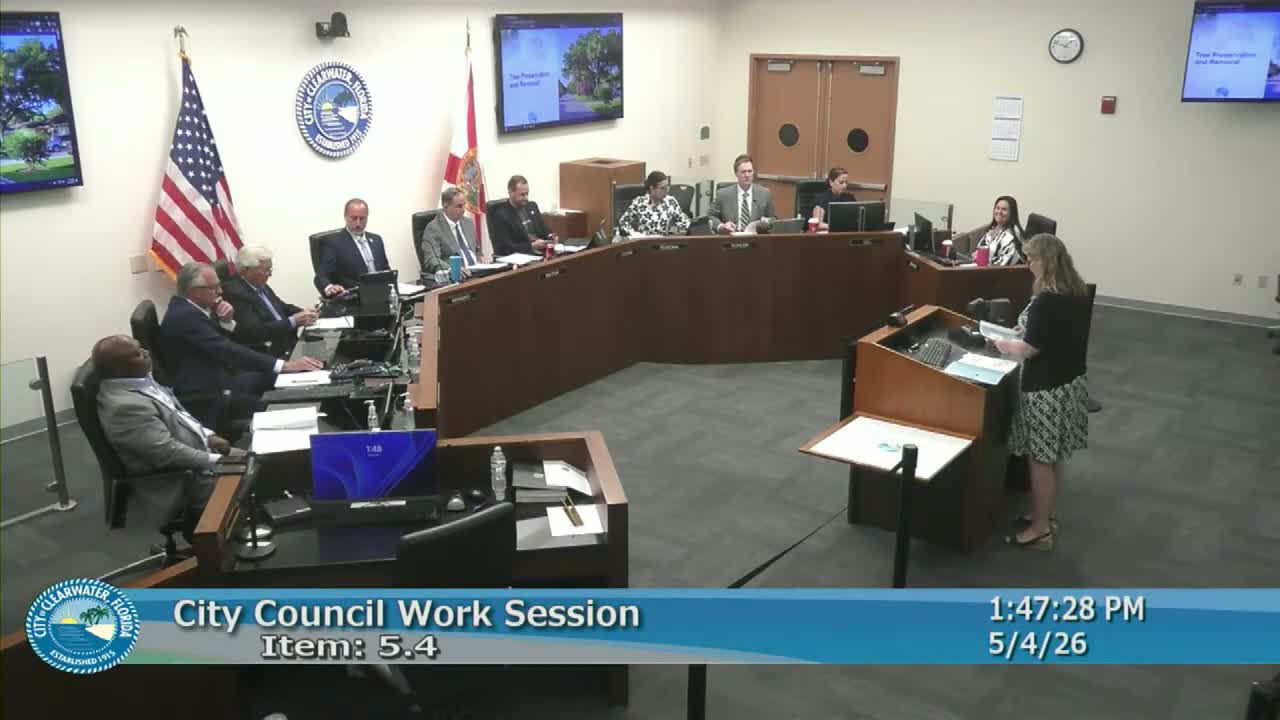
Lauren Matzke, planning and development, presented a detailed comparison of Clearwater's tree-preservation ordinance with Pinellas County's recent amendments, and asked the council for direction on potential code changes.
"So earlier this year, council had requested staff provide a summary of some changes that Pinellas County had recently completed," Matzke said, explaining staff looked at structural, administrative and mitigation differences between the codes. She told the council the county moved from an inch-for-inch mitigation system to a graded system that ties mitigation to tree size and a new rating scale, and that the county had simplified its rating scale to improve consistency.
The presentation highlighted several practical differences: Clearwater's mitigation is still primarily inch-for-inch (tree DBH measured in inches at breast height) and uses a $48-per-inch tree-bank rate; the county converted to a flat per-tree fee for many residential removals and detailed a graded mitigation table that reduces mitigation for lower-rated or nuisance trees. Matzke also outlined permitting activity (about 300 stand-alone permits in 2023) and noted the city's denial rate has hovered around 11% to 13%.
Vice mayor (unnamed in transcript) urged staff to incorporate the limits set by Florida Statute 163.045: "Local governments cannot require a permit fee or mitigation for removing trees on residential properties," he read during the discussion, and asked staff to cite that statute explicitly in any proposed ordinance changes.
Ted Kozak, planning and development (certified arborist), answered technical questions about palms and measurement thresholds. "Palms are not trees," Kozak said in the meeting, explaining palms lack the concentric rings used for DBH measurement and that "clear trunk" is measured differently for palms. He and Matzke discussed how the county measures palms by clear trunk height while the city currently uses a height threshold of 10 feet.
Council members focused their questions on three themes: 1) simplifying administration and improving predictability for residents, 2) protecting specimen and high-value trees, and 3) whether fees charged into the tree bank are appropriately calibrated. Council asked staff to prepare recommendations that could include aligning the city's rating system with the county for ease of administration, targeted code clarifications (exemptions, hazardous-tree handling, nuisance categories), and a fee study that isolates tree fees for comparison.
Finance and operations staff provided a tree-bank balance figure during the meeting: "It's just under $1,000,000," a staff member reported. Council members said some of the current balance should be directed to tree-planting and urban forestry projects and asked for a plan showing projected uses if fees are changed.
Matzke said staff will return with a proposed project timeline, recommended code language and fee recommendations. The council directed staff to consult neighboring municipalities, present a narrow fee comparison, and bring proposed ordinance language (or a workshop-level memo) before the council for further discussion.
Next steps: staff will provide a timeline and draft recommendations in one-on-ones with council members and then on a future workshop or ordinance agenda item. The council did not take any immediate regulatory action at this meeting.
"So earlier this year, council had requested staff provide a summary of some changes that Pinellas County had recently completed," Matzke said, explaining staff looked at structural, administrative and mitigation differences between the codes. She told the council the county moved from an inch-for-inch mitigation system to a graded system that ties mitigation to tree size and a new rating scale, and that the county had simplified its rating scale to improve consistency.
The presentation highlighted several practical differences: Clearwater's mitigation is still primarily inch-for-inch (tree DBH measured in inches at breast height) and uses a $48-per-inch tree-bank rate; the county converted to a flat per-tree fee for many residential removals and detailed a graded mitigation table that reduces mitigation for lower-rated or nuisance trees. Matzke also outlined permitting activity (about 300 stand-alone permits in 2023) and noted the city's denial rate has hovered around 11% to 13%.
Vice mayor (unnamed in transcript) urged staff to incorporate the limits set by Florida Statute 163.045: "Local governments cannot require a permit fee or mitigation for removing trees on residential properties," he read during the discussion, and asked staff to cite that statute explicitly in any proposed ordinance changes.
Ted Kozak, planning and development (certified arborist), answered technical questions about palms and measurement thresholds. "Palms are not trees," Kozak said in the meeting, explaining palms lack the concentric rings used for DBH measurement and that "clear trunk" is measured differently for palms. He and Matzke discussed how the county measures palms by clear trunk height while the city currently uses a height threshold of 10 feet.
Council members focused their questions on three themes: 1) simplifying administration and improving predictability for residents, 2) protecting specimen and high-value trees, and 3) whether fees charged into the tree bank are appropriately calibrated. Council asked staff to prepare recommendations that could include aligning the city's rating system with the county for ease of administration, targeted code clarifications (exemptions, hazardous-tree handling, nuisance categories), and a fee study that isolates tree fees for comparison.
Finance and operations staff provided a tree-bank balance figure during the meeting: "It's just under $1,000,000," a staff member reported. Council members said some of the current balance should be directed to tree-planting and urban forestry projects and asked for a plan showing projected uses if fees are changed.
Matzke said staff will return with a proposed project timeline, recommended code language and fee recommendations. The council directed staff to consult neighboring municipalities, present a narrow fee comparison, and bring proposed ordinance language (or a workshop-level memo) before the council for further discussion.
Next steps: staff will provide a timeline and draft recommendations in one-on-ones with council members and then on a future workshop or ordinance agenda item. The council did not take any immediate regulatory action at this meeting.
Don't Miss a Word: See the Full Meeting!
Go beyond summaries. Unlock every video, transcript, and key insight with a Founder Membership.
✓
Get instant access to full meeting videos
✓
Search and clip any phrase from complete transcripts
✓
Receive AI-powered summaries & custom alerts
✓
Enjoy lifetime, unrestricted access to government data
30-day money-back guarantee
