LFC action plan targets 3,200 disconnected youth, calls for cross-agency referrals and evidence-based scaling
April 27, 2026 | House of Representatives, Committees, Legislative, New Mexico
This article was created by AI summarizing key points discussed. AI makes mistakes, so for full details and context, please refer to the video of the full meeting. Please report any errors so we can fix them. Report an error »
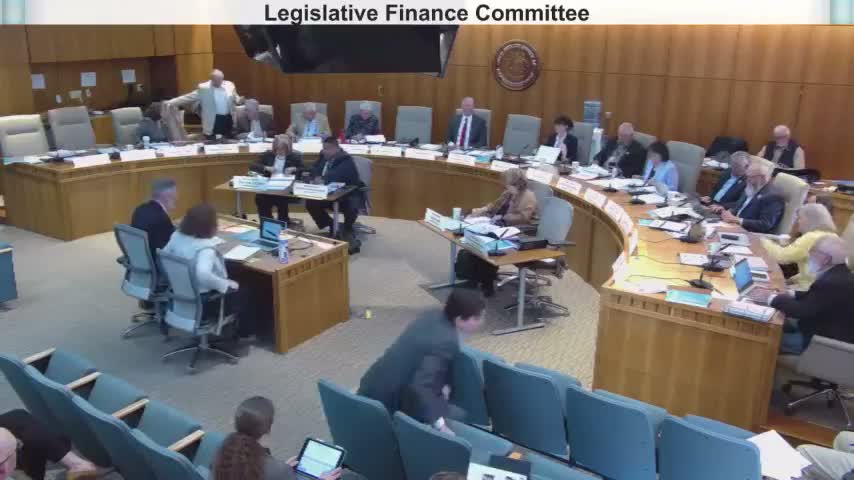
Legislative Finance Committee evaluators presented an action plan on Feb. 20 aimed at reconnecting young people ages 16–24 who are not working, in school or in training.
"According to the census, New Mexico has approximately 32,000 disconnected youth," Josh Chaffin, an LFC evaluator, told the committee. "These young people are more likely to experience lower lifetime earnings and greater involvement in costly public systems."
The report recommends a measurable target: reduce youth disconnection by 10% over three years, which the staff estimated would reconnect roughly 3,200 young people and return about $62 million annually in increased earnings or avoided public costs.
Key recommendations include better recruitment and retention into existing programs, requiring closed-loop referral systems so agencies can track whether referred youth actually engage in services, prioritizing or expanding evidence-based interventions (integrated education-and-training programs, pre-apprenticeships and Jobs for America's Graduates), and aligning housing and transportation investments to youth needs. LFC evaluators also urged creation of a cross-agency coordinating body—potentially a children’s-cabinet subcommittee—to set shared definitions, indicators and performance targets.
Workforce officials said they are pursuing federal WIOA waivers to give local areas more flexibility to serve out-of-school youth. "We requested waivers that could increase flexibility for youth services, including easing the out-of-school spending requirement and permitting individual training accounts for in-school youth," Scott Graginsky, deputy secretary at the Department of Workforce Solutions, told members.
Presenters and members highlighted service gaps in tribal and rural areas and noted that some programs do offer stipends or transportation support but that scale is limited. Amber Gallup, adult education director at the Higher Education Department, noted that some adult-education funding already allows stipends and transportation vouchers and pointed to a state stipend pilot that provides $1,000 to participants to reduce immediate barriers to participation.
Why it matters: LFC said concentrated disconnection in a handful of counties (including Bernalillo, Dona Ana, San Juan and McKinley) means targeted interventions can achieve outsized results, and staff underscored that many disconnected youth face overlapping barriers—housing instability, behavioral health needs and lack of training—that require coordinated responses rather than single-program fixes.
Next steps: The report calls for agencies to set participation targets for disconnected youth, establish closed-loop referrals, prioritize funding for programs with demonstrated outcomes and expand accountability and reporting. LFC recommended that programs that do not track outcomes should lose funding beginning in fiscal 2028 unless they demonstrate results.
The committee scheduled follow-up and cross-agency work this interim to align program targeting, data systems and pilot supports such as transportation.
"According to the census, New Mexico has approximately 32,000 disconnected youth," Josh Chaffin, an LFC evaluator, told the committee. "These young people are more likely to experience lower lifetime earnings and greater involvement in costly public systems."
The report recommends a measurable target: reduce youth disconnection by 10% over three years, which the staff estimated would reconnect roughly 3,200 young people and return about $62 million annually in increased earnings or avoided public costs.
Key recommendations include better recruitment and retention into existing programs, requiring closed-loop referral systems so agencies can track whether referred youth actually engage in services, prioritizing or expanding evidence-based interventions (integrated education-and-training programs, pre-apprenticeships and Jobs for America's Graduates), and aligning housing and transportation investments to youth needs. LFC evaluators also urged creation of a cross-agency coordinating body—potentially a children’s-cabinet subcommittee—to set shared definitions, indicators and performance targets.
Workforce officials said they are pursuing federal WIOA waivers to give local areas more flexibility to serve out-of-school youth. "We requested waivers that could increase flexibility for youth services, including easing the out-of-school spending requirement and permitting individual training accounts for in-school youth," Scott Graginsky, deputy secretary at the Department of Workforce Solutions, told members.
Presenters and members highlighted service gaps in tribal and rural areas and noted that some programs do offer stipends or transportation support but that scale is limited. Amber Gallup, adult education director at the Higher Education Department, noted that some adult-education funding already allows stipends and transportation vouchers and pointed to a state stipend pilot that provides $1,000 to participants to reduce immediate barriers to participation.
Why it matters: LFC said concentrated disconnection in a handful of counties (including Bernalillo, Dona Ana, San Juan and McKinley) means targeted interventions can achieve outsized results, and staff underscored that many disconnected youth face overlapping barriers—housing instability, behavioral health needs and lack of training—that require coordinated responses rather than single-program fixes.
Next steps: The report calls for agencies to set participation targets for disconnected youth, establish closed-loop referrals, prioritize funding for programs with demonstrated outcomes and expand accountability and reporting. LFC recommended that programs that do not track outcomes should lose funding beginning in fiscal 2028 unless they demonstrate results.
The committee scheduled follow-up and cross-agency work this interim to align program targeting, data systems and pilot supports such as transportation.
Don't Miss a Word: See the Full Meeting!
Go beyond summaries. Unlock every video, transcript, and key insight with a Founder Membership.
✓
Get instant access to full meeting videos
✓
Search and clip any phrase from complete transcripts
✓
Receive AI-powered summaries & custom alerts
✓
Enjoy lifetime, unrestricted access to government data
30-day money-back guarantee
