Committee debates easing reporting requirements for Alaska Native corporations; concerns about exempting large entities
May 04, 2026 | 2026 Legislature Alaska, Alaska
This article was created by AI summarizing key points discussed. AI makes mistakes, so for full details and context, please refer to the video of the full meeting. Please report any errors so we can fix them. Report an error »
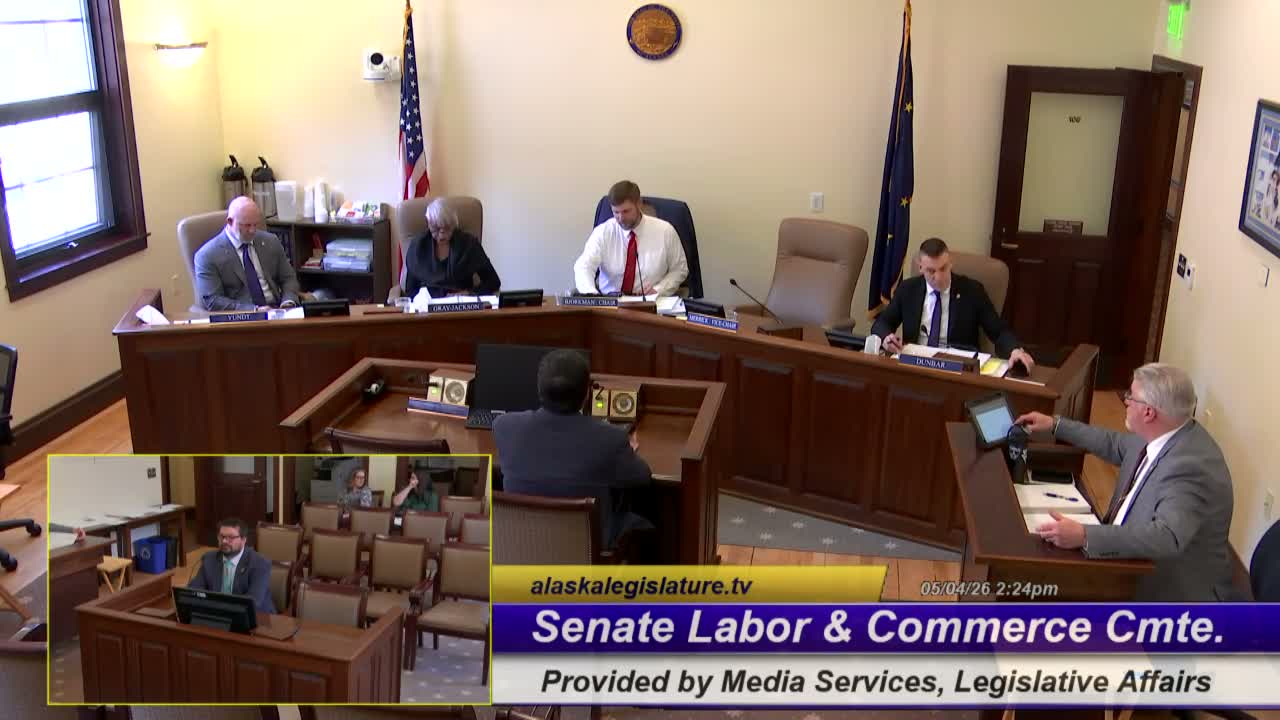
House Bill 126, presented May 4, would allow involuntarily dissolved Native corporations to reincorporate and retain assets granted under the Alaska Native Claims Settlement Act. The committee considered a draft proposed committee substitute that would change annual reporting triggers by removing the $1,000,000 asset threshold and using the count of original shareholders at formation rather than total current record shareholders.
Conrad Jackson, staff to the committee, explained the substitute would amend AS 45.55.139 and return to the original shareholder-count trigger for reporting to the division. Anne Sivilich of the Division of Banking and Securities told the committee that 59 corporations currently meet the filing requirement and division research identified roughly 22 corporations that would be affected under the amended language.
Christopher Slade, counsel for the Alaska Native Village Corporation Association, said counting original enrollees better reflects corporate scale because inheritance has increased record shareholders without corresponding growth in assets or operations. Slade said the amendment "does not weaken protection for shareholders" and noted that ANCSA still requires annual reports and audited financial statements to shareholders, and that shareholders retain rights to books and records.
Several senators raised concerns that removing the asset threshold could exempt very large village corporations from publicly filing proxy statements and audited financials that are currently public records. Senator Dunbar requested a written comparison of what public information would be lost relative to SEC filings for large corporations and asked for a list of the corporations likely to be exempted if the substitute is adopted.
A motion to adopt the draft proposed committee substitute was made as a working document; Senator Dunbar objected and said he would keep his objection in place until the requested information is provided. Public testimony was opened and left open; HB 126 was set aside for future consideration.
Why it matters: The change aims to reduce administrative burdens on small village Native corporations whose shareholder rolls have expanded by inheritance; opponents worry it could remove public disclosure that currently aids shareholder oversight for larger corporations.
Next steps: Committee staff will follow up with requested lists and written comparisons; the substitute remained objected to at the hearing and the bill was set aside for further consideration.
Conrad Jackson, staff to the committee, explained the substitute would amend AS 45.55.139 and return to the original shareholder-count trigger for reporting to the division. Anne Sivilich of the Division of Banking and Securities told the committee that 59 corporations currently meet the filing requirement and division research identified roughly 22 corporations that would be affected under the amended language.
Christopher Slade, counsel for the Alaska Native Village Corporation Association, said counting original enrollees better reflects corporate scale because inheritance has increased record shareholders without corresponding growth in assets or operations. Slade said the amendment "does not weaken protection for shareholders" and noted that ANCSA still requires annual reports and audited financial statements to shareholders, and that shareholders retain rights to books and records.
Several senators raised concerns that removing the asset threshold could exempt very large village corporations from publicly filing proxy statements and audited financials that are currently public records. Senator Dunbar requested a written comparison of what public information would be lost relative to SEC filings for large corporations and asked for a list of the corporations likely to be exempted if the substitute is adopted.
A motion to adopt the draft proposed committee substitute was made as a working document; Senator Dunbar objected and said he would keep his objection in place until the requested information is provided. Public testimony was opened and left open; HB 126 was set aside for future consideration.
Why it matters: The change aims to reduce administrative burdens on small village Native corporations whose shareholder rolls have expanded by inheritance; opponents worry it could remove public disclosure that currently aids shareholder oversight for larger corporations.
Next steps: Committee staff will follow up with requested lists and written comparisons; the substitute remained objected to at the hearing and the bill was set aside for further consideration.
View the Full Meeting & All Its Details
This article offers just a summary. Unlock complete video, transcripts, and insights as a Founder Member.
✓
Watch full, unedited meeting videos
✓
Search every word spoken in unlimited transcripts
✓
AI summaries & real-time alerts (all government levels)
✓
Permanent access to expanding government content
30-day money-back guarantee
