LAO and Inspector General Say 2026 High-Speed Rail Draft Lacks Required Details; Authority Says It Will Fix Deficiencies
April 27, 2026 | California State Senate, Senate, Legislative, California
This article was created by AI summarizing key points discussed. AI makes mistakes, so for full details and context, please refer to the video of the full meeting. Please report any errors so we can fix them. Report an error »
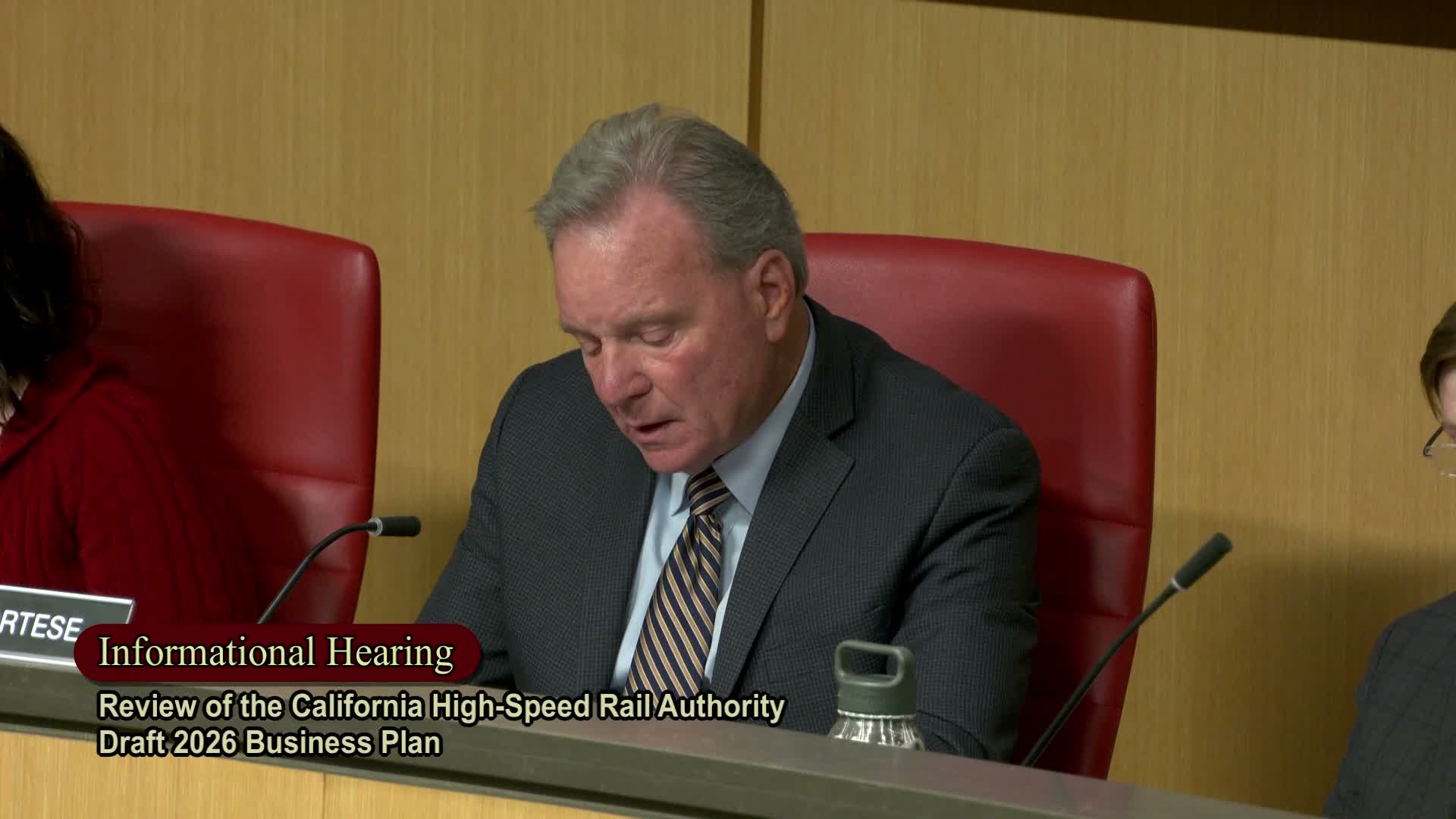
Chair Cortese convened the California State Senate Transportation Committee to review the California High Speed Rail Authority’s 2026 draft business plan and hear oversight analysis from the Legislative Analyst’s Office (LAO) and the Authority’s Office of Inspector General.
Helen Kerstein of the Legislative Analyst's Office told the committee the draft plan "never specifically mentions that the station locations are being changed" and that the plan’s cost estimates rely on assumptions—including shorter alignments and single-track sections—that are not presented transparently alongside the statute-defined baseline required under SB 198. Kerstein said the plan also assumes statutory changes and funding timing that increase borrowing needs and risk.
Ben Belknap, the Authority’s inspector general, told the committee his office reviewed the draft business plan and "has found that it falls short of complying with statutory requirements" and highlighted three deficiencies: unauthorized scope changes to the Merced–Bakersfield segment, an inadequate funding plan that omits borrowing costs, and missing procurement milestones that would let the Legislature track schedule risk.
Ian Chaudhary, CEO of the California High Speed Rail Authority, defended the program’s progress while answering questions. Chaudhary pointed to Central Valley construction and described recent procurement changes and optimizations, saying the Authority has "80 miles ready to receive tracks" and that the plan positions the Merced–Bakersfield early operating segment for completion on a schedule that would start testing and lead to revenue service in the early 2030s. He also said the state has secured a $1 billion annual appropriation through a Cap-and-Invest allocation that supports near-term work.
But committee members and LAO staff pressed that the draft plan’s cost and schedule assumptions are anchored to hypothetical scope reductions that require legislative action to implement, and that excluding reasonable borrowing costs from the funding picture can materially misstate whether existing resources are sufficient. The LAO and OIG both emphasized the Legislature needs a clear, statutory-compliant baseline cost and schedule, with any proposed scope-reduction options presented transparently and quantified for comparison.
Committee members repeatedly raised concerns about two central political and fiscal issues: station-location assumptions and proposals for value-capture or tax-increment financing. Several senators said station moves away from downtown Merced and downtown Bakersfield (presented in a supplemental technical appendix) substantially change the project the Legislature originally defined in statute. Vice Chair Senator Strickland and others said proposals to grant the Authority new financing or jurisdictional powers—such as authority over utility relocations or state-controlled tax-increment financing—would require explicit legislative approval and will face political resistance among local governments.
On federal funding, Authority witnesses said roughly $4.2 billion in previously expected federal grant commitments was withdrawn and that about $270 million in federal grants remain available for discrete Merced–Bakersfield scopes; the Authority said it will continue applying for federal grants even as it explores private financing and borrowing to accelerate cash flow. LAO witnesses warned that borrowing against future Cap-and-Invest (GGRF) receipts is sensitive because those revenues are uncertain and rulemaking could reduce them, making borrowing assumptions risky.
After the panels’ testimony, an extended round of public comment included local governments, special-district representatives, fire district and union leaders. Many commenters opposed state-controlled tax-increment financing and urged preserving local taxing authority, while the Transbay Joint Powers Authority and others urged recommitment to previously discussed portal funding to connect high-speed rail to the Salesforce Transit Center in downtown San Francisco.
The Authority repeatedly told the committee that station-location changes are the subject of ongoing conversations with city and county officials, that no contracts are in place for relocated stations, and that the draft business plan will be revised to address the OIG and LAO comments. The inspector general and LAO both asked the Authority to provide written reconciliation—showing whether and how the plan will move toward statutory compliance and how procurement and financing milestones will be tracked—before the Legislature finalizes its review.
The committee did not take formal votes. Chair Cortese closed by asking for the Authority’s written responses to the statutory noncompliance questions and said the final business plan should incorporate OIG comments; the hearing then moved to public comment and was adjourned.
Helen Kerstein of the Legislative Analyst's Office told the committee the draft plan "never specifically mentions that the station locations are being changed" and that the plan’s cost estimates rely on assumptions—including shorter alignments and single-track sections—that are not presented transparently alongside the statute-defined baseline required under SB 198. Kerstein said the plan also assumes statutory changes and funding timing that increase borrowing needs and risk.
Ben Belknap, the Authority’s inspector general, told the committee his office reviewed the draft business plan and "has found that it falls short of complying with statutory requirements" and highlighted three deficiencies: unauthorized scope changes to the Merced–Bakersfield segment, an inadequate funding plan that omits borrowing costs, and missing procurement milestones that would let the Legislature track schedule risk.
Ian Chaudhary, CEO of the California High Speed Rail Authority, defended the program’s progress while answering questions. Chaudhary pointed to Central Valley construction and described recent procurement changes and optimizations, saying the Authority has "80 miles ready to receive tracks" and that the plan positions the Merced–Bakersfield early operating segment for completion on a schedule that would start testing and lead to revenue service in the early 2030s. He also said the state has secured a $1 billion annual appropriation through a Cap-and-Invest allocation that supports near-term work.
But committee members and LAO staff pressed that the draft plan’s cost and schedule assumptions are anchored to hypothetical scope reductions that require legislative action to implement, and that excluding reasonable borrowing costs from the funding picture can materially misstate whether existing resources are sufficient. The LAO and OIG both emphasized the Legislature needs a clear, statutory-compliant baseline cost and schedule, with any proposed scope-reduction options presented transparently and quantified for comparison.
Committee members repeatedly raised concerns about two central political and fiscal issues: station-location assumptions and proposals for value-capture or tax-increment financing. Several senators said station moves away from downtown Merced and downtown Bakersfield (presented in a supplemental technical appendix) substantially change the project the Legislature originally defined in statute. Vice Chair Senator Strickland and others said proposals to grant the Authority new financing or jurisdictional powers—such as authority over utility relocations or state-controlled tax-increment financing—would require explicit legislative approval and will face political resistance among local governments.
On federal funding, Authority witnesses said roughly $4.2 billion in previously expected federal grant commitments was withdrawn and that about $270 million in federal grants remain available for discrete Merced–Bakersfield scopes; the Authority said it will continue applying for federal grants even as it explores private financing and borrowing to accelerate cash flow. LAO witnesses warned that borrowing against future Cap-and-Invest (GGRF) receipts is sensitive because those revenues are uncertain and rulemaking could reduce them, making borrowing assumptions risky.
After the panels’ testimony, an extended round of public comment included local governments, special-district representatives, fire district and union leaders. Many commenters opposed state-controlled tax-increment financing and urged preserving local taxing authority, while the Transbay Joint Powers Authority and others urged recommitment to previously discussed portal funding to connect high-speed rail to the Salesforce Transit Center in downtown San Francisco.
The Authority repeatedly told the committee that station-location changes are the subject of ongoing conversations with city and county officials, that no contracts are in place for relocated stations, and that the draft business plan will be revised to address the OIG and LAO comments. The inspector general and LAO both asked the Authority to provide written reconciliation—showing whether and how the plan will move toward statutory compliance and how procurement and financing milestones will be tracked—before the Legislature finalizes its review.
The committee did not take formal votes. Chair Cortese closed by asking for the Authority’s written responses to the statutory noncompliance questions and said the final business plan should incorporate OIG comments; the hearing then moved to public comment and was adjourned.
Don't Miss a Word: See the Full Meeting!
Go beyond summaries. Unlock every video, transcript, and key insight with a Founder Membership.
✓
Get instant access to full meeting videos
✓
Search and clip any phrase from complete transcripts
✓
Receive AI-powered summaries & custom alerts
✓
Enjoy lifetime, unrestricted access to government data
30-day money-back guarantee
