Cook County Public Guardian outlines child‑rep role, fees and plans to accept guardian‑ad‑litem appointments
April 27, 2026 | Cook County, Illinois
This article was created by AI summarizing key points discussed. AI makes mistakes, so for full details and context, please refer to the video of the full meeting. Please report any errors so we can fix them. Report an error »
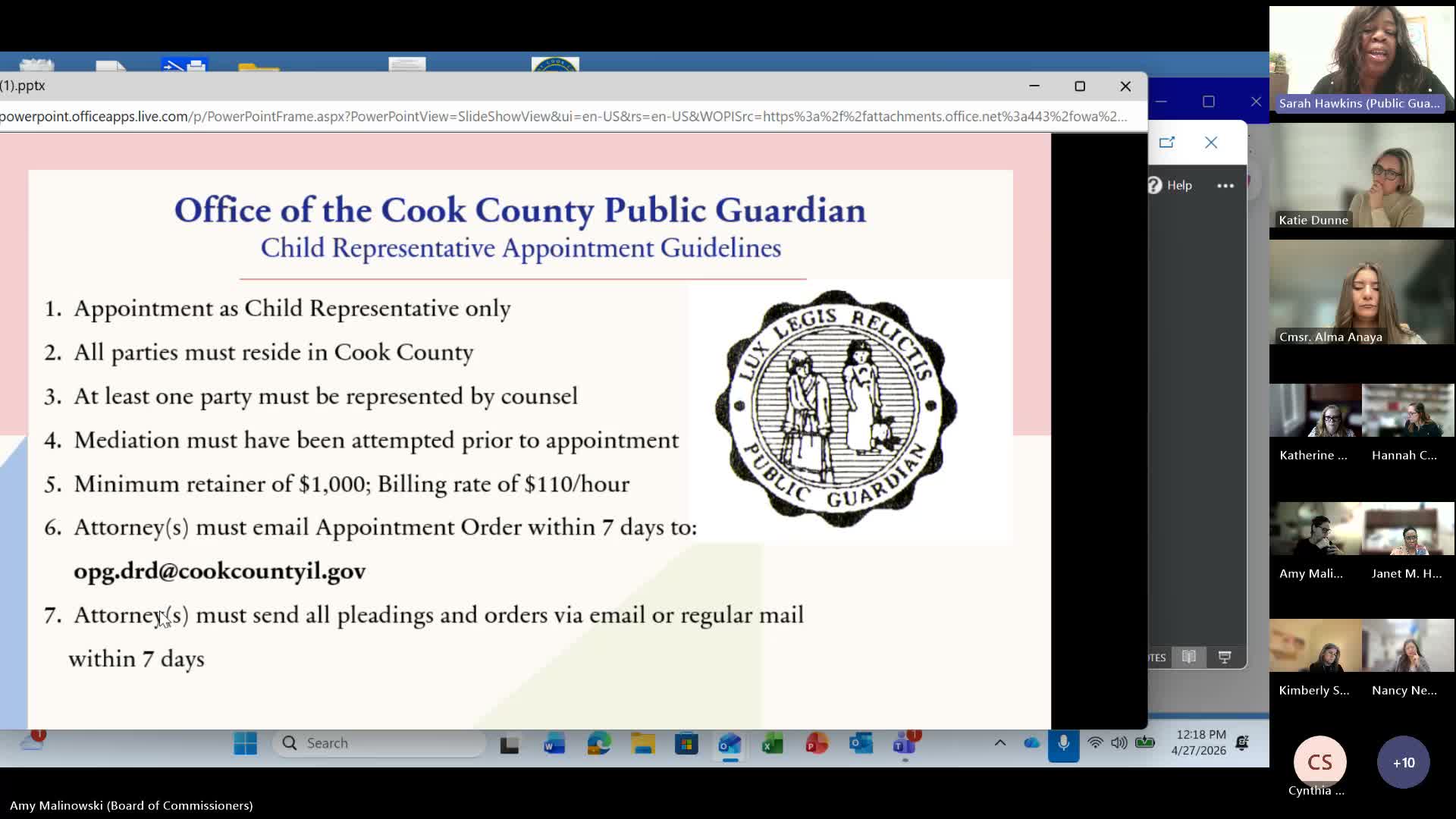
At a Cook County Violence Against Women Task Force working‑group meeting, Sarah Hawkins, director of the Domestic Relations Division of the Cook County Office of the Public Guardian (OPG), described how the office represents children in domestic relations matters, explained differences between child representatives and guardians ad litem (GALs), and outlined fees, intake procedures and plans to begin accepting GAL appointments.
Hawkins said the Domestic Relations Division — in operation since 1988 — is appointed by domestic‑relations judges in parentage, divorce, relocation (moves over 25 miles), orders of protection transferred from domestic‑violence court, visitation disputes and third‑party/ grandparent visitation cases. “We get appointed on cases where there are issues regarding visitation,” she said, and the office also drafts allocation‑of‑parental‑responsibilities judgments that set parenting time and decision‑making authority.
Hawkins emphasized the legal distinction between the child representative and a GAL. “The role of the child representative is to investigate,” she said. Child representatives interview parties, the child client and collateral witnesses, maintain attorney‑client confidentiality with the child, and take positions on what they believe is best for the child; unlike GALs, they do not serve as the court’s witness and are not appointed under the domestic‑violence statute (IDVA) for DV‑only cases. Hannah Cholowinski, senior division attorney in domestic relations, reiterated that the IDVA covers domestic‑violence issues and that GALs are not authorized under that statute, while other statutes and domestic relations rules govern DR cases.
On fees and billing, Hawkins said OPG uses a standard minimum retainer of $1,000 and an hourly billing rate of $110 but frequently negotiates payment plans and sometimes accepts smaller initial payments. “We are significantly less expensive than the private child reps and GALs,” she told the group, adding that private retainers can be several thousand dollars. Hawkins said appointment orders include OPG contact information and typically specify how the retainer is allocated (commonly split 50/50 between parties, though judges can assign different shares based on finances).
Hawkins described intake and case handling: attorneys on a case should send appointment orders and pleadings (OPG asks for these within seven days), OPG conducts a written intake and typically reaches out within 30 days to schedule initial appointments, and the division attempts mediation before accepting appointments where appropriate. She said there is no income cutoff for appointment; finances are a frequent reason judges appoint OPG because the office can connect families to low‑cost services and counseling providers.
The division also coordinates with the Department of Children and Family Services (DCFS) when appropriate and maintains referral networks for reunification therapy and supervised visitation. Hawkins said OPG started primarily at the Daley Center but, with videoconference tools, has expanded appointments and services at other Cook County courthouses including Markham, Rolling Meadows and Bridgeview and will travel for in‑person hearings when needed.
On capacity, Hawkins acknowledged peak periods and occasional limits on immediate availability: OPG may ask for extended court dates (for example, asking the court to move a 30‑day date to 60 days) and uses internal rotations to manage workloads. The division currently has six attorneys and said it handles roughly 10–15 new appointments per week and represents several hundred children (Hawkins estimated the office represents “somewhere between 900 and 950” children overall). She said OPG plans to add staff and train attorneys to accept GAL appointments in domestic relations court, a change the office is working toward.
Participants raised enforcement questions about unpaid fees and body‑attachment warrants. Hawkins said OPG typically remains on cases even when parties owe balances and that private attorneys are more likely to file petitions for rule to show cause seeking payment; she and Hannah Cholowinski recommended a separate session focused on court processes and body‑attachment procedures for a deeper procedural discussion.
The working group scheduled the related executive meeting for May 6 at 10 a.m. in the Cook County Boardroom to continue court‑process discussions and then adjourned.
Hawkins said the Domestic Relations Division — in operation since 1988 — is appointed by domestic‑relations judges in parentage, divorce, relocation (moves over 25 miles), orders of protection transferred from domestic‑violence court, visitation disputes and third‑party/ grandparent visitation cases. “We get appointed on cases where there are issues regarding visitation,” she said, and the office also drafts allocation‑of‑parental‑responsibilities judgments that set parenting time and decision‑making authority.
Hawkins emphasized the legal distinction between the child representative and a GAL. “The role of the child representative is to investigate,” she said. Child representatives interview parties, the child client and collateral witnesses, maintain attorney‑client confidentiality with the child, and take positions on what they believe is best for the child; unlike GALs, they do not serve as the court’s witness and are not appointed under the domestic‑violence statute (IDVA) for DV‑only cases. Hannah Cholowinski, senior division attorney in domestic relations, reiterated that the IDVA covers domestic‑violence issues and that GALs are not authorized under that statute, while other statutes and domestic relations rules govern DR cases.
On fees and billing, Hawkins said OPG uses a standard minimum retainer of $1,000 and an hourly billing rate of $110 but frequently negotiates payment plans and sometimes accepts smaller initial payments. “We are significantly less expensive than the private child reps and GALs,” she told the group, adding that private retainers can be several thousand dollars. Hawkins said appointment orders include OPG contact information and typically specify how the retainer is allocated (commonly split 50/50 between parties, though judges can assign different shares based on finances).
Hawkins described intake and case handling: attorneys on a case should send appointment orders and pleadings (OPG asks for these within seven days), OPG conducts a written intake and typically reaches out within 30 days to schedule initial appointments, and the division attempts mediation before accepting appointments where appropriate. She said there is no income cutoff for appointment; finances are a frequent reason judges appoint OPG because the office can connect families to low‑cost services and counseling providers.
The division also coordinates with the Department of Children and Family Services (DCFS) when appropriate and maintains referral networks for reunification therapy and supervised visitation. Hawkins said OPG started primarily at the Daley Center but, with videoconference tools, has expanded appointments and services at other Cook County courthouses including Markham, Rolling Meadows and Bridgeview and will travel for in‑person hearings when needed.
On capacity, Hawkins acknowledged peak periods and occasional limits on immediate availability: OPG may ask for extended court dates (for example, asking the court to move a 30‑day date to 60 days) and uses internal rotations to manage workloads. The division currently has six attorneys and said it handles roughly 10–15 new appointments per week and represents several hundred children (Hawkins estimated the office represents “somewhere between 900 and 950” children overall). She said OPG plans to add staff and train attorneys to accept GAL appointments in domestic relations court, a change the office is working toward.
Participants raised enforcement questions about unpaid fees and body‑attachment warrants. Hawkins said OPG typically remains on cases even when parties owe balances and that private attorneys are more likely to file petitions for rule to show cause seeking payment; she and Hannah Cholowinski recommended a separate session focused on court processes and body‑attachment procedures for a deeper procedural discussion.
The working group scheduled the related executive meeting for May 6 at 10 a.m. in the Cook County Boardroom to continue court‑process discussions and then adjourned.
Don't Miss a Word: See the Full Meeting!
Go beyond summaries. Unlock every video, transcript, and key insight with a Founder Membership.
✓
Get instant access to full meeting videos
✓
Search and clip any phrase from complete transcripts
✓
Receive AI-powered summaries & custom alerts
✓
Enjoy lifetime, unrestricted access to government data
30-day money-back guarantee
