Task force flags 72,274 active warrants in Cook County, urges coordinated response
April 27, 2026 | Cook County, Illinois
This article was created by AI summarizing key points discussed. AI makes mistakes, so for full details and context, please refer to the video of the full meeting. Please report any errors so we can fix them. Report an error »
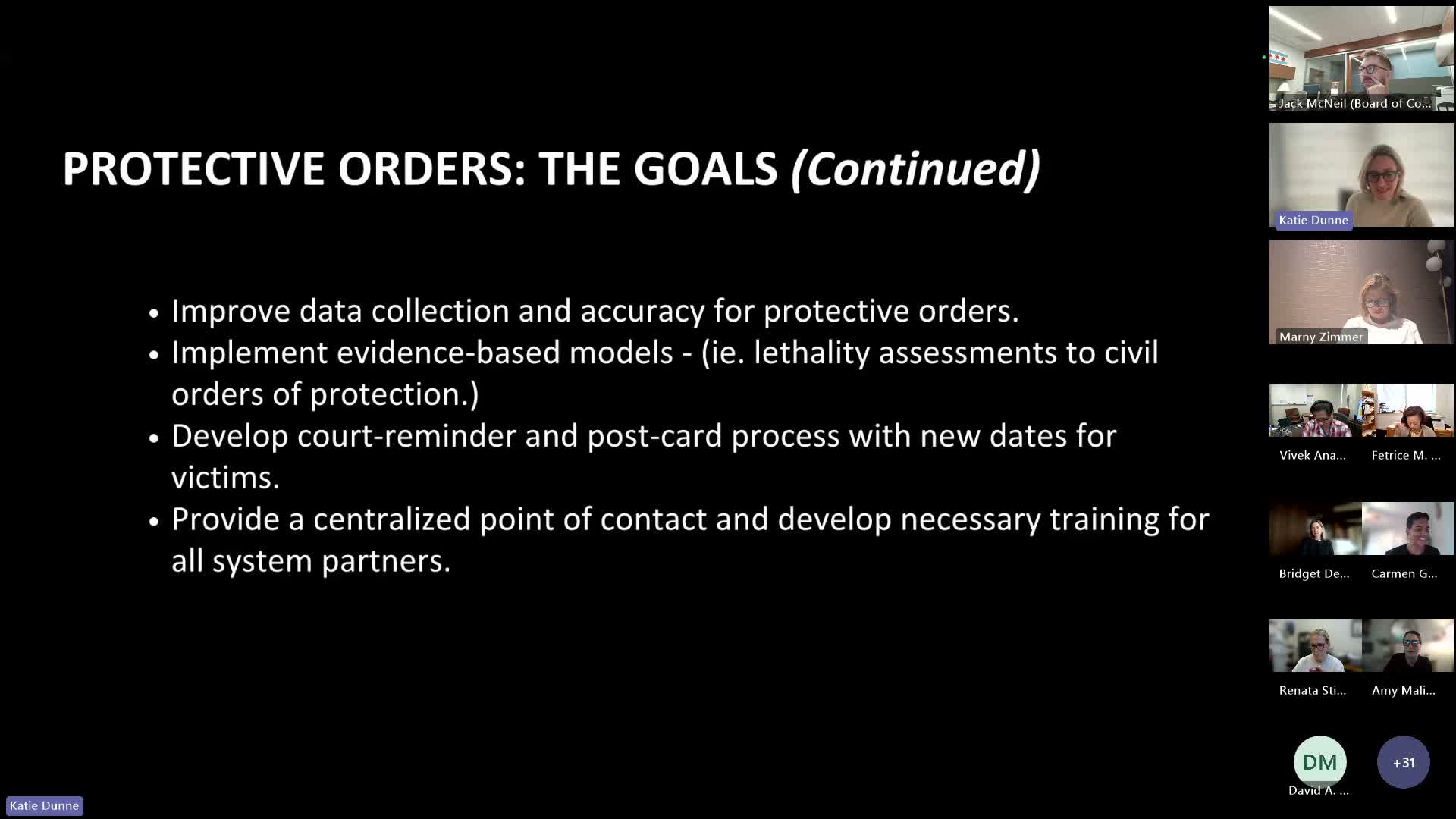
The Cook County Violence Against Women Task Force highlighted a large backlog of active warrants and urged coordinated data and service improvements to reduce risk to officers and the public. Katie Dunn (S3) told the group that a preliminary pull found “72,274 active warrants right now in Cook County,” and that roughly 7,500 were for domestic battery and violations of orders of protection.
Dunn said the number is up from a previous October 2024 pull that recorded about 42,000 criminal warrants (which did not include search warrants), and she attributed some of the increase to quashing efforts and the way cases are classified. “These numbers show that then those warrants are really just not being served,” she said, noting both public‑safety and operational consequences.
Clerk Vivek Ananda (S5) and other participants explained operational limits that create duplication and inefficiency: if a warrant is quashed but the removal is not propagated into LEADS, officers executing an arrest may spend four to six hours only to learn the warrant was no longer valid. That lag, Dunn said, is “the number one cause for arrest by the Chicago Police Department,” and she added that arrests initiated on warrants can take officers off the street for several hours, straining staffing and response capacity.
Participants asked for data access to audit and reconcile warrants. A meeting participant identified as Alfreda (S4) asked for a copy of the 72,000-warrant list to compare with local systems; Ian from OCJ (S9) also requested the list for internal OCJ use and said he would email the clerk’s office. Clerk Ananda agreed to follow up and said he could share the requested information.
Task force members discussed the potential for an expedited service track for domestic‑related warrants — modeled on specialized tracks such as GPS programs — when a victim or children are at risk, and noted that training, portal access and consistent reporting back to courts after firearm recoveries or warrant execution are essential for reliable data.
The group agreed to follow up offline on data sharing and cross‑agency reconciliation; participants said the task force will continue refining operational proposals alongside the proposed interagency data center and public dashboard.
Dunn said the number is up from a previous October 2024 pull that recorded about 42,000 criminal warrants (which did not include search warrants), and she attributed some of the increase to quashing efforts and the way cases are classified. “These numbers show that then those warrants are really just not being served,” she said, noting both public‑safety and operational consequences.
Clerk Vivek Ananda (S5) and other participants explained operational limits that create duplication and inefficiency: if a warrant is quashed but the removal is not propagated into LEADS, officers executing an arrest may spend four to six hours only to learn the warrant was no longer valid. That lag, Dunn said, is “the number one cause for arrest by the Chicago Police Department,” and she added that arrests initiated on warrants can take officers off the street for several hours, straining staffing and response capacity.
Participants asked for data access to audit and reconcile warrants. A meeting participant identified as Alfreda (S4) asked for a copy of the 72,000-warrant list to compare with local systems; Ian from OCJ (S9) also requested the list for internal OCJ use and said he would email the clerk’s office. Clerk Ananda agreed to follow up and said he could share the requested information.
Task force members discussed the potential for an expedited service track for domestic‑related warrants — modeled on specialized tracks such as GPS programs — when a victim or children are at risk, and noted that training, portal access and consistent reporting back to courts after firearm recoveries or warrant execution are essential for reliable data.
The group agreed to follow up offline on data sharing and cross‑agency reconciliation; participants said the task force will continue refining operational proposals alongside the proposed interagency data center and public dashboard.
Don't Miss a Word: See the Full Meeting!
Go beyond summaries. Unlock every video, transcript, and key insight with a Founder Membership.
✓
Get instant access to full meeting videos
✓
Search and clip any phrase from complete transcripts
✓
Receive AI-powered summaries & custom alerts
✓
Enjoy lifetime, unrestricted access to government data
30-day money-back guarantee
