Assembly health subcommittee reviews CDPH $5.1 billion budget; advocates urge funding for WIC, nursing‑home projects and CRDP
April 27, 2026 | California State Assembly, House, Legislative, California
This article was created by AI summarizing key points discussed. AI makes mistakes, so for full details and context, please refer to the video of the full meeting. Please report any errors so we can fix them. Report an error »
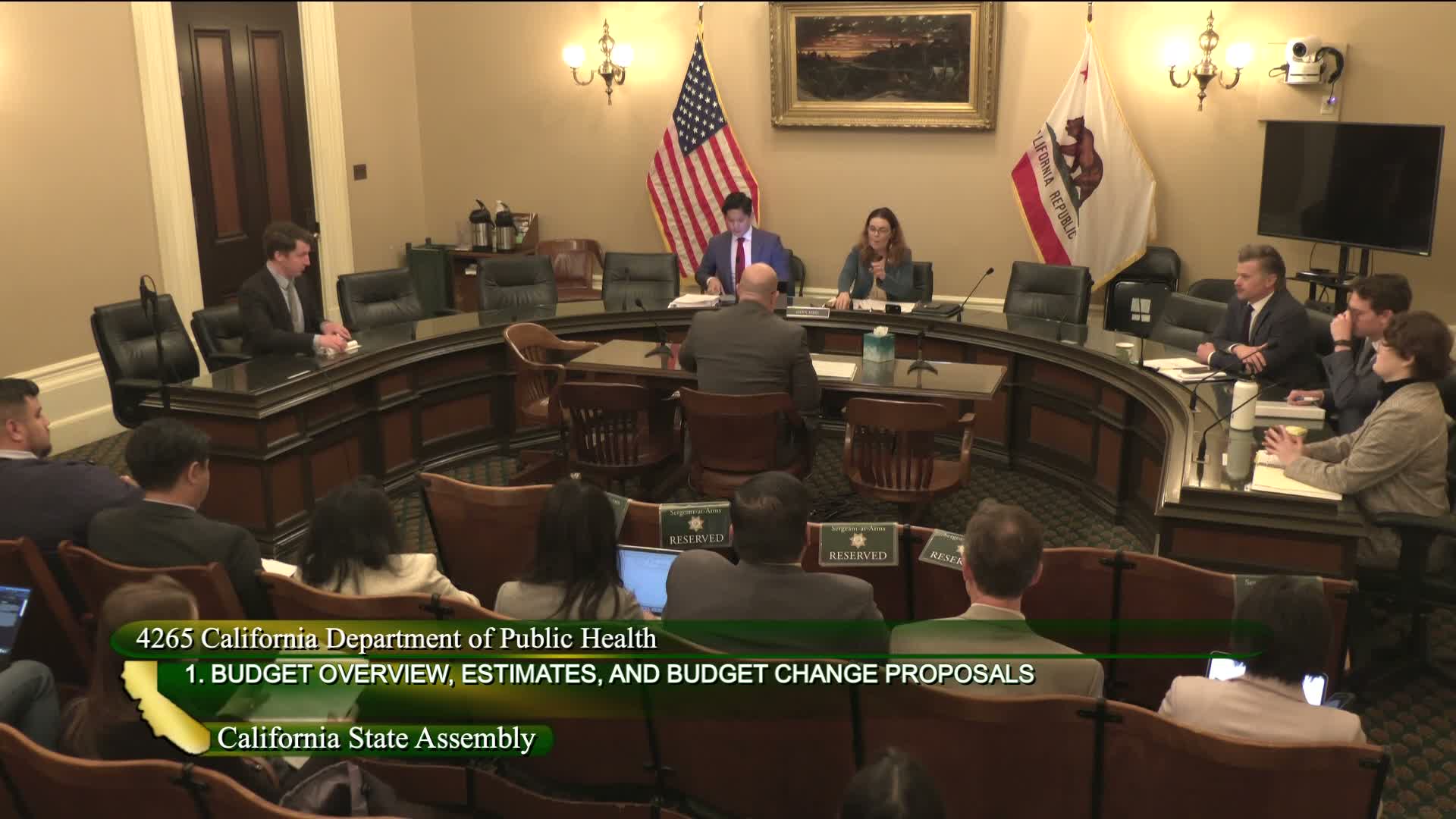
The Assembly Subcommittee No. 1 on Health on Wednesday heard an overview of the California Department of Public Health's proposed $5.1 billion budget and dozens of budget‑change proposals.
"CDPH operates a budget of 5,100,000,000 to support all of our programs," said Brandon Nunes, the department's chief deputy for operations, who briefed members on the request and a package of 19 non‑IT BCPs. Nunes said the total represented a roughly 2.1% increase from last year's Budget Act, with about $1.8 billion for state operations and $3.3 billion for local assistance. He described funding sources as roughly $2.3 billion federal funds, $2.2 billion special funds and $625 million general fund.
Nunes highlighted proposals across CDPH centers, including a $4.6 million request for the Center for Environmental Health to cover operational costs for inspecting x‑ray facilities; a $5.9 million quality‑improvement account request to streamline facility licensing; a $5 million authorization to award federal penalty funds to CMS‑approved local nursing‑home projects; and requests for staffing and implementation tied to perinatal pilots and rapid‑response teams. He said the Genetic Disease Screening Program is requesting $175 million for 2026–27, a modest 0.3% increase, and projected newborn and prenatal participation to be ‘‘relatively stable.’’ WIC food expenditures were estimated at $1.1 billion, a 6.4% rise driven by food‑price inflation.
Members pressed CDPH on program drivers. When asked about the small decline in newborn‑screening caseloads, Nunes said caseload largely follows births and reflected a slight downtrend. Faridha Chaudhary, WIC division director, said continuity remained a top priority after the 2025 federal funding lapse: "We were fortunate to be able to receive contingency funding from USDA and then also secure that general fund loan. Those strategies continue to remain in our pocket to respond as effectively as possible." She added CDPH saw a small dip in enrollment after the shutdown, which she attributed to public confusion despite outreach.
Public commenters urged targeted allocations within the CDPH request. George Cruz of the California Behavioral Health Association asked the committee to direct $30 million of a cited $50 million behavioral‑health service fund to sustain the California Reducing Disparities Project (CRDP). "Use 30,000,000 of that to fund the California Reducing Disparities Project for 2 additional years," Cruz said. Multiple CRDP grantees and community providers — including Clinica de la Rosa, Health Education Council and Asian American Recovery Services — also urged continued funding, describing local impacts and culturally informed prevention models.
Sarah Diaz of the California WIC Association praised CDPH's near completion of a new food package: "This vital targeted short term benefit supports about 1000000 Californians each month and has proven positive outcomes with great impact." Diaz warned that federal proposals under HR1 could raise administrative burdens by removing adjunctive eligibility tied to Medi‑Cal and CalFresh enrollment.
Other public commenters supported specific BCPs: the Mosquito and Vector Control Association thanked CDPH for a vector‑borne disease proposal, and medical groups backed the nursing‑home and hospital‑capacity efforts.
The subcommittee moved the record to subsequent agenda items after public comment. No formal votes were taken on the CDPH proposals at the hearing; the budget process will continue through the May revise and later legislative steps.
"CDPH operates a budget of 5,100,000,000 to support all of our programs," said Brandon Nunes, the department's chief deputy for operations, who briefed members on the request and a package of 19 non‑IT BCPs. Nunes said the total represented a roughly 2.1% increase from last year's Budget Act, with about $1.8 billion for state operations and $3.3 billion for local assistance. He described funding sources as roughly $2.3 billion federal funds, $2.2 billion special funds and $625 million general fund.
Nunes highlighted proposals across CDPH centers, including a $4.6 million request for the Center for Environmental Health to cover operational costs for inspecting x‑ray facilities; a $5.9 million quality‑improvement account request to streamline facility licensing; a $5 million authorization to award federal penalty funds to CMS‑approved local nursing‑home projects; and requests for staffing and implementation tied to perinatal pilots and rapid‑response teams. He said the Genetic Disease Screening Program is requesting $175 million for 2026–27, a modest 0.3% increase, and projected newborn and prenatal participation to be ‘‘relatively stable.’’ WIC food expenditures were estimated at $1.1 billion, a 6.4% rise driven by food‑price inflation.
Members pressed CDPH on program drivers. When asked about the small decline in newborn‑screening caseloads, Nunes said caseload largely follows births and reflected a slight downtrend. Faridha Chaudhary, WIC division director, said continuity remained a top priority after the 2025 federal funding lapse: "We were fortunate to be able to receive contingency funding from USDA and then also secure that general fund loan. Those strategies continue to remain in our pocket to respond as effectively as possible." She added CDPH saw a small dip in enrollment after the shutdown, which she attributed to public confusion despite outreach.
Public commenters urged targeted allocations within the CDPH request. George Cruz of the California Behavioral Health Association asked the committee to direct $30 million of a cited $50 million behavioral‑health service fund to sustain the California Reducing Disparities Project (CRDP). "Use 30,000,000 of that to fund the California Reducing Disparities Project for 2 additional years," Cruz said. Multiple CRDP grantees and community providers — including Clinica de la Rosa, Health Education Council and Asian American Recovery Services — also urged continued funding, describing local impacts and culturally informed prevention models.
Sarah Diaz of the California WIC Association praised CDPH's near completion of a new food package: "This vital targeted short term benefit supports about 1000000 Californians each month and has proven positive outcomes with great impact." Diaz warned that federal proposals under HR1 could raise administrative burdens by removing adjunctive eligibility tied to Medi‑Cal and CalFresh enrollment.
Other public commenters supported specific BCPs: the Mosquito and Vector Control Association thanked CDPH for a vector‑borne disease proposal, and medical groups backed the nursing‑home and hospital‑capacity efforts.
The subcommittee moved the record to subsequent agenda items after public comment. No formal votes were taken on the CDPH proposals at the hearing; the budget process will continue through the May revise and later legislative steps.
View the Full Meeting & All Its Details
This article offers just a summary. Unlock complete video, transcripts, and insights as a Founder Member.
✓
Watch full, unedited meeting videos
✓
Search every word spoken in unlimited transcripts
✓
AI summaries & real-time alerts (all government levels)
✓
Permanent access to expanding government content
30-day money-back guarantee
