Stakeholders warn against defunding CDPH IT systems as DOF proposes limited funding
April 27, 2026 | California State Assembly, House, Legislative, California
This article was created by AI summarizing key points discussed. AI makes mistakes, so for full details and context, please refer to the video of the full meeting. Please report any errors so we can fix them. Report an error »
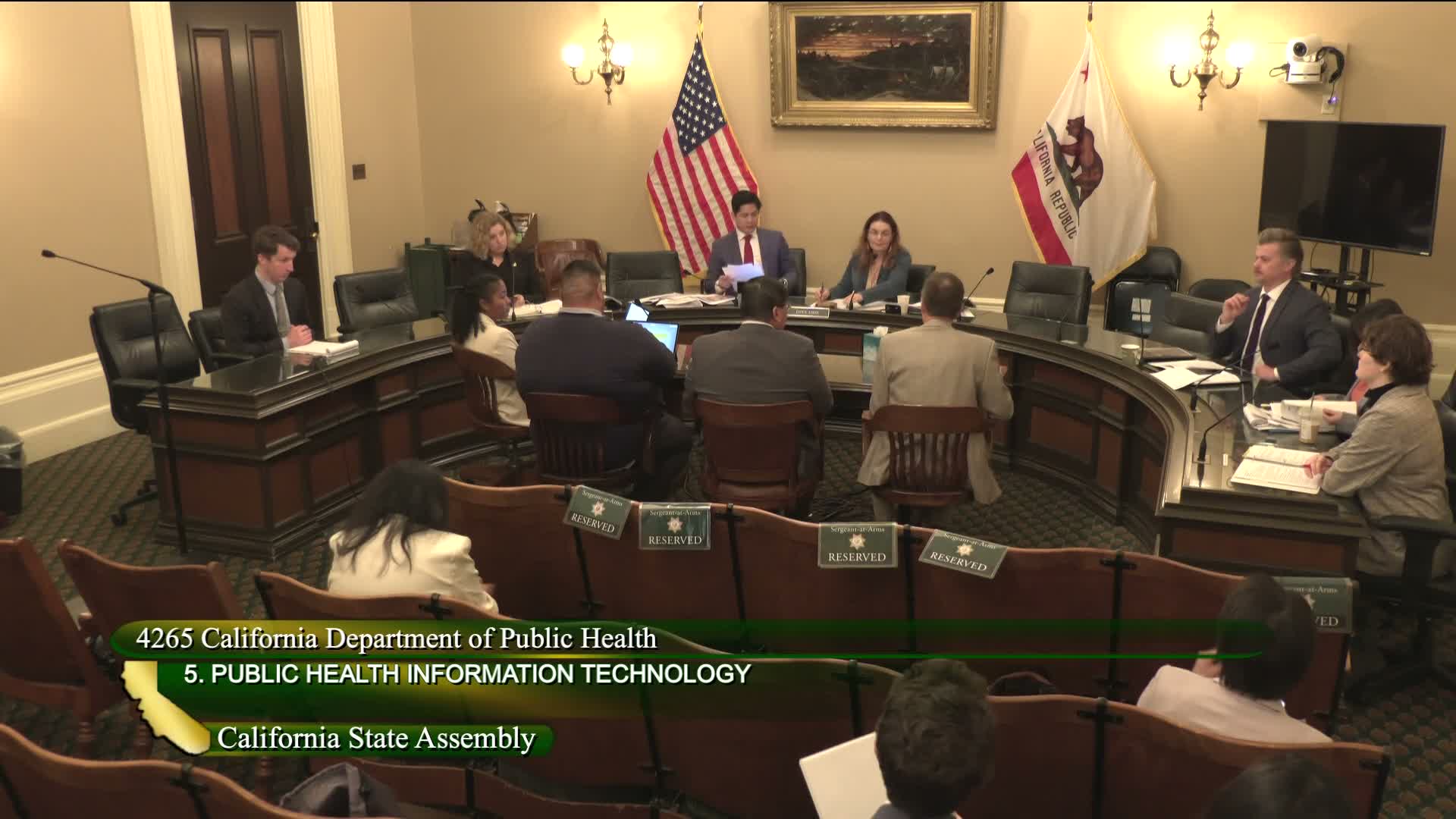
The Assembly Subcommittee heard a technical overview of California's core public‑health information systems and a dispute over which tools the governor's budget will fund.
"I think it's helpful to think of these systems ... as two related ecosystems," said James Watt, deputy director for infectious diseases at the California Department of Public Health, explaining that disease monitoring (SAFIRE, CalREDIE, CalConnect) and immunization systems (CARE/CAIR, Vaccine Management System/VMS, MyTurn, MyCAVAX) together support lab reporting, case investigation, immunization records and vaccine ordering.
Watt described workflows: labs and electronic health records send test data that SAFIRE and CalREDIE process and route to local health‑department workspaces; CalConnect supports contact tracing and automated communications; the immunization registry (CARE) and vaccine‑management systems track doses and enable provider queries.
Brio Thompson of the Department of Finance said the governor's budget includes funding for SAFIRE and continued funding for CalREDIE, but not for CalConnect, CARE or the vaccine‑management systems. Thompson said the administration is conducting a cost‑utility assessment and cited significantly lower post‑pandemic utilization for some systems.
Local health‑department representatives pushed back. "Public health information technology, it's not a nice to have. It's a must have," said Michelle Gibbons of the County Health Executives Association of California, warning that losing CalConnect and CARE would force manual spreadsheets, hamper contact tracing and limit the ability to quickly determine who is vaccinated during an outbreak.
Thompson said utilization of some systems has declined since the pandemic (he cited a roughly 90% fall in CalConnect records from peak volumes), and DOF will use that data in its review. Multiple committee members said the administration should either fund the systems through the May revise or present a clear plan and timeline for any phase‑out, noting the risk that defunding automation will make emergency response slower and more labor‑intensive.
No formal budget action occurred at the hearing; members signaled they expect more detail and possible budget adjustments at May revise.
"I think it's helpful to think of these systems ... as two related ecosystems," said James Watt, deputy director for infectious diseases at the California Department of Public Health, explaining that disease monitoring (SAFIRE, CalREDIE, CalConnect) and immunization systems (CARE/CAIR, Vaccine Management System/VMS, MyTurn, MyCAVAX) together support lab reporting, case investigation, immunization records and vaccine ordering.
Watt described workflows: labs and electronic health records send test data that SAFIRE and CalREDIE process and route to local health‑department workspaces; CalConnect supports contact tracing and automated communications; the immunization registry (CARE) and vaccine‑management systems track doses and enable provider queries.
Brio Thompson of the Department of Finance said the governor's budget includes funding for SAFIRE and continued funding for CalREDIE, but not for CalConnect, CARE or the vaccine‑management systems. Thompson said the administration is conducting a cost‑utility assessment and cited significantly lower post‑pandemic utilization for some systems.
Local health‑department representatives pushed back. "Public health information technology, it's not a nice to have. It's a must have," said Michelle Gibbons of the County Health Executives Association of California, warning that losing CalConnect and CARE would force manual spreadsheets, hamper contact tracing and limit the ability to quickly determine who is vaccinated during an outbreak.
Thompson said utilization of some systems has declined since the pandemic (he cited a roughly 90% fall in CalConnect records from peak volumes), and DOF will use that data in its review. Multiple committee members said the administration should either fund the systems through the May revise or present a clear plan and timeline for any phase‑out, noting the risk that defunding automation will make emergency response slower and more labor‑intensive.
No formal budget action occurred at the hearing; members signaled they expect more detail and possible budget adjustments at May revise.
View the Full Meeting & All Its Details
This article offers just a summary. Unlock complete video, transcripts, and insights as a Founder Member.
✓
Watch full, unedited meeting videos
✓
Search every word spoken in unlimited transcripts
✓
AI summaries & real-time alerts (all government levels)
✓
Permanent access to expanding government content
30-day money-back guarantee
