State agencies say long‑term care protections exist for transgender residents; advocates press for stronger enforcement
April 27, 2026 | California State Senate, Senate, Legislative, California
This article was created by AI summarizing key points discussed. AI makes mistakes, so for full details and context, please refer to the video of the full meeting. Please report any errors so we can fix them. Report an error »
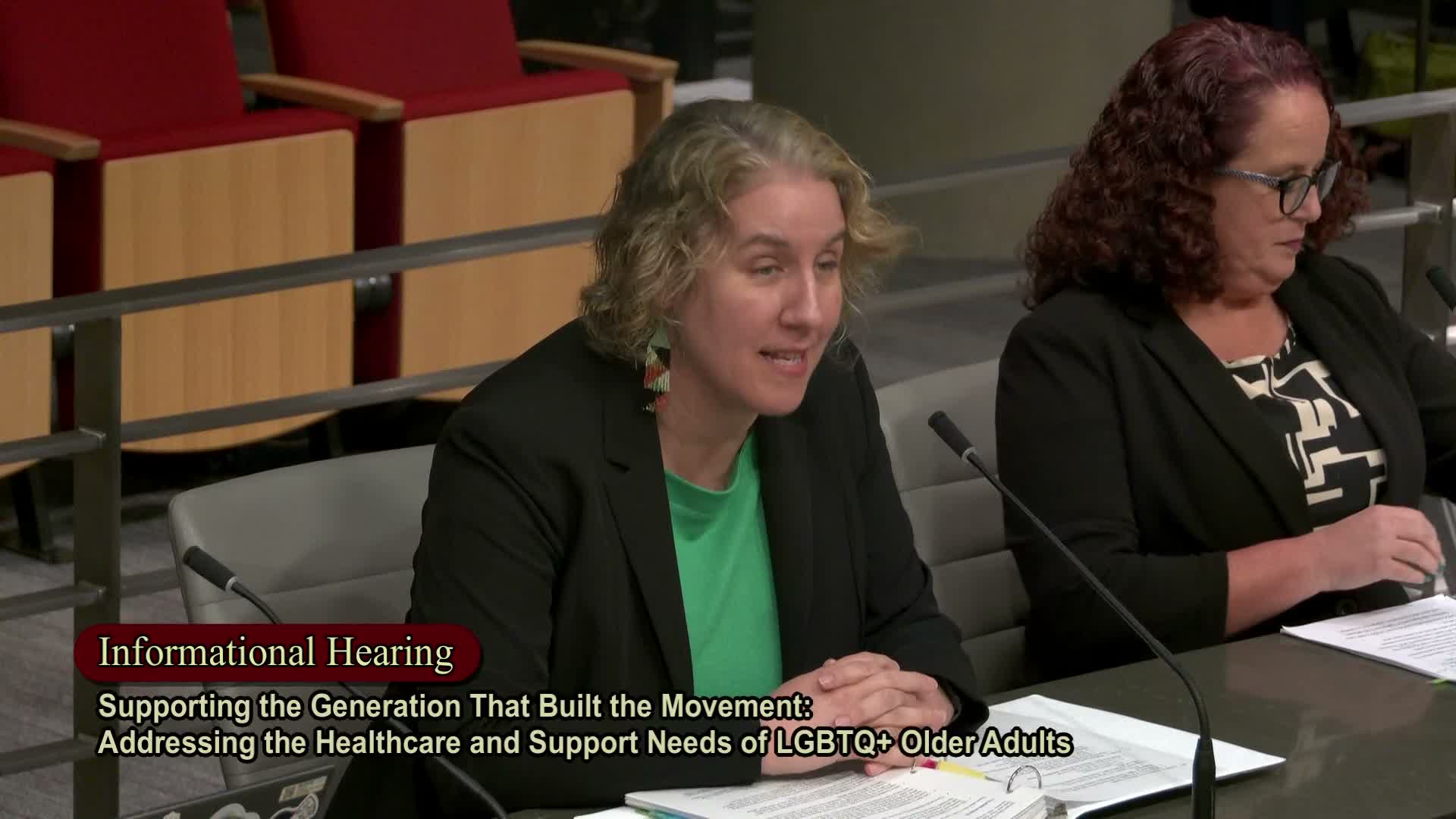
State licensing and public health officials told a Senate select committee they have statutory and regulatory tools to protect transgender, gender‑diverse and HIV‑positive residents in long‑term care facilities, but advocates said enforcement and front‑line practice still fall short.
Claire Ramsey of the Department of Social Services described licensing oversight for more than 15,600 adult and senior care facilities and recounted steps taken after passage of SB 219: provider information notices (PINs), required posting of nondiscrimination notices and the residents' bill of rights, regulatory changes to record preferred name/pronouns, and annual inspection practices. "We do have mechanisms in place to both hear about problems and then to follow‑up and require plans of compliance," she said.
Heather Chamizo of the California Department of Public Health said CDPH added SB 219 provisions to her agency's survey tool and reported that in the last five years CDPH received zero complaints and recorded two deficiencies during routine licensure surveys. Chamizo described the deficiency process, plan‑of‑correction timelines and revisit surveys to ensure compliance.
Advocates, including Bambi Salcedo of the Trans Latin Coalition, told the committee that structural barriers persist: a high share of frontline caregivers are people of color with varied cultural and religious beliefs, residents may not know how to file complaints, and some residents enter facilities without access to gender‑affirming care. Salcedo urged stronger enforcement, sustained funding for culturally competent care and peer‑led models.
Senator Scott Wiener, author of SB 219, noted that low complaint counts are encouraging but asked whether the low numbers reflect good compliance or underreporting. Department officials described complaint investigation timelines (an initial on‑site visit within 10 days), options for plans of correction, civil penalties and license revocation for serious or repeated violations.
The committee asked agencies to return with more detailed complaint statistics and to consider ways to ensure that required training for administrators and staff translates into safer daily practice for residents. No legislation was adopted at the hearing.
Claire Ramsey of the Department of Social Services described licensing oversight for more than 15,600 adult and senior care facilities and recounted steps taken after passage of SB 219: provider information notices (PINs), required posting of nondiscrimination notices and the residents' bill of rights, regulatory changes to record preferred name/pronouns, and annual inspection practices. "We do have mechanisms in place to both hear about problems and then to follow‑up and require plans of compliance," she said.
Heather Chamizo of the California Department of Public Health said CDPH added SB 219 provisions to her agency's survey tool and reported that in the last five years CDPH received zero complaints and recorded two deficiencies during routine licensure surveys. Chamizo described the deficiency process, plan‑of‑correction timelines and revisit surveys to ensure compliance.
Advocates, including Bambi Salcedo of the Trans Latin Coalition, told the committee that structural barriers persist: a high share of frontline caregivers are people of color with varied cultural and religious beliefs, residents may not know how to file complaints, and some residents enter facilities without access to gender‑affirming care. Salcedo urged stronger enforcement, sustained funding for culturally competent care and peer‑led models.
Senator Scott Wiener, author of SB 219, noted that low complaint counts are encouraging but asked whether the low numbers reflect good compliance or underreporting. Department officials described complaint investigation timelines (an initial on‑site visit within 10 days), options for plans of correction, civil penalties and license revocation for serious or repeated violations.
The committee asked agencies to return with more detailed complaint statistics and to consider ways to ensure that required training for administrators and staff translates into safer daily practice for residents. No legislation was adopted at the hearing.
View the Full Meeting & All Its Details
This article offers just a summary. Unlock complete video, transcripts, and insights as a Founder Member.
✓
Watch full, unedited meeting videos
✓
Search every word spoken in unlimited transcripts
✓
AI summaries & real-time alerts (all government levels)
✓
Permanent access to expanding government content
30-day money-back guarantee
