Connecticut extends and reshapes state solar and storage programs, setting targets and pilot studies
May 01, 2026 | 2026 Legislature CT, Connecticut
This article was created by AI summarizing key points discussed. AI makes mistakes, so for full details and context, please refer to the video of the full meeting. Please report any errors so we can fix them. Report an error »
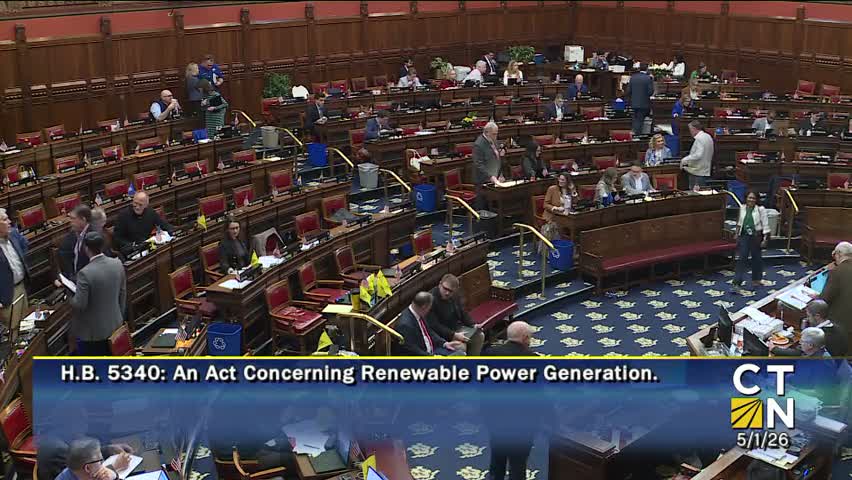
The House on Friday approved an expansive renewable-energy package that extends existing solar incentive programs, creates new budget targets, and tasks regulators and the Connecticut Green Bank to run pilot studies for battery storage.
Sponsor Representative Steinberg said the bill preserves state support for residential and community solar while giving regulators the flexibility to manage a single umbrella budget target across the successor programs. "We give PURA the agility to make corrections as market conditions change," he said in floor remarks. The bill sets a working budget target (discussed on the floor as $85 million per year in the initial formulation) and requires detailed monitoring and data-sharing between utilities, PURA and state agencies.
A key change is a strong emphasis on pairing storage with solar. Supporters cited preliminary Ratepayer Impact Metric (RIM) analysis for existing storage pilots that showed a ratio greater than 1.0, meaning more system value was realized than cost when solar and batteries operate together. Representative Steinberg described storage as "the key to unlocking the full value of solar" and said the Green Bank will run a pilot to test storage benefits across community contexts.
The bill also creates or strengthens: a community (shared) solar program focused on serving lower‑income customers, standards and a consumer-safety and disclosure framework for plug‑in portable solar devices, a task force on agrivoltaics (combining farming and limited solar arrays), and statewide guidance for streamlined permitting (including an off‑the‑shelf permitting app DEEP can offer to municipalities).
Opponents urged caution. Several lawmakers pressed for clear ratepayer-impact studies before committing long-term targets; Representative Mara proposed an amendment requiring completion of recently requested studies before program roll-out (that amendment failed on the floor). Critics argued repeated 20‑year tariff commitments could lock future ratepayers into long obligations and emphasized preserving prime farmland from large ground-mount arrays.
The House adopted the bill and recorded the roll-call; sponsors said PURA and DEEP will be responsible for implementing program details, and that the bill includes consumer protections (plain-language contracts, notice periods, safety standards and training for emergency responders). Proponents pointed to job growth in Connecticut's clean-energy sector and argued the investments support local resilience and peak-demand reductions.
Sponsor Representative Steinberg said the bill preserves state support for residential and community solar while giving regulators the flexibility to manage a single umbrella budget target across the successor programs. "We give PURA the agility to make corrections as market conditions change," he said in floor remarks. The bill sets a working budget target (discussed on the floor as $85 million per year in the initial formulation) and requires detailed monitoring and data-sharing between utilities, PURA and state agencies.
A key change is a strong emphasis on pairing storage with solar. Supporters cited preliminary Ratepayer Impact Metric (RIM) analysis for existing storage pilots that showed a ratio greater than 1.0, meaning more system value was realized than cost when solar and batteries operate together. Representative Steinberg described storage as "the key to unlocking the full value of solar" and said the Green Bank will run a pilot to test storage benefits across community contexts.
The bill also creates or strengthens: a community (shared) solar program focused on serving lower‑income customers, standards and a consumer-safety and disclosure framework for plug‑in portable solar devices, a task force on agrivoltaics (combining farming and limited solar arrays), and statewide guidance for streamlined permitting (including an off‑the‑shelf permitting app DEEP can offer to municipalities).
Opponents urged caution. Several lawmakers pressed for clear ratepayer-impact studies before committing long-term targets; Representative Mara proposed an amendment requiring completion of recently requested studies before program roll-out (that amendment failed on the floor). Critics argued repeated 20‑year tariff commitments could lock future ratepayers into long obligations and emphasized preserving prime farmland from large ground-mount arrays.
The House adopted the bill and recorded the roll-call; sponsors said PURA and DEEP will be responsible for implementing program details, and that the bill includes consumer protections (plain-language contracts, notice periods, safety standards and training for emergency responders). Proponents pointed to job growth in Connecticut's clean-energy sector and argued the investments support local resilience and peak-demand reductions.
View the Full Meeting & All Its Details
This article offers just a summary. Unlock complete video, transcripts, and insights as a Founder Member.
✓
Watch full, unedited meeting videos
✓
Search every word spoken in unlimited transcripts
✓
AI summaries & real-time alerts (all government levels)
✓
Permanent access to expanding government content
30-day money-back guarantee
