Yuma County presses state agencies over biosolids dumping as residents raise groundwater and fly concerns
May 04, 2026 | Yuma County, Arizona
This article was created by AI summarizing key points discussed. AI makes mistakes, so for full details and context, please refer to the video of the full meeting. Please report any errors so we can fix them. Report an error »
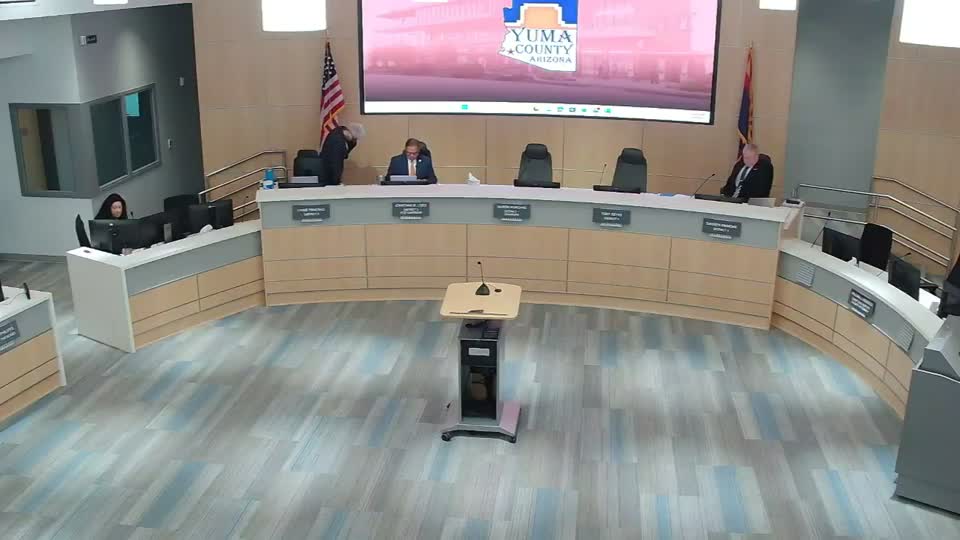
Vice Chairman Lines opened the meeting by telling residents the Board has spent more than six years asking the Arizona Department of Environmental Quality and the State Land Department to stop land application of biosolids in Yuma County and to seek alternative disposal outside the county. He said the Board's members had sent formal letters, pursued legislation and met with state officials, including a recent meeting with the ADEQ director and the State Land Department to press for stronger oversight and alternatives.
Resident Rodney Williams told the Board he has decades of experience in agriculture and waste treatment and warned that improper biosolids disposal threatens groundwater. "This is not being done anywhere near according to EPA guidelines," Williams said, arguing the principal risk is to the aquifer under the Salton Sea basin. He cited a 2008 Lawrence Livermore Labs study and estimated large recoverable groundwater volumes while urging county and state action and offering his technical expertise.
Board members said they had asked ADEQ and State Lands to enforce pathogen-reduction requirements and to treat biosolids combined with solid waste as solid waste when appropriate. Vice Chairman Lines reported that ADEQ told the Board it has conducted site visits and will present a complaint-based report connected to fly complaints; the Board also said it had asked cities that send biosolids to seek alternative disposal.
Alexis Sussdorf, filling in for the county's legislative liaison, told the Board the state's "state land continuation" language and related bills are being monitored closely because they could affect lease holdovers such as the AgTech site. She said the county's advocacy had helped prompt tightened language at the state level but that enforcement and some decision points remain in state hands.
The Board and residents emphasized transparency: residents asked that the Board and ADEQ release records used to support county letters and any environmental testing or enforcement reports. The Board said it would continue pressing legislators and state agencies and would seek real-time cost estimates from State Lands regarding improvements tied to lease termination or holdover remedies.
The meeting produced no formal county ordinance or vote on the matter; Board members framed the item as ongoing intergovernmental advocacy and monitoring rather than a final county action. The county encouraged residents to continue filing complaints and public-record requests and said it will continue pursuing legislative and administrative remedies.
Resident Rodney Williams told the Board he has decades of experience in agriculture and waste treatment and warned that improper biosolids disposal threatens groundwater. "This is not being done anywhere near according to EPA guidelines," Williams said, arguing the principal risk is to the aquifer under the Salton Sea basin. He cited a 2008 Lawrence Livermore Labs study and estimated large recoverable groundwater volumes while urging county and state action and offering his technical expertise.
Board members said they had asked ADEQ and State Lands to enforce pathogen-reduction requirements and to treat biosolids combined with solid waste as solid waste when appropriate. Vice Chairman Lines reported that ADEQ told the Board it has conducted site visits and will present a complaint-based report connected to fly complaints; the Board also said it had asked cities that send biosolids to seek alternative disposal.
Alexis Sussdorf, filling in for the county's legislative liaison, told the Board the state's "state land continuation" language and related bills are being monitored closely because they could affect lease holdovers such as the AgTech site. She said the county's advocacy had helped prompt tightened language at the state level but that enforcement and some decision points remain in state hands.
The Board and residents emphasized transparency: residents asked that the Board and ADEQ release records used to support county letters and any environmental testing or enforcement reports. The Board said it would continue pressing legislators and state agencies and would seek real-time cost estimates from State Lands regarding improvements tied to lease termination or holdover remedies.
The meeting produced no formal county ordinance or vote on the matter; Board members framed the item as ongoing intergovernmental advocacy and monitoring rather than a final county action. The county encouraged residents to continue filing complaints and public-record requests and said it will continue pursuing legislative and administrative remedies.
Don't Miss a Word: See the Full Meeting!
Go beyond summaries. Unlock every video, transcript, and key insight with a Founder Membership.
✓
Get instant access to full meeting videos
✓
Search and clip any phrase from complete transcripts
✓
Receive AI-powered summaries & custom alerts
✓
Enjoy lifetime, unrestricted access to government data
30-day money-back guarantee
