House adopts statewide ban on students’ cellphones during school day after lengthy floor debate
April 27, 2026 | 2026 Legislature CT, Connecticut
This article was created by AI summarizing key points discussed. AI makes mistakes, so for full details and context, please refer to the video of the full meeting. Please report any errors so we can fix them. Report an error »
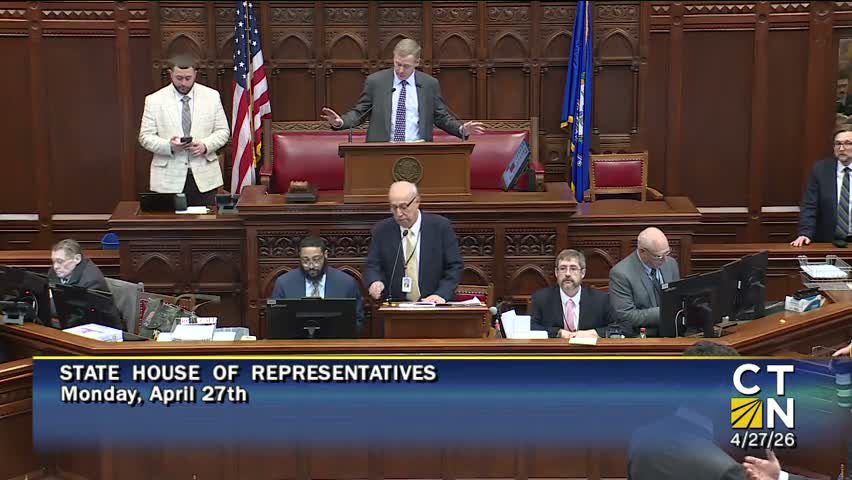
The Connecticut House on Monday passed HB 5035, a bill requiring every local board of education to adopt a policy prohibiting students from accessing personal wireless communication devices on school grounds from bell to bell while allowing exemptions for individualized education programs, 504 plans and licensed medical determinations. Representative Jen Lieber, chair of the Education Committee, led floor debate and presented the bill as a statewide backstop to the patchwork of district policies, saying districts that adopt bell-to-bell bans reported smoother transitions and greater student engagement.
Supporters said the measure addresses a broad concern about students’ attention and mental health. Representative Comey, who described pilots in her district, said districts that implemented bell-to-bell policies reported improved peer interaction and classroom focus. Representative Leeper and other proponents cited teacher and superintendent testimony asking for a single statewide standard to reduce enforcement burden on educators.
Opponents pressed on local control, practical enforcement and cost. Several members including Representatives Scott and Howard argued many districts already have effective, tailored policies and warned the bill creates an unfunded mandate. Representative Zepkus and others questioned how towns with limited facilities or budgets would provide storage or enforce rules, and warned teachers might be left to police students’ devices. Representative Master Francesco offered an amendment to include teachers and administrators in the ban (House Amendment Schedule B), arguing leaders should “practice what we preach”; that amendment failed on a roll call.
Lieber said the bill deliberately leaves storage and discipline procedures to local boards while setting uniform goals and that no statewide penalties are included in the text. The bill also permits limited device use for medically necessary purposes tied to IEPs and 504s, and allows districts to craft local implementation details such as use of pouches, lockers or other storage.
The House debated enforcement mechanics, the role of school safety plans and fiscal impacts, and rejected a proposed amendment to require teachers and administrators to follow the same prohibition (the amendment failed on a roll call). The bill carried an amendment on the floor and was passed as amended. Final roll-call results were read on the floor at the close of the session. The law requires districts to adopt policies and communicate them to families; the Department of Education previously published model policies and will be expected to provide guidance as schools implement the new requirement.
What’s next: With House passage, the bill moves to the Senate for consideration; implementation details—how districts choose storage, discipline, and whether state or bond funds will assist purchases such as pouches—are likely to shape debates ahead of final enactment.
Supporters said the measure addresses a broad concern about students’ attention and mental health. Representative Comey, who described pilots in her district, said districts that implemented bell-to-bell policies reported improved peer interaction and classroom focus. Representative Leeper and other proponents cited teacher and superintendent testimony asking for a single statewide standard to reduce enforcement burden on educators.
Opponents pressed on local control, practical enforcement and cost. Several members including Representatives Scott and Howard argued many districts already have effective, tailored policies and warned the bill creates an unfunded mandate. Representative Zepkus and others questioned how towns with limited facilities or budgets would provide storage or enforce rules, and warned teachers might be left to police students’ devices. Representative Master Francesco offered an amendment to include teachers and administrators in the ban (House Amendment Schedule B), arguing leaders should “practice what we preach”; that amendment failed on a roll call.
Lieber said the bill deliberately leaves storage and discipline procedures to local boards while setting uniform goals and that no statewide penalties are included in the text. The bill also permits limited device use for medically necessary purposes tied to IEPs and 504s, and allows districts to craft local implementation details such as use of pouches, lockers or other storage.
The House debated enforcement mechanics, the role of school safety plans and fiscal impacts, and rejected a proposed amendment to require teachers and administrators to follow the same prohibition (the amendment failed on a roll call). The bill carried an amendment on the floor and was passed as amended. Final roll-call results were read on the floor at the close of the session. The law requires districts to adopt policies and communicate them to families; the Department of Education previously published model policies and will be expected to provide guidance as schools implement the new requirement.
What’s next: With House passage, the bill moves to the Senate for consideration; implementation details—how districts choose storage, discipline, and whether state or bond funds will assist purchases such as pouches—are likely to shape debates ahead of final enactment.
Don't Miss a Word: See the Full Meeting!
Go beyond summaries. Unlock every video, transcript, and key insight with a Founder Membership.
✓
Get instant access to full meeting videos
✓
Search and clip any phrase from complete transcripts
✓
Receive AI-powered summaries & custom alerts
✓
Enjoy lifetime, unrestricted access to government data
30-day money-back guarantee
