House OKs rapid-response plan for invasive aquatic species and creates pesticide working group
April 27, 2026 | 2026 Legislature CT, Connecticut
This article was created by AI summarizing key points discussed. AI makes mistakes, so for full details and context, please refer to the video of the full meeting. Please report any errors so we can fix them. Report an error »
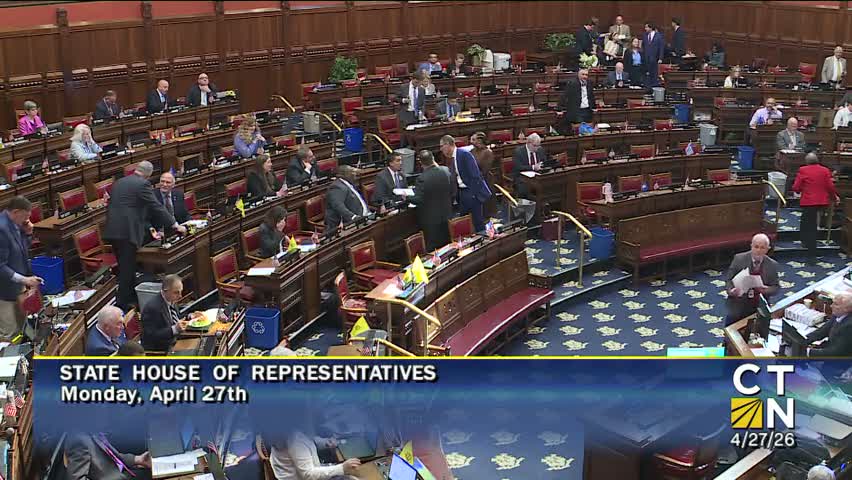
The Connecticut House voted to establish a rapid-response framework to address newly discovered aquatic invasive plants — notably hydrilla — and to create a legislative working group to modernize pesticide reporting. The House adopted an amendment that directs the Connecticut Agricultural Experiment Station’s Office of Aquatic Invasive Species to develop a rapid-response protocol in consultation with the Department of Energy and Environmental Protection, prioritized to identify and treat newly established infestations before seeding cycles.
Supporters including Representatives Parker and Lamarck Muir urged faster, coordinated action so small outbreaks do not become widespread infestations in lakes and rivers. Lawmakers emphasized that response may include mechanical harvesting, containment and targeted treatments, and that the approach is intended to be science-driven and to prioritize non-chemical options where effective. The amendment also created a multi-stakeholder working group — with representation from farmers, conservation groups, golf-course superintendents, and applicators — to define a balanced, searchable reporting system for pesticide use.
What’s next: The bill passed the House as amended. The working group will report back next year and the Ag Experiment Station will draft the rapid-response protocol; municipalities and lake associations should follow the group’s outreach and invite participation.
Supporters including Representatives Parker and Lamarck Muir urged faster, coordinated action so small outbreaks do not become widespread infestations in lakes and rivers. Lawmakers emphasized that response may include mechanical harvesting, containment and targeted treatments, and that the approach is intended to be science-driven and to prioritize non-chemical options where effective. The amendment also created a multi-stakeholder working group — with representation from farmers, conservation groups, golf-course superintendents, and applicators — to define a balanced, searchable reporting system for pesticide use.
What’s next: The bill passed the House as amended. The working group will report back next year and the Ag Experiment Station will draft the rapid-response protocol; municipalities and lake associations should follow the group’s outreach and invite participation.
Don't Miss a Word: See the Full Meeting!
Go beyond summaries. Unlock every video, transcript, and key insight with a Founder Membership.
✓
Get instant access to full meeting videos
✓
Search and clip any phrase from complete transcripts
✓
Receive AI-powered summaries & custom alerts
✓
Enjoy lifetime, unrestricted access to government data
30-day money-back guarantee
