House approves budget adjustment package sending $300M in one-time relief to towns, clears early childhood endowment deposit
May 02, 2026 | 2026 Legislature CT, Connecticut
This article was created by AI summarizing key points discussed. AI makes mistakes, so for full details and context, please refer to the video of the full meeting. Please report any errors so we can fix them. Report an error »
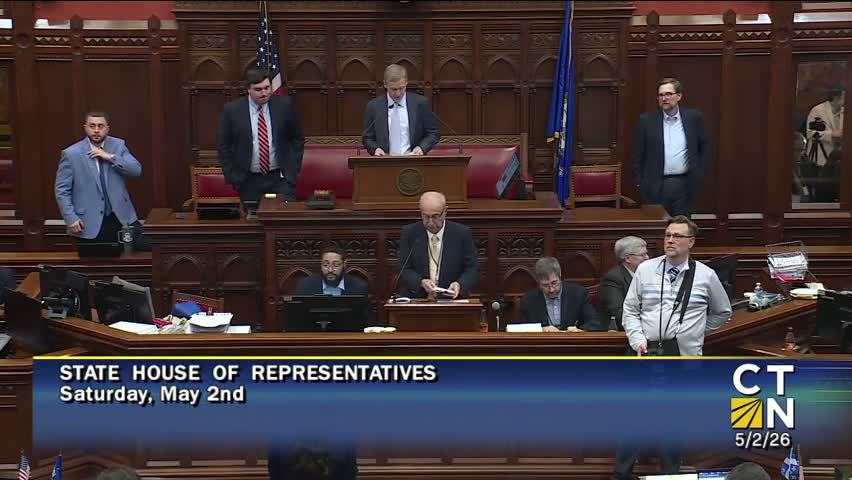
The Connecticut House passed a budget-adjustment measure late Saturday that its proponents said sends one-time relief to cities and towns, increases targeted education aid and deposits a large sum into a new early childhood endowment.
Representative Maria Horn, a co-chair of the finance committee, moved acceptance of the joint committee’s report and urged colleagues to approve the measure, saying, “It includes 300,000,000 of relief for cities, towns, and schools.” The bill was debated for more than three hours on the floor before the final roll call.
Supporters characterized the package as a mix of one-time and recurring measures aimed at affordability. Representative Walker, chair of the Appropriations Committee, told the chamber the bill includes roughly $190,000,000 in education funding and raises the education foundation amount to $13,080, while adding supplemental tranches (foundation +2% and foundation +2% +4%) intended to ensure every town sees some increase. Walker said the supplemental education aid is intended to help municipalities lower mill rates in the short term and that training will explain permitted uses.
Opponents warned the package does not solve structural fiscal pressures. Representative Nuccio, the ranking member, pressed the majority on an out‑year fiscal gap and singled out Medicaid, saying the state faced an approximately $80,000,000 Medicaid overspend and a projected $109,000,000 deficit that the adjustment did not fully resolve. “We’re adding 75,000,000 to Medicaid. We have an $80,000,000 deficit,” she said, arguing the bill relies too heavily on one‑time maneuvers rather than long‑term fixes.
Other floor exchanges focused on bonding and capital projects, hospital financing tied to a pending federal approval process, and new line items that reclassify prior operating expenditures as “various grants.” Representative Napoli, who addressed the bonding package, described capital investments to modernize state facilities and support public safety and higher education.
Lawmakers debated and rejected two high‑profile floor amendments. One proposal, offered as House Amendment A (LCO 5790), would have created a non‑lapsing municipal property tax relief fund financed by excess sales and use tax revenue and delayed implementation until fiscal 2028; members discussed merits and sustainability before the amendment failed on the floor. A second proposal, House Amendment B (LCO 5808), would have exempted Social Security from state taxation if future revenue growth met a specified trigger; it also failed.
Members also questioned a provision enabling the State Department of Education to partner with parent‑advocacy nonprofits to replace a dissolved council. Chairs said the change does not create new entities but allows the state to enter cooperative agreements with existing groups and leverage federal funding; members asked for clear accountability and noted the provision had not appeared in the agency bill or received a public hearing.
On the final roll call the clerk announced the bill passed as amended: total voting 148; 127 yes, 21 no, 3 absent. Following the passage, the presiding officer declared the bill approved in concurrence with the Senate.
What’s next: the package, including hospital tax changes and other elements that affect federal authorizations, will proceed to the relevant administrative and federal review steps described by proponents; advocates and critics said attention will now turn to long‑term structural policy choices before the next biennium.
Representative Maria Horn, a co-chair of the finance committee, moved acceptance of the joint committee’s report and urged colleagues to approve the measure, saying, “It includes 300,000,000 of relief for cities, towns, and schools.” The bill was debated for more than three hours on the floor before the final roll call.
Supporters characterized the package as a mix of one-time and recurring measures aimed at affordability. Representative Walker, chair of the Appropriations Committee, told the chamber the bill includes roughly $190,000,000 in education funding and raises the education foundation amount to $13,080, while adding supplemental tranches (foundation +2% and foundation +2% +4%) intended to ensure every town sees some increase. Walker said the supplemental education aid is intended to help municipalities lower mill rates in the short term and that training will explain permitted uses.
Opponents warned the package does not solve structural fiscal pressures. Representative Nuccio, the ranking member, pressed the majority on an out‑year fiscal gap and singled out Medicaid, saying the state faced an approximately $80,000,000 Medicaid overspend and a projected $109,000,000 deficit that the adjustment did not fully resolve. “We’re adding 75,000,000 to Medicaid. We have an $80,000,000 deficit,” she said, arguing the bill relies too heavily on one‑time maneuvers rather than long‑term fixes.
Other floor exchanges focused on bonding and capital projects, hospital financing tied to a pending federal approval process, and new line items that reclassify prior operating expenditures as “various grants.” Representative Napoli, who addressed the bonding package, described capital investments to modernize state facilities and support public safety and higher education.
Lawmakers debated and rejected two high‑profile floor amendments. One proposal, offered as House Amendment A (LCO 5790), would have created a non‑lapsing municipal property tax relief fund financed by excess sales and use tax revenue and delayed implementation until fiscal 2028; members discussed merits and sustainability before the amendment failed on the floor. A second proposal, House Amendment B (LCO 5808), would have exempted Social Security from state taxation if future revenue growth met a specified trigger; it also failed.
Members also questioned a provision enabling the State Department of Education to partner with parent‑advocacy nonprofits to replace a dissolved council. Chairs said the change does not create new entities but allows the state to enter cooperative agreements with existing groups and leverage federal funding; members asked for clear accountability and noted the provision had not appeared in the agency bill or received a public hearing.
On the final roll call the clerk announced the bill passed as amended: total voting 148; 127 yes, 21 no, 3 absent. Following the passage, the presiding officer declared the bill approved in concurrence with the Senate.
What’s next: the package, including hospital tax changes and other elements that affect federal authorizations, will proceed to the relevant administrative and federal review steps described by proponents; advocates and critics said attention will now turn to long‑term structural policy choices before the next biennium.
Don't Miss a Word: See the Full Meeting!
Go beyond summaries. Unlock every video, transcript, and key insight with a Founder Membership.
✓
Get instant access to full meeting videos
✓
Search and clip any phrase from complete transcripts
✓
Receive AI-powered summaries & custom alerts
✓
Enjoy lifetime, unrestricted access to government data
30-day money-back guarantee
