Collin County commissioners split over changing Regional Transportation Council representative
April 27, 2026 | Collin County, Texas
This article was created by AI summarizing key points discussed. AI makes mistakes, so for full details and context, please refer to the video of the full meeting. Please report any errors so we can fix them. Report an error »
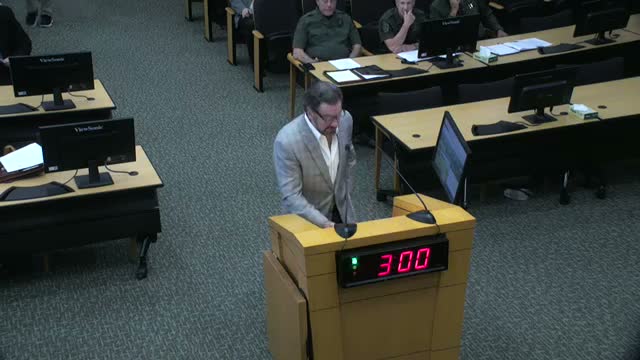
The Collin County Commissioners Court debated and narrowly approved changes to several board and commission appointments, including the county’s primary and alternate seats on the Regional Transportation Council (RTC). The motion to change appointments passed 3 to 2 after several commissioners and guests made remarks for and against removing the current representative.
Supporters argued the current representative has a long record of securing federal and state transportation dollars for Collin County. ‘‘Because of his work, Collin County is now competing and winning at a level that has secured nearly $6,000,000,000 in transportation funding for projects in our county,’’ said George Fuller, mayor of McKinney, during public comment, citing major corridor projects such as US‑380, State Highway 121 and the Dallas North Tollway expansion.
Opponents described the proposed change as precedent‑setting and framed it as a response to recent regional votes, including decisions involving DART. One commissioner, defending his record on transportation, outlined a multi‑decade record of securing over $5,000,000,000 for Collin County projects and said he would not change his recorded vote on the DART matter.
Commissioners said the decision reflected competing responsibilities: loyalty to a colleague’s long service versus responsiveness to constituents who raised concerns about specific RTC votes. The judge framed the change as part of routine reassignment because several current appointees will leave office at the end of the term and the court may prefer representatives who will serve full upcoming terms.
The court adopted the proposed court order on appointments by a 3–2 vote. The item included a recommendation to appoint Michael Slaughter—then a candidate for commissioners court—to two boards whose bylaws do not require an elected official. The court’s action will change who represents Collin County at the RTC while the county finalizes future appointments.
The court recorded the vote as 3 in favor and 2 opposed on the motion to adopt the court order changing appointments. Commissioners exchanged robust argument on whether the move was punitive, whether it risked losing institutional knowledge and whether it reflected constituents’ views.
Next steps: the appointments take effect per the court’s adopted order and will be reflected on the county’s roster of board and commission representatives.
Supporters argued the current representative has a long record of securing federal and state transportation dollars for Collin County. ‘‘Because of his work, Collin County is now competing and winning at a level that has secured nearly $6,000,000,000 in transportation funding for projects in our county,’’ said George Fuller, mayor of McKinney, during public comment, citing major corridor projects such as US‑380, State Highway 121 and the Dallas North Tollway expansion.
Opponents described the proposed change as precedent‑setting and framed it as a response to recent regional votes, including decisions involving DART. One commissioner, defending his record on transportation, outlined a multi‑decade record of securing over $5,000,000,000 for Collin County projects and said he would not change his recorded vote on the DART matter.
Commissioners said the decision reflected competing responsibilities: loyalty to a colleague’s long service versus responsiveness to constituents who raised concerns about specific RTC votes. The judge framed the change as part of routine reassignment because several current appointees will leave office at the end of the term and the court may prefer representatives who will serve full upcoming terms.
The court adopted the proposed court order on appointments by a 3–2 vote. The item included a recommendation to appoint Michael Slaughter—then a candidate for commissioners court—to two boards whose bylaws do not require an elected official. The court’s action will change who represents Collin County at the RTC while the county finalizes future appointments.
The court recorded the vote as 3 in favor and 2 opposed on the motion to adopt the court order changing appointments. Commissioners exchanged robust argument on whether the move was punitive, whether it risked losing institutional knowledge and whether it reflected constituents’ views.
Next steps: the appointments take effect per the court’s adopted order and will be reflected on the county’s roster of board and commission representatives.
Don't Miss a Word: See the Full Meeting!
Go beyond summaries. Unlock every video, transcript, and key insight with a Founder Membership.
✓
Get instant access to full meeting videos
✓
Search and clip any phrase from complete transcripts
✓
Receive AI-powered summaries & custom alerts
✓
Enjoy lifetime, unrestricted access to government data
30-day money-back guarantee
