Charter operators press Panama City leaders for permitting and enforcement at public ramps
May 03, 2026 | Panama City, Bay County, Florida
This article was created by AI summarizing key points discussed. AI makes mistakes, so for full details and context, please refer to the video of the full meeting. Please report any errors so we can fix them. Report an error »
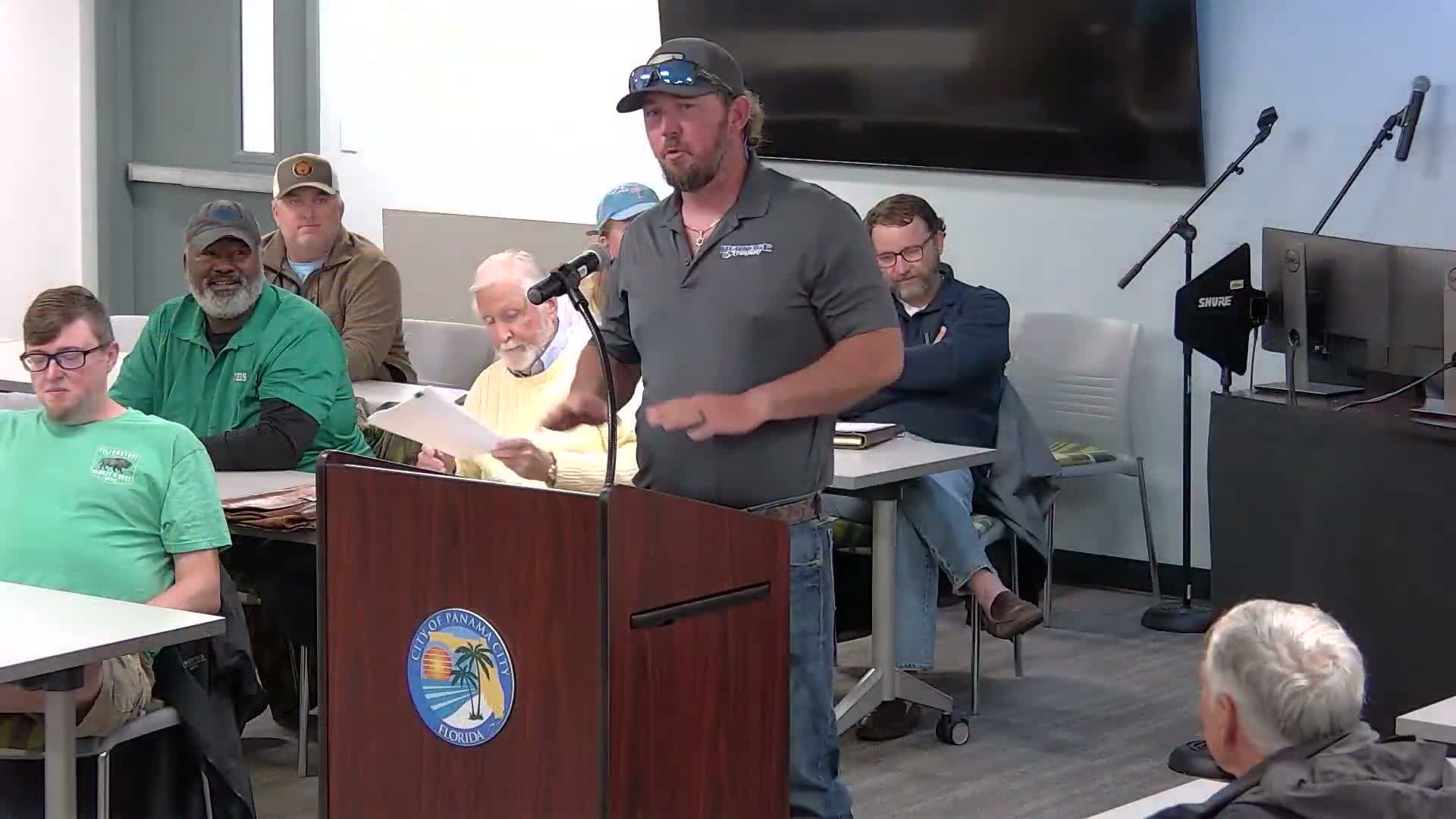
Local charter-boat and commercial-fishing operators urged Panama City officials on Saturday to curb unlicensed commercial activity at public boat ramps and to create a permitting and enforcement pathway.
At the open conversation, business owners including Josh Sauls and Matt Smith said that operators who launch from residential docks or plain public ramps undercut licensed captains, harm the visitor experience and put pressure on limited parking near Saint Andrews, Carl Gray and Snug Harbor. "We've got to have some enforcement, some oversight," Josh Sauls said, recommending a permitting system that would require commercial operators to show insurance, captains' credentials and fisheries permits.
Sauls and other operators proposed limiting which ramps may be used for commercial launches, charging permits tied to industry-standard liability coverage, and routing permit fees back into ramp maintenance. Matt Smith, who said he has run charter operations since 2009, told the commission that a high barrier to entry and consistent enforcement would separate serious operators from unlicensed competitors and improve safety and customer confidence.
City officials and staff acknowledged the problem and proposed several next steps. Commissioners suggested a small working group of local operators, staff and business owners to draft permitting parameters, including parking, insurance requirements and whether fees could be used for dredging or ramp maintenance. Staff said existing ordinances may cover some practices but that enforcement has been inconsistent and that targeted signage and notices are a quick first step.
The commission discussed possible user-fee models — for example, annual passes for Bay County residents or daily launch fees for nonresidents — and noted that dredging and maintenance for some ramps can run tens of thousands of dollars per year. Officials said they would explore immediate case-by-case enforcement and bring back options within 60–90 days for a citizen–staff working group to consider.
The exchange came amid a broader discussion about how to balance resident access with commercial activity on scarce public facilities. Commissioners and business owners agreed on the meeting's goal: to preserve waterfront commerce while protecting resident access and public safety. The commission did not vote on a formal policy at the meeting; staff said they would follow up with the proposed stakeholder group and report back to the commission.
At the open conversation, business owners including Josh Sauls and Matt Smith said that operators who launch from residential docks or plain public ramps undercut licensed captains, harm the visitor experience and put pressure on limited parking near Saint Andrews, Carl Gray and Snug Harbor. "We've got to have some enforcement, some oversight," Josh Sauls said, recommending a permitting system that would require commercial operators to show insurance, captains' credentials and fisheries permits.
Sauls and other operators proposed limiting which ramps may be used for commercial launches, charging permits tied to industry-standard liability coverage, and routing permit fees back into ramp maintenance. Matt Smith, who said he has run charter operations since 2009, told the commission that a high barrier to entry and consistent enforcement would separate serious operators from unlicensed competitors and improve safety and customer confidence.
City officials and staff acknowledged the problem and proposed several next steps. Commissioners suggested a small working group of local operators, staff and business owners to draft permitting parameters, including parking, insurance requirements and whether fees could be used for dredging or ramp maintenance. Staff said existing ordinances may cover some practices but that enforcement has been inconsistent and that targeted signage and notices are a quick first step.
The commission discussed possible user-fee models — for example, annual passes for Bay County residents or daily launch fees for nonresidents — and noted that dredging and maintenance for some ramps can run tens of thousands of dollars per year. Officials said they would explore immediate case-by-case enforcement and bring back options within 60–90 days for a citizen–staff working group to consider.
The exchange came amid a broader discussion about how to balance resident access with commercial activity on scarce public facilities. Commissioners and business owners agreed on the meeting's goal: to preserve waterfront commerce while protecting resident access and public safety. The commission did not vote on a formal policy at the meeting; staff said they would follow up with the proposed stakeholder group and report back to the commission.
Don't Miss a Word: See the Full Meeting!
Go beyond summaries. Unlock every video, transcript, and key insight with a Founder Membership.
✓
Get instant access to full meeting videos
✓
Search and clip any phrase from complete transcripts
✓
Receive AI-powered summaries & custom alerts
✓
Enjoy lifetime, unrestricted access to government data
30-day money-back guarantee
