Land‑use language would limit Act 250 review to development footprints, Land Use Review Board member says
May 01, 2026 | Natural Resources & Energy, SENATE, Committees, Legislative , Vermont
This article was created by AI summarizing key points discussed. AI makes mistakes, so for full details and context, please refer to the video of the full meeting. Please report any errors so we can fix them. Report an error »
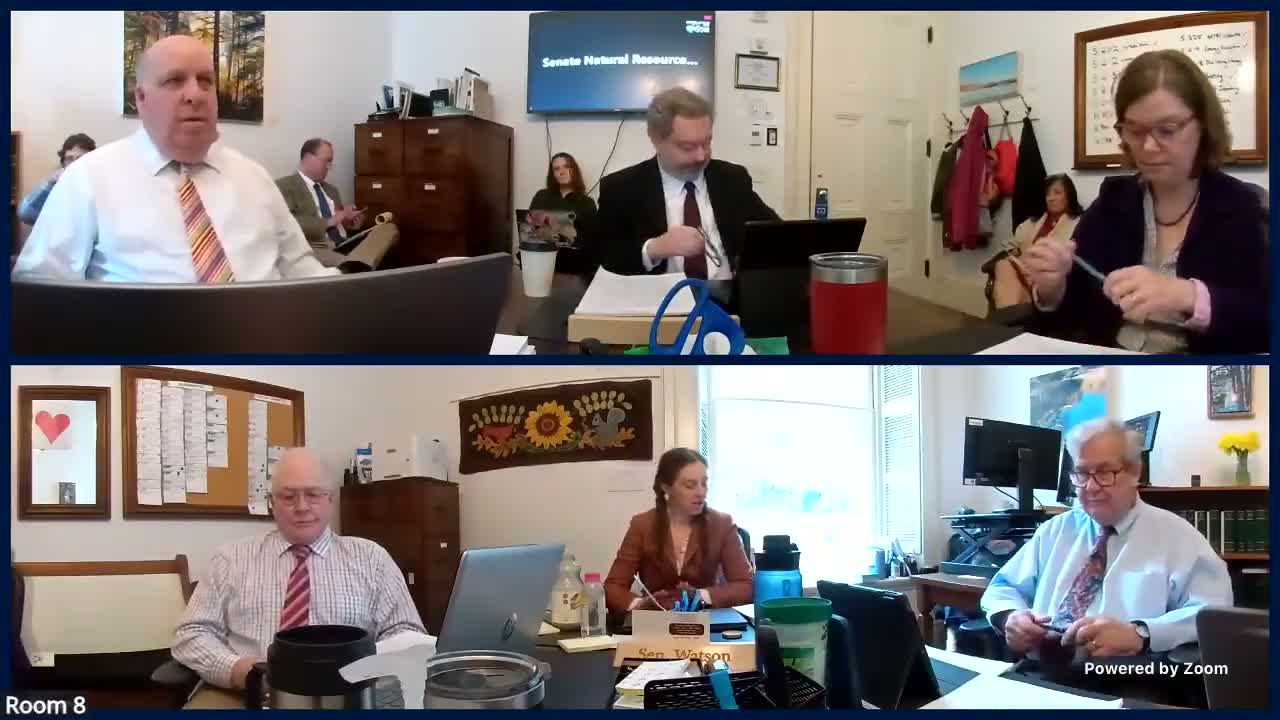
A member of the Land Use Review Board told the Senate Natural Resources & Energy Committee that proposed changes to Act 250 (in H932) are intended to limit jurisdictional review to the actual development footprint and the narrow supporting areas, so that ongoing forestry and logging on large tracts would not be swept into development regulation.
Brooke Dangoldine, who identified herself as a member of the Land Use Review Board, summarized the intent: the key sentence in the proposed text “is a specification that when development is proposed to occur on a parcel or attractive land that is devoted to logging in forestry, only those portions of the parcel or the tract that support the development shall be subject to regulation under this chapter.” She said adopting that approach preserves the ability of loggers to operate on the parts of a tract not supporting development while still protecting buffers or mitigation areas attached to a specific permit.
Committee members asked how the boundaries would be determined, whether district coordinators would be involved before an application and how protections for streams or other mitigation zones would be enforced. Dangoldine said district coordinators would help define the limits and that permit conditions could still preclude logging in protected buffers.
Proponents said the proposal arose from a stakeholder study aimed at streamlining permitting and recognizing forestry management practices, while opponents cautioned the language must not create loopholes around buffers or mitigation measures. The committee discussed editorial changes and agreed to follow up with the board and partners on clearer drafting.
What happens next: Stakeholders will provide suggested redrafts and the committee will revisit the language in a future session.
Brooke Dangoldine, who identified herself as a member of the Land Use Review Board, summarized the intent: the key sentence in the proposed text “is a specification that when development is proposed to occur on a parcel or attractive land that is devoted to logging in forestry, only those portions of the parcel or the tract that support the development shall be subject to regulation under this chapter.” She said adopting that approach preserves the ability of loggers to operate on the parts of a tract not supporting development while still protecting buffers or mitigation areas attached to a specific permit.
Committee members asked how the boundaries would be determined, whether district coordinators would be involved before an application and how protections for streams or other mitigation zones would be enforced. Dangoldine said district coordinators would help define the limits and that permit conditions could still preclude logging in protected buffers.
Proponents said the proposal arose from a stakeholder study aimed at streamlining permitting and recognizing forestry management practices, while opponents cautioned the language must not create loopholes around buffers or mitigation measures. The committee discussed editorial changes and agreed to follow up with the board and partners on clearer drafting.
What happens next: Stakeholders will provide suggested redrafts and the committee will revisit the language in a future session.
View the Full Meeting & All Its Details
This article offers just a summary. Unlock complete video, transcripts, and insights as a Founder Member.
✓
Watch full, unedited meeting videos
✓
Search every word spoken in unlimited transcripts
✓
AI summaries & real-time alerts (all government levels)
✓
Permanent access to expanding government content
30-day money-back guarantee
